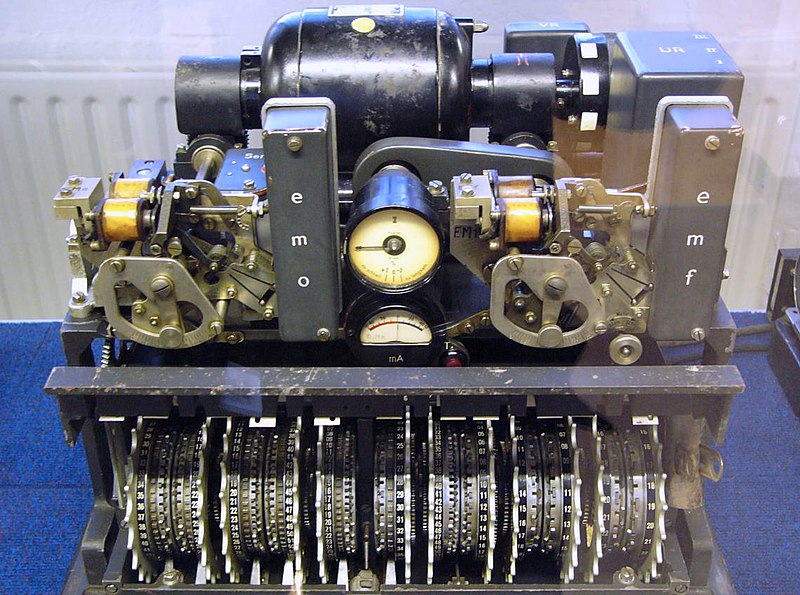
File:Lorenz-SZ42-2.jpg · Wikimedia Commons · See Wikimedia Commons
cryptography
Sign in to saveAlso known as cryptographic engineering, cryptology, crypto
thumb|alt=Lorenz cipher machine with twelve rotors mechanism|upright=1.5| Lorenz cipher machine, used in [[World War II to encrypt communications of the German High Command]] Cryptography, or cryptology, is the practice and study of techniques for secure communication in the presence of adversarial behavior. More generally, cryptography is about constructing and analyzing protocols that prevent third parties or the public from reading private messages. Modern cryptography exists at the intersection of the disciplines of mathematics, computer science, information security, electrical engin
Cryptography is the practice of using techniques to send messages securely so that only the intended recipient can read them, even if others try to intercept the communication. It matters because it helps protect private information from being read by unauthorized people or adversaries who might try to access it.
AI-generated from the Wikipedia summary — may contain errors.
Wikidata facts
- Image
- Lorenz-SZ42-2.jpg
Show 5 more facts
- Stack Exchange tag
- academia.stackexchange.com/tags/cryptography
- Stack Exchange site URL
- crypto.stackexchange.com
- Commons category
- Cryptography
- ACM Classification Code (2012)
- 10002979
Sources (8)
via Wikidata · CC0
~58 min read
Article
26 sectionsContents
- Terminology
- History
- Classic cryptography
- Early computer-era cryptography
- Modern cryptography
- Symmetric-key cryptography
- Public-key cryptography
- Cryptographic hash functions
- Cryptanalysis
- Cryptographic primitives
- Cryptosystems
- Lightweight cryptography
- Applications
- Cybersecurity
- Cryptocurrencies and cryptoeconomics
- Quantum computing cybersecurity
- Legal issues
- Prohibitions
- Export controls
- NSA involvement
- Digital rights management
- Forced disclosure of encryption keys
- See also
- References
- Further reading
- External links
thumb|alt=Lorenz cipher machine with twelve rotors mechanism|upright=1.5| Lorenz cipher machine, used in [[World War II to encrypt communications of the German High Command]] Cryptography, or cryptology, is the practice and study of techniques for secure communication in the presence of adversarial behavior. More generally, cryptography is about constructing and analyzing protocols that prevent third parties or the public from reading private messages. Modern cryptography exists at the intersection of the disciplines of mathematics, computer science, information security, electrical engineering, digital signal processing, physics, and others. Core concepts related to information security (data confidentiality, data integrity, authentication and non-repudiation) are also central to cryptography. Practical applications of cryptography include electronic commerce, chip-based payment cards, digital currencies, computer passwords and military communications.
Cryptography prior to the modern age was effectively synonymous with encryption, converting readable information (plaintext) to unintelligible nonsense text (ciphertext), which can only be read by reversing the process (decryption). The sender of an encrypted (coded) message shares the decryption (decoding) technique only with the intended recipients to preclude access from adversaries. The cryptography literature often uses the names "Alice" (or "A") for the sender, "Bob" (or "B") for the intended recipient, and "Eve" (or "E") for the eavesdropping adversary. Since the development of rotor cipher machines in World War I and the advent of computers in World War II, cryptography methods have become increasingly complex and their applications more varied.
Gallery (25)
Available in 100 languages
- Español
- Français
- Deutsch
- 中文
- 日本語
- Русский
- Português
- Italiano
- العربية
- हिन्दी
- Afrikaans
- Albanian
- Armenian
- Asturian
- Azerbaijani
- Bahasa Indonesia
- Bangla
- Bashkir
Show 81 more
- Basque
- Bavarian
- be_x_old
- Belarusian
- Bosnian
- Bulgarian
- Burmese
- Catalan
- Central Kurdish
- Croatian
- Czech
- Danish
- Egyptian Arabic
- Esperanto
- Estonian
- Filipino
- Finnish
- Galician
- Gan Chinese
- gcr
- Georgian
- Greek
- Gujarati
- Hebrew
- Hungarian
- Icelandic
- Ido
- Irish
- Jamaican Creole English
- Javanese
- Kannada
- Kazakh
- Kyrgyz
- Latin
- Latvian
- Lithuanian
- Lombard
- Macedonian
- Malay
- Malayalam
- Marathi
- Mari
- Mongolian
- Moroccan Arabic
- Nederlands
- Northern Frisian
- Norwegian
- Norwegian Nynorsk
- Occitan
- Odia
- Piedmontese
- Polski
- Romanian
- Serbian
- Serbian (Latin)
- Sicilian
- simple
- skr
- Slovak
- Slovenian
- Svenska
- Swahili
- syl
- Tajik
- Tamil
- Tiếng Việt
- Türkçe
- Ukrainian
- Urdu
- Uzbek
- Waray
- Western Panjabi
- Wu Chinese
- Yiddish
- Zaza
- zh_min_nan
- zh_yue
- Zulu
- فارسی
- ไทย
- 한국어
via Wikidata sitelinks · CC0