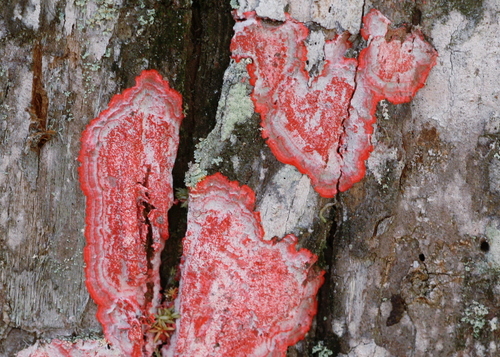
(c) Mary Keim, some rights reserved (CC BY-NC-SA) · cc-by-nc-sa
Cryptothecia
Sign in to saveCryptothecia is a genus of white to greenish crustose lichens that grow on bark, wood, or leaves, in tropical or subtropical areas worldwide. It has a conspicuous prothallus that develops around its periphery which can be bright red in some species, hence the common name wreath lichen. The main vegetative body (thallus) lacks a cortex (ecorticate and is often immersed in the substrate or byssoid (whispy, like teased wool). The medulla is white, well defined, and often peppered with calcium oxalate crystals. Ascomata are not well defined, being cushions of soft white mycelium immersed in the me
Species
Christmas lichen
GENUS
- KingdomFungi
- PhylumAscomycota
- ClassArthoniomycetes
- OrderArthoniales
- FamilyArthoniaceae
via GBIF
Museum specimens
- Specimen records
- 823
- With media
- 251
- Family
- Arthoniaceae
- Collections
- US
- Recorded in
- Guyana, United States, Panama
Wikidata facts
- Instance of
- taxon
- Parent taxon
- Arthoniaceae
- Image
- Cryptothecia.jpg
Show 5 more facts
- Commons category
- Cryptothecia
- taxon name
- Cryptothecia
- taxon rank
- genus
- topic's main category
- Category:Cryptothecia
- taxon author citation
- Stirt.
Sources (2)
via Wikidata · CC0
~4 min read
Encyclopedic overview
5 sectionsContents
- Taxonomy
- Description
- Species
- References
- Further reading
Cryptothecia is a genus of white to greenish crustose lichens that grow on bark, wood, or leaves, in tropical or subtropical areas worldwide. It has a conspicuous prothallus that develops around its periphery which can be bright red in some species, hence the common name wreath lichen. The main vegetative body (thallus) lacks a cortex (ecorticate and is often immersed in the substrate or byssoid (whispy, like teased wool). The medulla is white, well defined, and often peppered with calcium oxalate crystals. Ascomata are not well defined, being cushions of soft white mycelium immersed in the medullary tissue, hence the name from the Greek krypto = "to conceal" and theke = "a container or sheath". It contains Trentepohlia, a green alga, as its photobiont partner.
Two species have been described in North America. At least one species, Cryptothecia rubrocincta, has been used in Brazil as a source of dye.
Excerpted from Wikipedia’s “Cryptothecia” article, available under the CC BY-SA 4.0 licence.