File:Nympheas_71293_3.jpg · Wikimedia Commons · See Wikimedia Commons
cyan
Sign in to saveAlso known as color cyan, colour cyan, cyan color, cyan colour, #00ffff, green-blue, bleen, blue-green
Cyan () is the color between blue and green on the visible spectrum of light. It is evoked by light with a predominant wavelength between 500 and 520 nm, between the wavelengths of green and blue.
Cyan is a bright color that sits between blue and green in the spectrum of visible light. It appears when light has a wavelength between 500 and 520 nanometers, making it useful in applications like color printing and display technology.
AI-generated from the Wikipedia summary — may contain errors.
Key facts
- Color.title
- Cyan (subtractive primary)
- Color.hex
- 00B7EB
- Color.caption
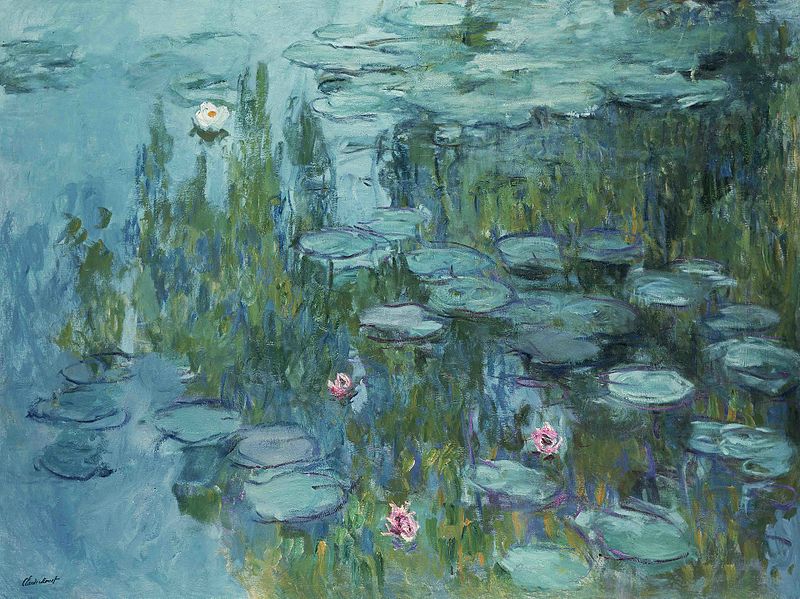
- Clockwise, from top left: Water Lilies by Claude Monet; American robin's eggs; surgical mask and headscarf of an Iranian woman; shallow water on a sandy beach near Barcelona; a Chinese funerary urn; the planet Uranus
- Color.wavelength
- 490–520
- Color.frequency
- 610–575
- Color.symbolism
- Water
- Color.source
- CMYK
- Color.cmyk
- (100, 0, 0, 0)
- Color.isccname
- Brilliant greenish blue
via Wikipedia infobox
Wikidata facts
- Instance of
- color term
- Subclass of
- color
- Followed by
- blue
- Follows
- green
- Image
- Color icon cyan.svg
Show 11 more facts
- different from
- blue-green
- CSS color keyword
- cyan
- sRGB color hex triplet
- 00FFFF
- Commons category
- Cyan
- partially coincident with
- blue-green
- on focus list of Wikimedia project
- Wikipedia:Vital articles/Level/4
- frequency
- 599000000000000
- wavelength
- 500
- OpenStreetMap tag
- colour=cyan
- maintained by WikiProject
- WikiProject Color
- opposite of
- distinguishing blue from green in language
Sources (6)
via Wikidata · CC0
~10 min read
Encyclopedic overview
18 sectionsContents
- Shades and variations
- History
- Etymology and terminology
- On the web and in printing
- Web colors cyan and aqua
- Process cyan
- In science and nature
- Color of water
- Cyan and cyanide
- Oxygen
- Bacteria
- Astronomy
- Energy
- Photography and film
- Medicine
- Gallery
- See also
- References
Cyan () is the color between blue and green on the visible spectrum of light. It is evoked by light with a predominant wavelength between 500 and 520 nm, between the wavelengths of green and blue.
In the subtractive color system, or CMYK color model, which can be overlaid to produce all colors in paint and color printing, cyan is one of the primary colors, along with magenta and yellow. In the additive color system, or RGB color model, used to create all the colors on a computer or television display, cyan is made by mixing equal amounts of green and blue light. Cyan is the complement of red; it can be made by the removal of red from white. Mixing red light and cyan light at the right intensity will make white light. It is commonly seen on a bright, sunny day in the sky.
Excerpted from Wikipedia’s “cyan” article, available under the CC BY-SA 4.0 licence.
Gallery (12)
Available in 79 languages
- Español
- Français
- Deutsch
- 中文
- 日本語
- Русский
- Português
- Italiano
- العربية
- हिन्दी
- Afrikaans
- Albanian
- Armenian
- Asturian
- azb
- Bahasa Indonesia
- Balinese
- Bangla
Show 60 more
- Basque
- Bosnian
- Breton
- Bulgarian
- Catalan
- cdo
- Croatian
- Czech
- Danish
- Egyptian Arabic
- Esperanto
- Estonian
- Fijian
- Filipino
- Finnish
- Galician
- Greek
- Hakka Chinese
- Hebrew
- Hungarian
- Icelandic
- Ido
- Kashmiri
- Latin
- Latvian
- Lingua Franca Nova
- Lithuanian
- Lojban
- Luxembourgish
- Macedonian
- Malay
- Mazanderani
- Nederlands
- Norwegian
- Norwegian Nynorsk
- Occitan
- Polski
- Romanian
- Serbian
- Serbian (Latin)
- simple
- Slovenian
- Somali
- Svenska
- Swahili
- Tatar
- Tiếng Việt
- Toki Pona
- Tsonga
- Türkçe
- Ukrainian
- Western Frisian
- Wu Chinese
- Yiddish
- zh_classical
- zh_min_nan
- zh_yue
- فارسی
- ไทย
- 한국어
via Wikidata sitelinks · CC0