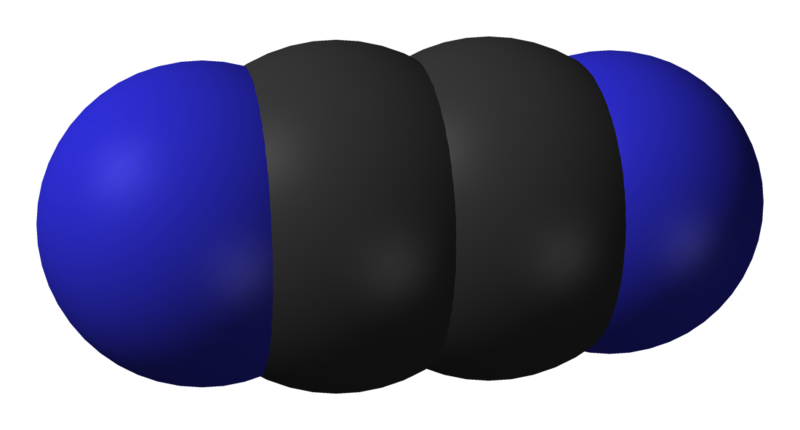
File:Cyanogen-3D-vdW.png · Wikimedia Commons · See Wikimedia Commons
cyanogen
Sign in to saveAlso known as oxalic nitrile, glycolonitrile, dicyan, dicyanogen, ethanedinitrile, oxalonitrile, cyanogen gas
Cyanogen is the chemical compound with the formula . Its structure is . The simplest stable carbon nitride, it is a colorless and highly toxic gas with a pungent odor. The molecule is a pseudohalogen. Cyanogen molecules are linear, and consist of two CN groups ‒ analogous to diatomic halogen molecules, such as Cl, but far less oxidizing. The two cyano groups are bonded together at their carbon atoms, though other isomers have been detected. The name is also used for the CN radical, and hence is used for compounds such as cyanogen bromide () (but see also Cyano radical). When burned at increase
Chemical data
- Formula
- C2N2
- Molecular weight
- 52.03 g/mol
- IUPAC name
- oxalonitrile
- SMILES
- C(#N)C#N
- InChIKey
- JMANVNJQNLATNU-UHFFFAOYSA-N
- XLogP
- 0.1
- Polar surface area
- 47.6 Ų
- H-bond donors
- 0
- H-bond acceptors
- 2
- Formal charge
- 0
via PubChem
Wikidata facts
- Subclass of
- carbon nitride
- Has part
- nitrogen
- Mass
- 52.006
Show 16 more facts
- Commons category
- Cyanogen
- chemical formula
- C₂N₂
- density
- 0.95
- NIOSH Pocket Guide ID
- 0161
- melting point
- -27.9
- boiling point
- -21.1
- vapor pressure
- 5.1
- solubility
- 1
- lower flammable limit
- 6.6
- upper flammable limit
- 32
- ionization energy
- 13.37
- described by source
- Brockhaus and Efron Encyclopedic Dictionary
- time-weighted average exposure limit
- 20
- canonical SMILES
- C(#N)C#N
- discoverer or inventor
- Joseph Louis Gay-Lussac
- electric dipole moment
- 0
via Wikidata · CC0
~4 min read
Encyclopedic overview
8 sectionsContents
- Preparation
- Reactions
- Paracyanogen
- History
- Safety
- See also
- References
- External links
Cyanogen is the chemical compound with the formula . Its structure is . The simplest stable carbon nitride, it is a colorless and highly toxic gas with a pungent odor. The molecule is a pseudohalogen. Cyanogen molecules are linear, and consist of two CN groups ‒ analogous to diatomic halogen molecules, such as Cl, but far less oxidizing. The two cyano groups are bonded together at their carbon atoms, though other isomers have been detected. The name is also used for the CN radical, and hence is used for compounds such as cyanogen bromide () (but see also Cyano radical). When burned at increased pressure with oxygen, it is possible to get a blue tinted flame, the temperature of which is about (a higher temperature is possible with ozone). It is as such regarded as the gas with the second highest temperature of burning (after dicyanoacetylene).
Cyanogen is the anhydride of oxamide:
Excerpted from Wikipedia’s “cyanogen” article, available under the CC BY-SA 4.0 licence.