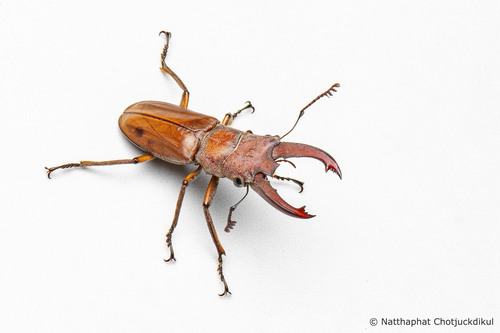
(c) Natthaphat Chotjuckdikul, all rights reserved, uploaded by Natthaphat Chotjuckdikul
Cyclommatus
Sign in to saveCyclommatus is a genus of the family Lucanidae, also known as the stag beetle. The majority of the species from the genus Cyclommatus are located in Southeast Asia, though some species are found in China and Taiwan as well. The genus Cyclommatus also consists of three subgenera: Cyclommatus (Parry, 1863), Cyclommatinus (Didier, 1927) and Cyclommatellus (Nagel, 1936). Each subgenera contains 80, 24 and 3 species respectively. In total, the genus Cyclommatus consists of a total of 134 species, though more are still being discovered to this day.
Species
GENUS
- KingdomAnimalia
- PhylumArthropoda
- ClassInsecta
- OrderColeoptera
- FamilyLucanidae
via GBIF
Museum specimens
- Specimen records
- 279
- With media
- 5
- Family
- Lucanidae
- Collections
- NHMUK, RBINS-SCIENTIFIC HERITAGE
- Recorded in
- Thailand, Malaysia, India, China
Wikidata facts
Show 5 more facts
- taxon name
- Cyclommatus
- taxon rank
- genus
- Commons category
- Cyclommatus
- topic's main category
- Category:Cyclommatus
- start time
- 33200000-0
Sources (1)
via Wikidata · CC0
~8 min read
Encyclopedic overview
8 sectionsContents
- Taxonomy
- Evolution
- Distribution
- Description
- Life cycle
- Pet trade
- Species
- References
Cyclommatus is a genus of the family Lucanidae, also known as the stag beetle. The majority of the species from the genus Cyclommatus are located in Southeast Asia, though some species are found in China and Taiwan as well. The genus Cyclommatus also consists of three subgenera: Cyclommatus (Parry, 1863), Cyclommatinus (Didier, 1927) and Cyclommatellus (Nagel, 1936). Each subgenera contains 80, 24 and 3 species respectively. In total, the genus Cyclommatus consists of a total of 134 species, though more are still being discovered to this day.
The chief distinguishing characteristics of this genus are its impressive mandibles, which can sometimes be as long as its body, as well as its lustrous metallic exoskeleton, which can range from red, brown, green, purple, gold and a rarer blue-black. As such, beetles from the genus Cyclommatus can command a high price from collectors, with a demand for both live and dried specimens.
Excerpted from Wikipedia’s “Cyclommatus” article, available under the CC BY-SA 4.0 licence.