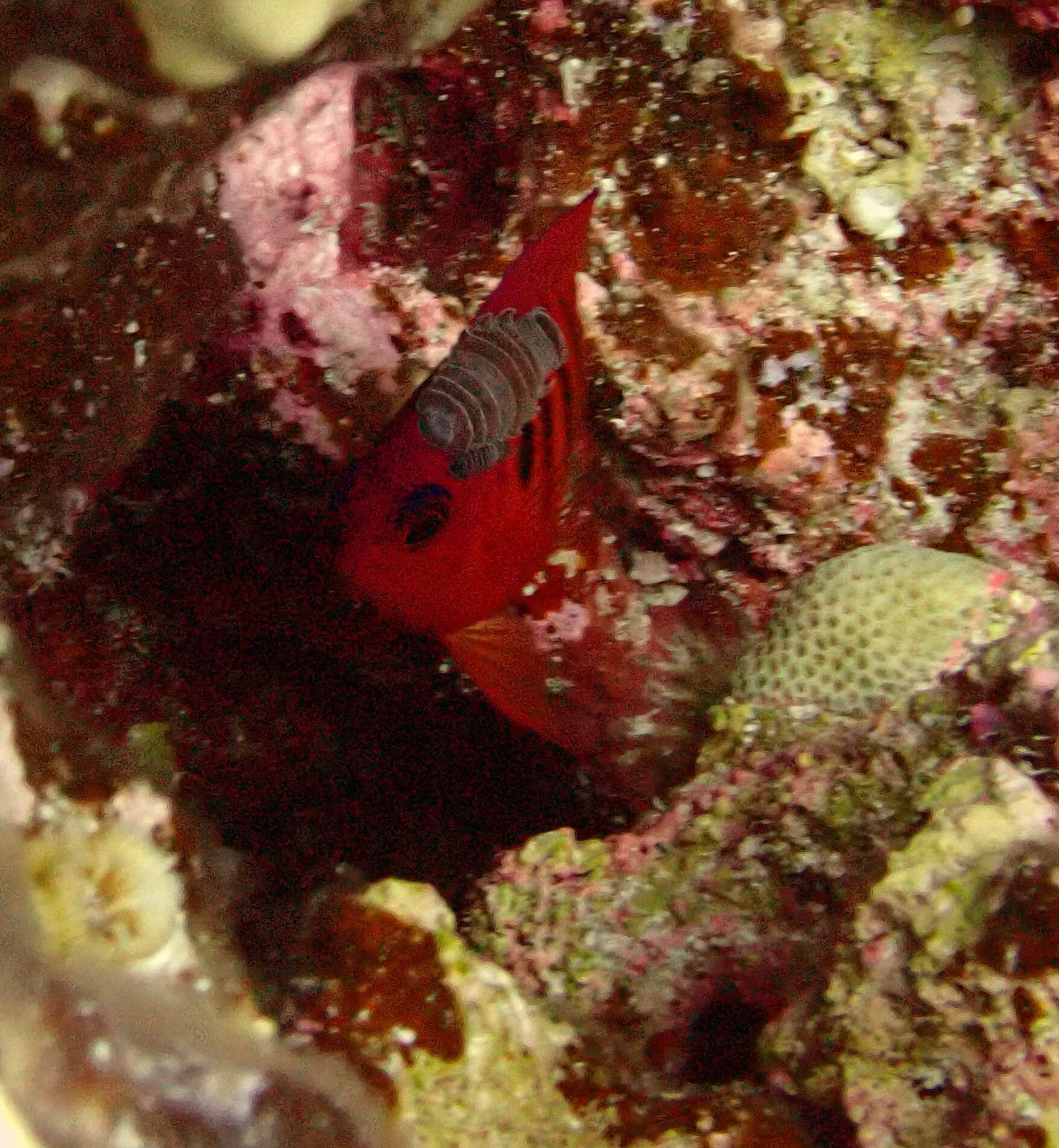
Encyclopedia of Life · EOL (see source)
Species
SPECIES
- KingdomAnimalia
- PhylumArthropoda
- ClassMalacostraca
- OrderIsopoda
- FamilyCymothoidae
二名法 Cymothoa exigua(Schiødte & Meinert, 1884) 縮頭魚虱(學名:Cymothoa exigua、tongue-eating louse),俗名食舌虱或食舌蟲,是一種寄生的甲殼類。 縮頭魚虱長約3-4厘米。它們會從墨西哥笛鯛的鰓進入到其體內,依附在舌根中。它們的前爪會抽走舌頭上的血液,使其萎縮。它們會依附在舌頭的肌肉上取而代之。更奇特的是墨西哥笛鯛仍能像使用正常舌頭般使用縮頭魚虱。縮頭魚虱似乎不會對魚的身體造成其他傷害。[1]當縮頭魚虱取代舌頭後,它們一方面會以魚的血液為食,另一方面吸取魚的黏液,並善盡舌頭的功用。這是唯一已知完全取代寄主器官的寄生方式。[1]現時相信縮頭魚虱對人類並沒有危害。[2] Cymothoa屬下有很多物種[3],但就只有縮頭魚虱是會取代寄主的舌頭。於2005年,在英國發現寄生了縮頭魚虱的魚類,完全超出了一般認為它們的加利福尼亞州的分佈地,有指這是它們向外擴散的可能性[4],但也有指可能是魚類遭寄生後游到英國海域的。[5][6]曾有魚類食品業者因為製程疏忽,導致消費者打開鮪魚罐頭時,發現縮頭魚虱的案例。[7][8] 參考 ^ 1.0 1.1 R. C. Brusca & M. R. Gilligan. Tongue replacement in a marine fish (Lutjanus guttatus) by a parasitic isopod (Crustacea: Isopoda). Copeia. 1983, 3 (3): 813–6. doi:10.2307/1444352. ^ Rare tongue-eating parasite found. BBC News. 2009-09-09. ^ Vernon E. Thatcher, Gustavo S. de Araujo, José T. A. X. de Lima & Sathyabama Chellappa. Cymothoa spinipalpa sp. nov. (Isopoda, Cymothoidae) a buccal cavity parasite of the marine fish, Oligoplites saurus (Bloch & Schneider) (Osteichthyes, Carangidae) of Rio Grande do Norte State, Brazil (PDF). Revista Brasileira de Zoologia. 2007, 24 (1): 238–245. ^ Tongue-eating bug found in fish. BBC News. 2005-09-02. ^ Tongue-eating louse fou
via GBIF
Museum specimens
- Specimen records
- 73
- Family
- Cymothoidae
- Collections
- ICML-UNAM, CIAD
- Recorded in
- Mexico
Wikidata facts
Show 3 more facts
- taxon rank
- species
- taxon name
- Cymothoa exigua
- Commons category
- Cymothoa exigua
Sources (1)
via Wikidata · CC0
~10 min read
Encyclopedic overview
Cymothoa exigua, also commonly known as the tongue-eating louse, is a parasitic isopod of the family Cymothoidae. As an ectoparasite, it lives on the outside of the host, and is found throughout the Atlantic and Pacific Oceans. Adults grow up to an inch in length and are among the largest isopods recorded. C. exigua are hermaphrodites, and are all born as a male before switching to female later in life. As such, female C. exigua are generally larger than males.
Many species of Cymothoa have been identified, and only Cymothoidae isopods are known to consume and replace the host's organs. Other species of isopods known to parasitize fish in this way include Cymothoa borbonica and Ceratothoa imbricata. Cymothoids are adapted to specific areas of attachment on the host, including scale-clingers, mouth- or gill-dwellers, and flesh-burrowers.
Excerpted from Wikipedia’s “Cymothoa exigua” article, available under the CC BY-SA 4.0 licence.