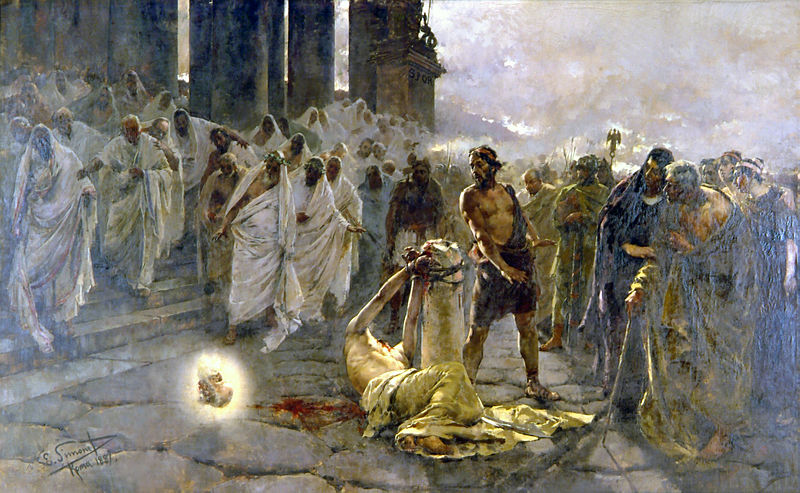
File:Decapitación_de_San_Pablo_-_Simonet_-_1887.jpg · Wikimedia Commons · See Wikimedia Commons
decapitation
Sign in to saveAlso known as beheading, beheadings
thumb|Beheadings in an illumination from Jean Froissart|Froissart's Chronicles from the beginning of the 15th century – the execution of Guillaume Sans and his secretary in [[Bordeaux on the orders of Thomas Felton]] thumb|Perseus using the severed head of [[Medusa to turn King Polydectes to stone]] thumb|Depiction of an Ethiopian Empire|Ethiopian emperor executing people, 18th century Decapitation is the total separation of the head from the body. This injury is fatal to humans and all vertebrate animals, since it deprives the brain of oxygenated blood by way of severing the jugular vein and
Decapitation is the complete separation of the head from the body, an injury that is fatal to humans and all vertebrate animals because it cuts off the brain's supply of oxygenated blood. Historically, decapitation has been used as a method of execution across various cultures and time periods.
AI-generated from the Wikipedia summary — may contain errors.
Key facts
- Medical condition.name
- Decapitation
- Medical condition.image
- Decapitación de San Pablo - Simonet - 1887.jpg
- Medical condition.caption
- The Beheading of Saint Paul. Painting by Enrique Simonet in 1887, Málaga Cathedral
- Medical condition.causes
- Deliberate (executions, murder or homicide, suicide); unintended (accidents)
- Medical condition.prognosis
- Invariably fatal
via Wikipedia infobox
Research
5,863 papers- Suicidal decapitation by hanging: A systematic review of the literature and comparison with case reports.Legal medicine (Tokyo, Japan) · 2024Tomassini L, Gambelunghe C, Fedeli P et al.DOI: 10.1016/j.legalmed.2024.102464
- Decapitation in reality and fine art: A review.ReviewForensic science international · 2017Nikolić V, Savić S, Antunović V et al.DOI: 10.1016/j.forsciint.2017.09.014
- Train-related suicidal decapitation.Forensic science, medicine, and pathology · 2021Woolery S, Prahlow JADOI: 10.1007/s12024-021-00396-8
- Incomplete decapitation in suicidal vehicle-assisted ligature strangulation: A case report and a review of the literature.ReviewLegal medicine (Tokyo, Japan) · 2024Lorenzoni M, Baldisser F, Del Balzo G et al.DOI: 10.1016/j.legalmed.2023.102378
- Vehicle-assisted ligature decapitation - an unusual case report.ReviewForensic science, medicine, and pathology · 2025Passos D, Duarte E, Andrade da Costa A et al.DOI: 10.1007/s12024-023-00744-w
- Decapitation in the long-necked Triassic marine reptile Tanystropheus.Current biology : CB · 2023Spiekman SNF, Mujal EDOI: 10.1016/j.cub.2023.04.027
- A case of complete decapitation in suicidal hanging : the mechanism and condition of decapitation.ReviewThe journal of medical investigation : JMI · 2023Ito A, Nushida H, Kurata H et al.DOI: 10.2152/jmi.70.290
- Decapitation.The Antiseptic · 1951MATHUR SC
via PubMed
Wikidata facts
- Instance of
- cause of death
- Subclass of
- execution
- Named after
- head
- Image
- Chinese to be beheaded in Nanking Massacre.jpg
Show 5 more facts
- topic's main category
- Category:People executed by decapitation
- Commons category
- Decapitation
- P8168
- Amy Lowell
- described by source
- Pauly–Wissowa
- related category
- Category:People executed by decapitation
via Wikidata · CC0
~30 min read
Encyclopedic overview
38 sectionsContents
- Etymology
- History
- Physiological aspects
- Physiology of death by decapitation
- Technology
- Guillotine
- {{lang|de|Fallbeil}}
- Historical practices by nation
- Africa
- Congo
- Asia
- Azerbaijan
- China
- India
- Japan
- Korea
- Thailand
- Vietnam
- Europe
- Bosnia and Herzegovina
- Britain
- Celts
- Classical antiquity
- France
- Nordic countries
- Spain
- Middle East
- Iran
- Iraq
- Saudi Arabia
- Syria
- North America
- Mexico
- United States
- Notable people who have been beheaded
- See also
- References
- External links
thumb|Beheadings in an illumination from Jean Froissart|Froissart's Chronicles from the beginning of the 15th century – the execution of Guillaume Sans and his secretary in [[Bordeaux on the orders of Thomas Felton]] thumb|Perseus using the severed head of [[Medusa to turn King Polydectes to stone]] thumb|Depiction of an Ethiopian Empire|Ethiopian emperor executing people, 18th century Decapitation is the total separation of the head from the body. This injury is fatal to humans and all vertebrate animals, since it deprives the brain of oxygenated blood by way of severing the jugular vein and common carotid artery, while all other organs are deprived of the involuntary functions that are needed for the body to function. The term beheading refers to the act of deliberately decapitating a person, either as a means of murder or as an execution; it may be performed with an axe, sword, or knife, or by mechanical means such as a guillotine. An executioner who carries out executions by beheading is sometimes called a headsman. Accidental decapitation can be the result of an explosion, a car or industrial accident, improperly administered execution by hanging or other violent injury. The national laws of Saudi Arabia and Yemen permit beheading. Under Sharia, which exclusively applies to Muslims, beheading is also a legal punishment in Zamfara State, Nigeria. Cases of decapitation by suicidal hanging, suicide by train decapitation and by guillotine have been documented.
Less commonly, decapitation can also refer to the removal of the head from a body that is already dead. This might be done to take the head as a trophy, as a secondary stage of an execution by hanging, for public display, to make the deceased more difficult to identify, for cryonics, or for other, more esoteric reasons.
Excerpted from Wikipedia’s “decapitation” article, available under the CC BY-SA 4.0 licence.
Gallery (52)
Available in 58 languages
- Español
- Français
- Deutsch
- 中文
- 日本語
- Русский
- Português
- Italiano
- العربية
- Armenian
- Asturian
- Bahasa Indonesia
- Basque
- Belarusian
- Breton
- Catalan
- cdo
- Croatian
Show 39 more
- Czech
- Danish
- Esperanto
- Finnish
- Galician
- Greek
- Hausa
- Hebrew
- Icelandic
- Irish
- Kazakh
- Latin
- Latvian
- Malagasy
- Malay
- Malayalam
- Marathi
- Nederlands
- Norwegian
- Norwegian Nynorsk
- Polski
- Romanian
- Scottish Gaelic
- Serbian
- Serbian (Latin)
- simple
- Slovak
- Svenska
- Tiếng Việt
- Türkçe
- Ukrainian
- Urdu
- Western Frisian
- zh_classical
- zh_min_nan
- zh_yue
- فارسی
- ไทย
- 한국어
via Wikidata sitelinks · CC0