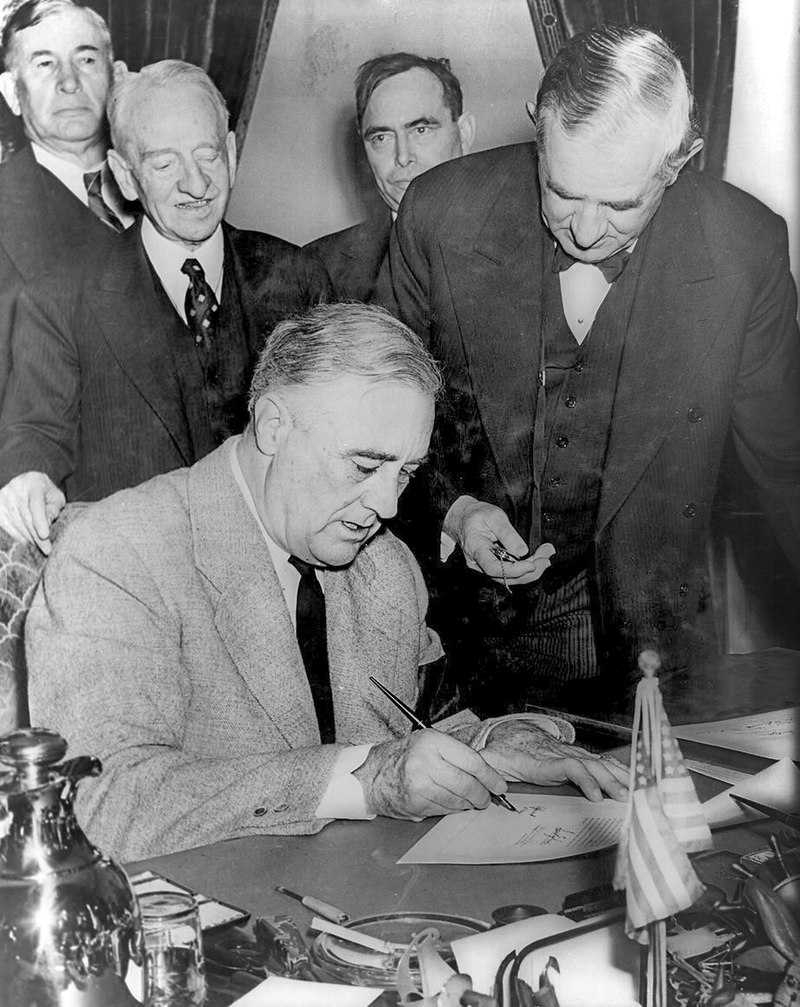
File:Franklin_Roosevelt_signing_declaration_of_war_against_Germany.jpg · Wikimedia Commons · See Wikimedia Commons
declaration of war
Sign in to saveformal announcement by which one state goes to war against another
Wikidata facts
- Subclass of
- declaration
Show 4 more facts
- facet of
- law of war
- topic's main category
- Category:Declarations of war
- Commons category
- Declarations of war
- on focus list of Wikimedia project
- Wikipedia:Vital articles/Level/4
Sources (2)
via Wikidata · CC0
~10 min read
Encyclopedic overview
US President Franklin D. Roosevelt signs a declaration of war against Nazi Germany on 11 December 1941. A declaration of war is a formal act by which one state announces existing or impending war activity against another. The declaration is a performative speech act (or the public signing of a document) by an authorized party of a national government, in order to create a state of war between two or more states.
The legality of who is competent to declare war varies between nations and forms of government. In many nations, that power is given to the head of state or sovereign. In other cases, something short of a full declaration of war, such as a letter of marque or a covert operation, may authorise war-like acts by privateers or mercenaries. The official international protocol for declaring war was defined in the Hague Convention (III) of 1907 on the Opening of Hostilities.
Excerpted from Wikipedia’s “declaration of war” article, available under the CC BY-SA 4.0 licence.
Gallery (2)
Available in 47 languages
- Español
- Français
- Deutsch
- 中文
- 日本語
- Русский
- Português
- Italiano
- العربية
- Albanian
- Asturian
- Azerbaijani
- Bahasa Indonesia
- Basque
- Belarusian
- Breton
- Catalan
- Central Kurdish
Show 28 more
via Wikidata sitelinks · CC0