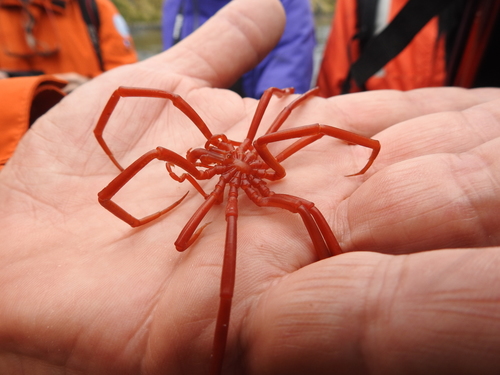
(c) Lindblad Expeditions, all rights reserved, uploaded by Lindblad Expeditions
Decolopoda
Sign in to saveDecolopoda is a genus of sea spider (class Pycnogonida) in the family Colossendeidae. This genus includes two valid species, D. australis and D. qasimi. As the name of this genus implies, these two species are among the seven species of sea spider with five pairs of legs in adults instead of the usual four leg pairs. The species D. australis is notable as the first polymerous (i.e., extra-legged) sea spider to be discovered.
Species
GENUS
- KingdomAnimalia
- PhylumArthropoda
- ClassPycnogonida
- OrderPantopoda
- FamilyColossendeidae
via GBIF
Museum specimens
- Specimen records
- 13
- Family
- Colossendeidae
- Collections
- USNM, SIO, YPM, MNHN, NHMUK
- Recorded in
- Antarctica, Iles Kerguelen
~7 min read
Encyclopedic overview
6 sectionsContents
- Discovery and taxonomy
- Phylogeny
- Description
- Locomotion
- Distribution
- References
Decolopoda is a genus of sea spider (class Pycnogonida) in the family Colossendeidae. This genus includes two valid species, D. australis and D. qasimi. As the name of this genus implies, these two species are among the seven species of sea spider with five pairs of legs in adults instead of the usual four leg pairs. The species D. australis is notable as the first polymerous (i.e., extra-legged) sea spider to be discovered.
== Discovery and taxonomy == The species D. australis was first described by the American naturalist James Eights in 1834. He based the original description of this species on specimens found in the sea along the South Shetland Islands in the Antarctic region. Naturalists mostly ignored his discovery, dismissing the description by Eights as erroneous or based on a monstrosity, until the discovery of more ten-legged species several decades later.
Excerpted from Wikipedia’s “Decolopoda” article, available under the CC BY-SA 4.0 licence.