File:Deletion_of_chromosome_section.svg · Wikimedia Commons · See Wikimedia Commons
deletion mutation
Sign in to saveAlso known as deletion, genetic deletion, partial monosomy, DNA deletion
mutation that removes a part of a DNA sequence
Research
179,737 papers- Multi-locus deletion mutation induced by silver nanoparticles: Role of lysosomal-autophagy dysfunction.Ecotoxicology and environmental safety · 2023
- A Novel Exon 2 Deletion Mutation in the GRXCR1 Gene Associated With Non-Syndromic Hearing Loss: A Case Report and Review of Literatures.The Annals of otology, rhinology, and laryngology · 2023
- One-step determination of deletion mutation based on loop-mediated isothermal amplification.Analytical biochemistry · 2021
- A novel large deletion mutation involving the PORCN gene in a Chinese patient with focal dermal hypoplasia and literature review.International journal of dermatology · 2023
- Associations between pre-S deletion mutation of hepatitis B virus and risk of hepatocellular carcinoma in the Asian population: a meta-analysis.Medical science monitor : international medical journal of experimental and clinical research · 2015
via PubMed
~7 min read
Encyclopedic overview
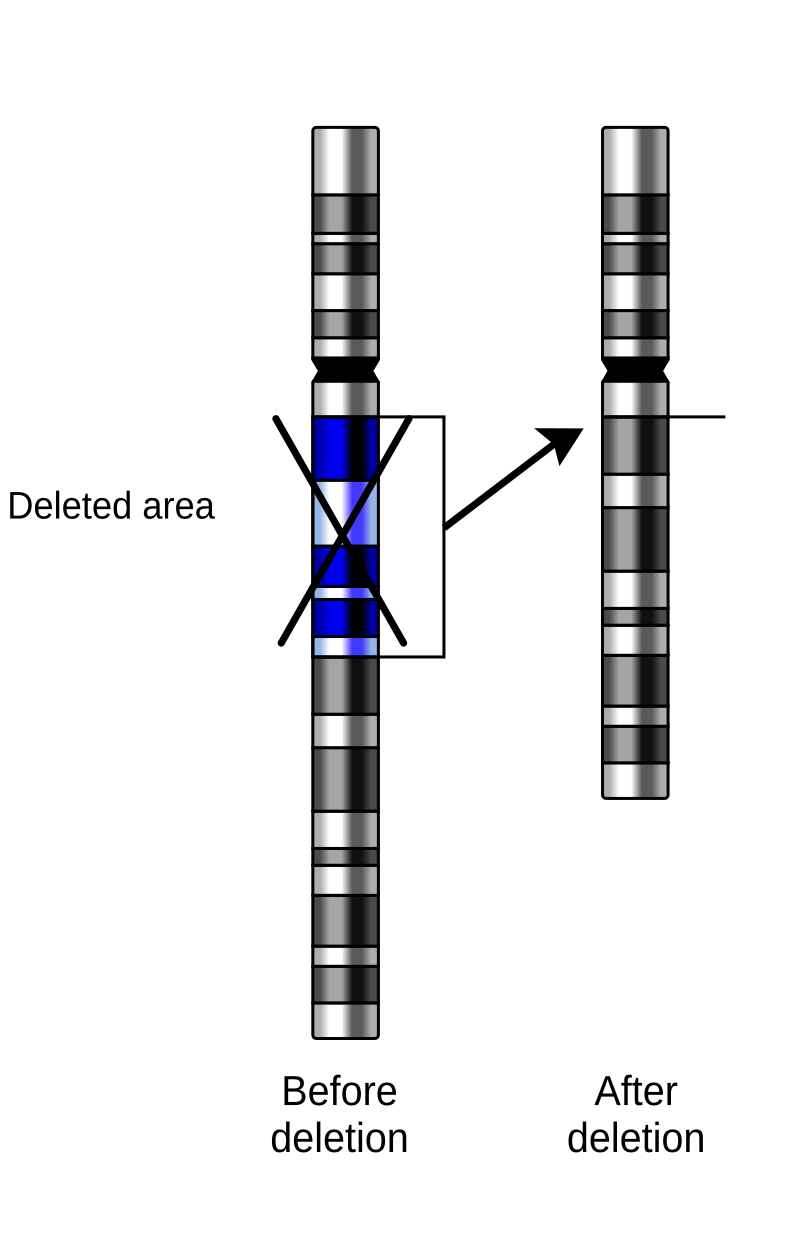
Deletion on a chromosome In genetics, a deletion (also called gene deletion, deficiency, or deletion mutation) (sign: Δ) is a mutation (a genetic aberration) in which a part of a chromosome or a sequence of DNA is left out during DNA replication. Any number of nucleotides can be deleted, from a single base to an entire piece of chromosome. Some chromosomes have fragile spots where breaks occur, which result in the deletion of a part of the chromosome. The breaks can be induced by heat, viruses, radiation, or chemical reactions. When a chromosome breaks, if a part of it is deleted or lost, the missing piece of chromosome is referred to as a deletion or a deficiency.
For synapsis to occur between a chromosome with a large intercalary deficiency and a normal complete homolog, the unpaired region of the normal homolog must loop out of the linear structure into a deletion or compensation loop.
Excerpted from Wikipedia’s “deletion mutation” article, available under the CC BY-SA 4.0 licence.