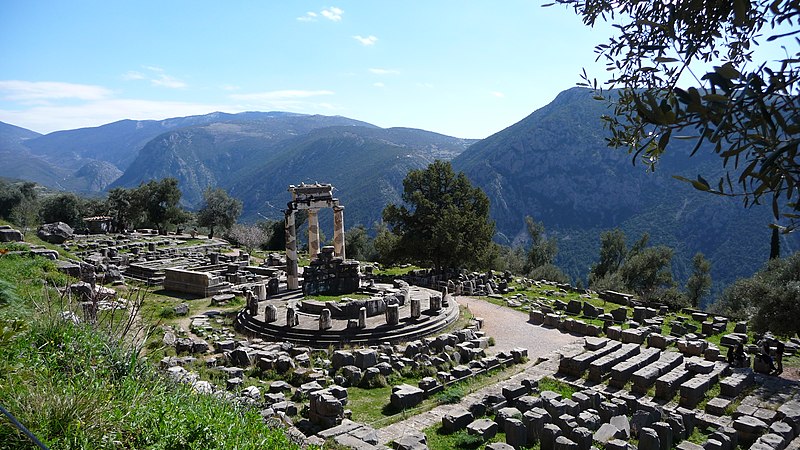
File:Delphi,_Greece_-_panoramio.jpg · Wikimedia Commons · See Wikimedia Commons
Delphi
Sign in to saveAlso known as Delphi (Samian Ware Discovery Site), Ancient Delphi, ancient Delphi
thumb|upright=1.75|Delphi among the main Greek sanctuaries Delphi (; ), in legend previously called Pytho (Πυθώ), was an ancient sacred precinct in central Greece. It was the seat of Pythia, the major oracle who was consulted about important decisions throughout the ancient classical world. The ancient Greeks considered the centre of the world to be in Delphi, marked by the stone monument known as the Omphalos of Delphi. The term omphalos was the Greek word for "navel".
Delphi was an ancient sacred site in central Greece that housed Pythia, a famous oracle whom people throughout the classical world consulted for guidance on important decisions. The ancient Greeks believed Delphi marked the center of the world, symbolized by a stone monument called the Omphalos (meaning "navel" in Greek).
AI-generated from the Wikipedia summary — may contain errors.
Key facts
- Ancient site.name
- Delphi
- Ancient site.relief
- yes
- Ancient site.image
- Delphi, Greece - panoramio.jpg
- Ancient site.alt
- Delphic Tholos
- Ancient site.caption
- The Athena temple complex, including the Delphic Tholos. The background is the Pleistos River Valley.
- Ancient site.image_upright
- 1.3
- Ancient site.map_type
- Greece
- Ancient site.map_size
- 290px
- Ancient site.location
- Phocis, Greece
- Ancient site.map_dot_label
- Delphi
- Ancient site.type
- Ruins of an ancient sacred precinct
- Ancient site.height
- Top of a scarp maximum off the valley floor
- Ancient site.archaeologists
- French School at Athens
- Ancient site.cultures
- Ancient Greece
- Ancient site.ownership
- Hellenic Republic
- Ancient site.management
- Ministry of Culture and Sports
- Ancient site.public_access
- Accessible for a fee
- Ancient site.designation1
- WHS
via Wikipedia infobox
Wikidata facts
- Official name
- Δελφοί
- Country
- Greece
- Located in
- Delfi Municipality
- Elevation
- 570
- Image
- Delphi Temple of Apollo.jpg
Show 6 more facts
- Commons gallery
- Delphi
- Commons category
- Ancient Delphi
- native label
- Δελφοί
- culture
- Ancient Greece
- time period
- Ancient Greece
via Wikidata · CC0
~55 min read
Encyclopedic overview
38 sectionsContents
- Names
- Delphi and the Delphic region
- Archaeology of the precinct
- Delphi Archaeological Museum
- Architecture of the precinct
- Temple of Apollo
- Treasuries
- Altar of the Chians
- Stoa of the Athenians
- Theatre
- Tholos
- Gymnasium
- Stadium
- Hippodrome
- Polygonal wall
- Castalian spring
- Roman Agora
- Athletic statues
- Myths regarding the origin of the precinct
- Oracle of Delphi
- The prophetic process
- Influence, devastations and a temporary revival
- Religious significance of the oracle
- History
- Ancient Delphi
- Amphictyonic Council
- The sacred precinct in the Iron Age
- Abandonment and rediscovery
- Delphi in later art
- Delphi in later literature
- Gallery
- See also
- Footnotes
- Citations
- Citation references
- Further reading
- 5th-century evidence
- External links
thumb|upright=1.75|Delphi among the main Greek sanctuaries Delphi (; ), in legend previously called Pytho (Πυθώ), was an ancient sacred precinct in central Greece. It was the seat of Pythia, the major oracle who was consulted about important decisions throughout the ancient classical world. The ancient Greeks considered the centre of the world to be in Delphi, marked by the stone monument known as the Omphalos of Delphi. The term omphalos was the Greek word for "navel".
According to the Suda, Delphi took its name from the Delphyne, the she-serpent (drakaina) who lived there and was killed by the god Apollo (in other accounts the serpent was the male serpent (drakon) Python).
Excerpted from Wikipedia’s “Delphi” article, available under the CC BY-SA 4.0 licence.
Gallery (52)
On the map
6 mapped locations
Available in 80 languages
- Español
- Français
- Deutsch
- 中文
- 日本語
- Русский
- Português
- Italiano
- العربية
- हिन्दी
- Afrikaans
- Albanian
- Armenian
- Asturian
- Azerbaijani
- Bahasa Indonesia
- Basque
- Belarusian
Show 61 more
- Bosnian
- Breton
- Bulgarian
- Catalan
- Cebuano
- Croatian
- Czech
- Danish
- Esperanto
- Estonian
- Filipino
- Finnish
- Galician
- Georgian
- Greek
- Gujarati
- Hebrew
- Hungarian
- hyw
- Icelandic
- Ido
- Irish
- Kazakh
- Kurdish
- Latin
- Latvian
- Lithuanian
- Macedonian
- Malay
- Malayalam
- Maltese
- Marathi
- Nederlands
- Norwegian
- Norwegian Nynorsk
- Occitan
- Polski
- Romanian
- Serbian
- Serbian (Latin)
- Sicilian
- simple
- Sindhi
- Slovak
- Slovenian
- Svenska
- Tamil
- Tiếng Việt
- Türkçe
- Ukrainian
- Urdu
- Uzbek
- Waray
- Welsh
- Western Panjabi
- Wu Chinese
- Yiddish
- zh_yue
- فارسی
- ไทย
- 한국어
via Wikidata sitelinks · CC0