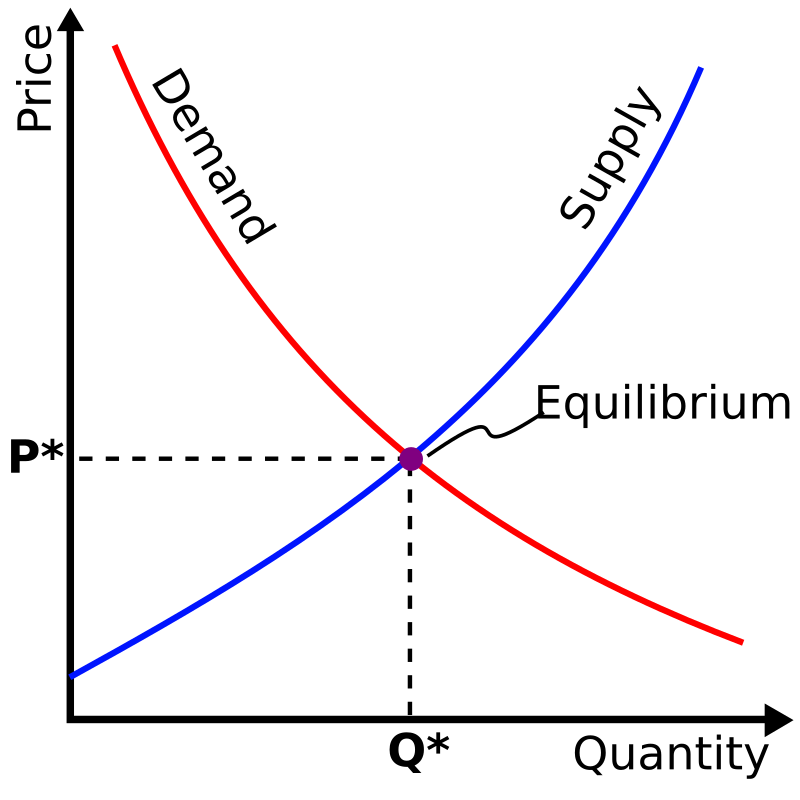
File:Supply-demand-equilibrium.svg · Wikimedia Commons · See Wikimedia Commons
demand
Sign in to saveIn economics, demand is the quantity of a good that consumers are willing and able to purchase at various prices during a given time. In economics "demand" for a commodity is not the same thing as "desire" for it. It refers to both the desire to purchase and the ability to pay for a commodity.
Demand is the amount of a good that people are willing and able to buy at different prices during a certain period—it's not just about wanting something, but having the money to actually purchase it. Understanding demand matters because it helps explain how prices and availability of products are determined in the marketplace.
AI-generated from the Wikipedia summary — may contain errors.
Wikidata facts
- Part of
- supply and demand
Show 4 more facts
- topic's main category
- Category:Demand
- opposite of
- supply
- equivalent class
- schema.org/Demand
- Commons category
- Demand
Sources (2)
via Wikidata · CC0
~21 min read
Encyclopedic overview
21 sectionsContents
- Factors influencing demand
- Demand function equation
- Demand curve
- Price elasticity of demand
- Elasticity along linear demand curve
- Constant price elasticity demand
- Perfectly inelastic demand
- Market structure and the demand curve
- Inverse demand function
- Residual demand curve
- Demand function and total revenue
- Is the demand curve for PC firm really flat?
- Demand management in economics
- Different types of goods demand
- Criticism
- Demand reduction
- In psychopharmacology
- In energy conservation
- See also
- Notes
- Further reading
In economics, demand is the quantity of a good that consumers are willing and able to purchase at various prices during a given time. In economics "demand" for a commodity is not the same thing as "desire" for it. It refers to both the desire to purchase and the ability to pay for a commodity.
Demand is always expressed in relation to a particular price and a particular time period since demand is a flow concept. Flow is any variable which is expressed per unit of time. Demand thus does not refer to a single isolated purchase, but a continuous flow of purchases.
Excerpted from Wikipedia’s “demand” article, available under the CC BY-SA 4.0 licence.