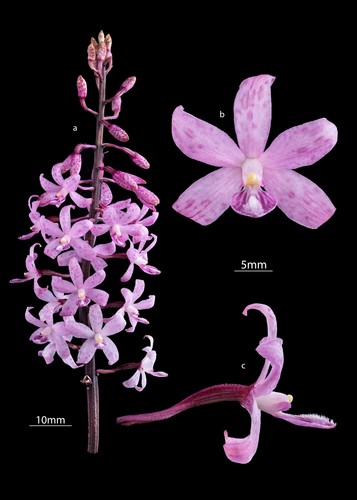
(c) izakschoon, some rights reserved (CC BY-NC), uploaded by izakschoon · cc-by-nc
Dipodium
Sign in to saveDipodium, commonly known as hyacinth orchids, is a genus of about forty species of orchids native to tropical, subtropical and temperate regions of south-east Asia, New Guinea, the Pacific Islands and Australia. It includes both terrestrial and climbing species, some with leaves and some leafless, but all with large, often colourful flowers on tall flowering stems. It is the only genus of its alliance, Dipodium.
Species
Rosy Hyacinth Orchid
GENUS
- KingdomPlantae
- PhylumTracheophyta
- ClassLiliopsida
- OrderAsparagales
- FamilyOrchidaceae
Dipodium es un género con 25 especies de orquídeas de hábitos terrestres. Es nativo de las regiones tropicales y subtropicales de China, Malasia, Nueva Guinea, las islas del Pacífico y Australia. Es el único género de la alianza Dipodium.
via GBIF · Kew POWO
Museum specimens
- Specimen records
- 51
- With media
- 39
- Family
- Orchidaceae
- Collections
- A, MO, CMN, AMES, MEL, MICH
- Recorded in
- Indonesia, Malaysia, Australia, Papua New Guinea, Philippines
Wikidata facts
- Instance of
- taxon
- Parent taxon
- Eulophiinae
- Image
- Dipodium punctatum fir00002.jpg
Show 6 more facts
- topic's main category
- Category:Dipodium
- taxon name
- Dipodium
- taxon rank
- genus
- Commons category
- Dipodium
- Commons gallery
- Dipodium
Sources (1)
via Wikidata · CC0
~5 min read
Encyclopedic overview
9 sectionsContents
- Description
- Taxonomy
- Distribution and habitat
- Ecology
- Uses
- Use in horticulture
- Species
- References
- External links
Dipodium, commonly known as hyacinth orchids, is a genus of about forty species of orchids native to tropical, subtropical and temperate regions of south-east Asia, New Guinea, the Pacific Islands and Australia. It includes both terrestrial and climbing species, some with leaves and some leafless, but all with large, often colourful flowers on tall flowering stems. It is the only genus of its alliance, Dipodium.
==Description== Orchids in the genus Dipodium are perennial, terrestrial herbs or climbers/epiphytes. Many species, particularly in eastern Australia are leafless mycoheterotrophs. Others have medium-sized to very large leaves that are parallel-veined and have entire margins. The flowers are arranged in a raceme with very few or up to fifty large, often colourful flowers. These may be fragrant or odourless, are white, pink, purple, yellow or green, often with spots or blotches. The sepals and petals are free from and similar to each other. The labellum projects forwards and has three lobes with a central band of colourful hairs. Each flower has two pollinia that are supported on two stipes. Dehiscent capsules, produced after flowering, hold the seed which is released when the capsule splits longitudinally along six seams. Between 30 and 500 seeds are produced per capsule.
Excerpted from Wikipedia’s “Dipodium” article, available under the CC BY-SA 4.0 licence.
Gallery (5)
Available in 16 languages
- Español
- Português
- Bahasa Indonesia
- Cebuano
- Croatian
- Komi
- Komi-Permyak
- Moksha
- Nederlands
- Polski
- Svenska
- Tiếng Việt
- Udmurt
- Waray
- Western Mari
via Wikidata sitelinks · CC0