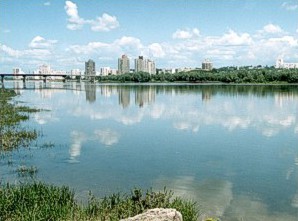
File:Dniester01.jpg · Wikimedia Commons · See Wikimedia Commons
Dniester
Sign in to saveAlso known as Dnister River
The Dniester ( ) is a transboundary river in Eastern Europe. It runs first through Ukraine and then through Moldova (from which it more or less separates the breakaway territory of Transnistria), finally discharging into the Black Sea on Ukrainian territory again.
The Dniester is a river in Eastern Europe that flows through Ukraine and Moldova before emptying into the Black Sea, serving as a natural boundary between Moldova and the breakaway region of Transnistria. It matters as a significant transboundary waterway that affects the geography and political divisions of the region.
AI-generated from the Wikipedia summary — may contain errors.
Key facts
- River.name
- Dniester
- River.image
- Dniester01.jpg
- River.image_size
- 250
- River.image_caption
- Rîbnița and the Dniester river
- River.map
- Dniester map.png
- River.map_size
- 250
- River.map_caption
- Map of the Dniester basin
- River.pushpin_map_size
- 250
- River.mapframe
- yes
- River.mapframe zoom
- 5
- River.subdivision_type1
- Country
- River.subdivision_type5
- Cities
- River.source1_location
- Eastern Beskids (Ukrainian Carpathians)
- River.mouth
- Black Sea
- River.mouth_location
- Odesa Oblast
- River.tributaries_left
- Murafa, Smotrych, Zbruch, Seret, Strypa, Zolota Lypa, Stryi
- River.tributaries_right
- Botna, Bîc, Răut, Svicha, Lomnytsia, Ichel
- River.custom_label
- Designation
via Wikipedia infobox
Wikidata facts
- Instance of
- river
- Country
- Transnistria
- Located in
- Chernivtsi Oblast
- Continent
- Europe
- Image
- 19-01-18-Prednistrowien-RalfR-18.jpg
- Length
- 1352
Show 14 more facts
- tributary
- Derlo
- on focus list of Wikimedia project
- WikiProject Ukraine
- category for the water basin
- Category:Dniester basin
- mouth of the watercourse
- Dniester Lyman
- Commons category
- Dniester
- topic's main category
- Category:Dniester
- described by source
- Pauly–Wissowa
- watershed area
- 72100
- discharge
- 310
- origin of the watercourse
- Vovche
- lake on watercourse
- Dniester Reservoir
- basin country
- Ukraine
- different from
- Dnieper
- native label
- Nistru
via Wikidata · CC0
~7 min read
Encyclopedic overview
11 sectionsContents
- Names
- Geography
- History
- Tributaries
- Eco-TIRAS International Environmental Association of River Keepers
- Gallery
- See also
- Notes
- References
- General
- External links
The Dniester ( ) is a transboundary river in Eastern Europe. It runs first through Ukraine and then through Moldova (from which it more or less separates the breakaway territory of Transnistria), finally discharging into the Black Sea on Ukrainian territory again.
== Names == The name Dniester derives from Sarmatian dānu nazdya "the close river". (The Dnieper, also of Sarmatian origin, derives from the opposite meaning, "the river on the far side".) Alternatively, according to Vasily Abaev Dniester would be a blend of Scythian dānu "river" and Thracian Ister, the previous name of the river, literally Dān-Ister (River Ister). The Ancient Greek name of Dniester, Tyras (Τύρας), is from Scythian tūra, meaning "rapid".
Excerpted from Wikipedia’s “Dniester” article, available under the CC BY-SA 4.0 licence.
Gallery (9)
On the map
6 mapped locations
Available in 101 languages
- Español
- Français
- Deutsch
- 中文
- 日本語
- Русский
- Português
- Italiano
- العربية
- Afrikaans
- Albanian
- Amharic
- Aragonese
- Armenian
- Asturian
- azb
- Azerbaijani
- Bahasa Indonesia
Show 82 more
- Bashkir
- Basque
- be_x_old
- Belarusian
- Bhojpuri
- Bosnian
- Breton
- Bulgarian
- Catalan
- Cebuano
- Chuvash
- Crimean Tatar
- Croatian
- Czech
- Danish
- Egyptian Arabic
- Esperanto
- Estonian
- Finnish
- Galician
- Georgian
- Greek
- Hebrew
- Hungarian
- Icelandic
- Ido
- Interlingua
- Irish
- Kashubian
- Kazakh
- Kotava
- Kyrgyz
- Latin
- Latvian
- Lingua Franca Nova
- Lithuanian
- lld
- Lombard
- Macedonian
- Malagasy
- Malay
- Marathi
- Mari
- Mingrelian
- Moksha
- Mongolian
- Nederlands
- Northern Frisian
- Norwegian
- Norwegian Nynorsk
- Occitan
- Old English
- Ossetic
- Polski
- Romanian
- Rusyn
- Serbian
- Serbian (Latin)
- simple
- Slovak
- Slovenian
- Svenska
- Swahili
- Tatar
- Tiếng Việt
- Toki Pona
- Türkçe
- Udmurt
- Ukrainian
- Upper Sorbian
- Uzbek
- Welsh
- West Flemish
- Western Frisian
- Western Panjabi
- Wu Chinese
- Yakut
- Yiddish
- zh_yue
- فارسی
- ไทย
- 한국어
via Wikidata sitelinks · CC0