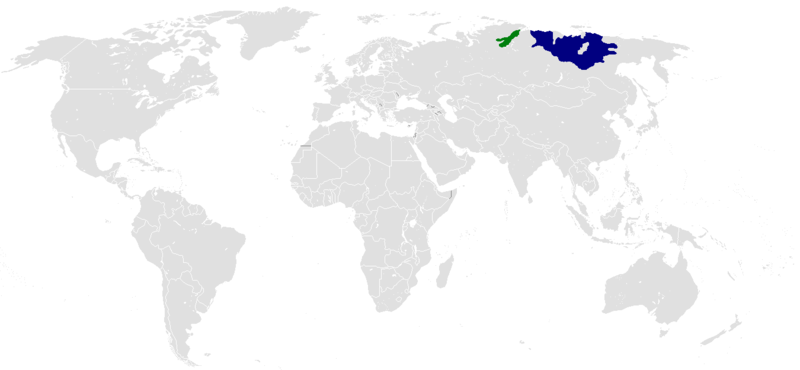
File:Yakut_and_Dolgan_languages.png · Wikimedia Commons · See Wikimedia Commons
Dolgan
Sign in to saveAlso known as Dolgan language
Turkic language with around 5,000 speakers, spoken in the Taymyr Peninsula in Russia
Key facts
- Pronunciation
- [dɔlgæn]
- Native to
- Russia
- Region
- Taymyrsky Dolgano-Nenetsky District , Krasnoyarsk Krai
- Ethnicity
- Dolgans
- Native speakers
- 5,300 (2020 census)
- Language family
- Turkic Common Turkic Siberian Turkic Northern Siberian Dolgan
- Dialects
- Western (Norilsk, Yenisey) Central (Avam) Eastern (Khatanga)
- Iso 639 3
- dlg
- Glottolog
- dolg1241
- Elp
- Dolgan
via Wikipedia infobox
Described at
Turkic Database at Elegant Lexicon
A searchable database of lexical items in the Turkic languages
turkic.elegantlexicon.com →423 entries in lexical database. Click here for all forms in the database. Dolgan is often regarded as a dialect of Sakha , despite the fact that it has its own literary standard. The Dolgan writing system has varied considerably over time. The alphabet given below is the most recent version.
Excerpt from a page describing this subject · 1,706 chars · not written by Vinony
Wikidata facts
- Instance of
- modern language
- Country
- Russia
Show 8 more facts
- writing system
- Cyrillic script
- topic's main category
- Category:Dolgan language
- linguistic typology
- agglutinative language
- indigenous to
- Dolgans
- number of speakers, writers, or signers
- 4836
- native label
- һака
- described at URL
- turkic.elegantlexicon.com/lx.php?lx=dgn
Sources (7)
via Wikidata · CC0
~8 min read
Encyclopedic overview
The Dolgan language (долган, dolgan or һака, haka) is an endangered Turkic language, spoken in the Taymyr Peninsula in Russia. The speakers are known as the Dolgans. The word "Dolgan", derived from Evenki, means 'tribe living on the middle reaches of the river'. This is most likely signifying the geographical location of the Dolgan tribe. Its closest relative is Sakha.
The language is very local and restricted to a certain area and has declined in usage over the years. As of 2020 there are only about 5,350 speakers of the language. The language has experienced a few changes since the beginning of its formation, such as alphabet and phrasing terms. The issue as of recently has become the weak integration of this local language within families with mixed marriages. Instead of speaking either of the parents' local languages, the family incorporates Russian as the more dominant language to ease interfamilial and external communication. This results in children learning the language only slightly or as a second language. Over generations, the language continues to fade. In 1999, however, some children were apparently learning Dolgan, with Russian also being learned at an early age.
Excerpted from Wikipedia’s “Dolgan” article, available under the CC BY-SA 4.0 licence.