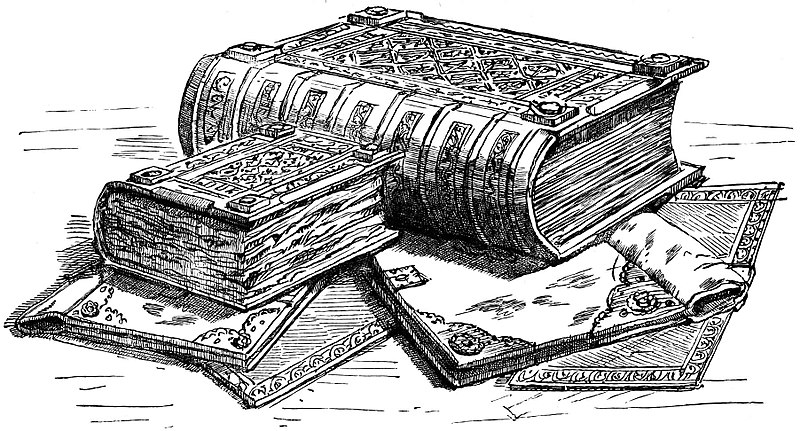
File:Domesday-book-1804x972.jpg · Wikimedia Commons · See Wikimedia Commons
Domesday Book
Sign in to saveAlso known as Book of Winchester, Liber de Wintonia, Great Domesday Book
manuscript record of the "Great Survey" of much of England and parts of Wales completed in 1086
The Domesday Book is a manuscript record of a massive survey of England and parts of Wales that was completed in 1086, ordered by William the Conqueror to document the land, property, and resources across his realm. It remains one of the most important historical documents for understanding medieval England, providing detailed information about the people, economy, and geography of the time.
AI-generated from the Wikipedia summary — may contain errors.
Wikidata facts
- Instance of
- cadastre
- Country
- Spain
- Author
- William the Conqueror
- Collection
- UK National Archives
- Image
- Domesday book--w.jpg
Show 8 more facts
- Commons category
- Domesday Book
- topic's main category
- Category:Domesday Book
- Commons gallery
- Domesday Book
- inception
- 1086-00-00
- commissioned by
- William the Conqueror
- language of work or name
- medieval Latin
- inventory number
- E 31/2/2
- different from
- Doomsday Book
via Wikidata · CC0
~28 min read
Encyclopedic overview
Domesday Book (/ˈduːmzdeɪ/ DOOMZ-day; the Middle English spelling of "Doomsday Book") is a manuscript record of the Great Survey of much of England and parts of Wales completed in 1086 at the behest of William the Conqueror. The manuscript was originally known by the Latin name Liber de Wintonia, meaning "Book of Winchester", where it was originally kept in the royal treasury. The Anglo-Saxon Chronicle states that in 1085 the king sent his agents to survey every shire in England, to list his holdings and dues owed to him.
Written in Medieval Latin, it was highly abbreviated and included some vernacular native terms without Latin equivalents. The survey's main purpose was to record the annual value of every piece of landed property to its lord, and the resources in land, labour force, and livestock from which the value derived.
Excerpted from Wikipedia’s “Domesday Book” article, available under the CC BY-SA 4.0 licence.
Gallery (8)
Available in 58 languages
- Español
- Français
- Deutsch
- 中文
- 日本語
- Русский
- Português
- Italiano
- العربية
- हिन्दी
- Afrikaans
- Albanian
- Armenian
- Basque
- Belarusian
- Breton
- Bulgarian
- Catalan
Show 39 more
- Croatian
- Czech
- Danish
- Egyptian Arabic
- Esperanto
- Estonian
- Finnish
- Galician
- Georgian
- Greek
- Hebrew
- Hungarian
- Icelandic
- Ido
- Latin
- Latvian
- Lithuanian
- Luxembourgish
- Macedonian
- Nederlands
- Norwegian
- Norwegian Nynorsk
- Occitan
- Old English
- Polski
- Romanian
- Serbian
- Serbian (Latin)
- simple
- Slovak
- Slovenian
- Svenska
- Türkçe
- Ukrainian
- Welsh
- Western Frisian
- فارسی
- ไทย
- 한국어
via Wikidata sitelinks · CC0