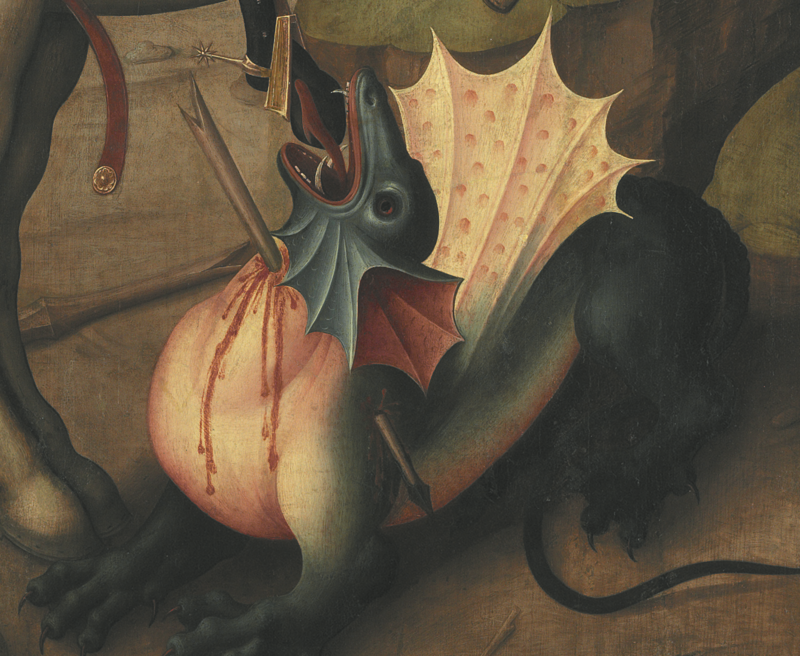
File:St_Catherine,_St_George_and_the_Dragon_(Mästaren_från_Kappenberg)_-_Nationalmuseum_-_18337_(brightened),_draken.png · Wikimedia Commons · See Wikimedia Commons
dragon
Sign in to saveAlso known as drake
A dragon is a mythical creature found in the folklore of cultures throughout the world. It is generally reptilian or serpentine in form and often possesses a variety of predatory features, such as claws, wings, scales, or horns. Dragons are typically portrayed as intelligent beings capable of manipulating natural elements. Their appearance commonly incorporates reptilian, mammalian, and avian traits.
A dragon is a mythical creature that appears in the folklore of many cultures around the world, typically depicted as a reptilian or serpent-like being with features such as claws, wings, scales, or horns. Dragons are generally portrayed as intelligent creatures capable of controlling natural elements, and their appearance often combines characteristics from reptiles, mammals, and birds.
AI-generated from the Wikipedia summary — may contain errors.
Wikidata facts
- Image
- Friedrich-Johann-Justin-Bertuch Mythical-Creature-Dragon 1806.jpg
Show 10 more facts
- described by source
- Pauly–Wissowa
- Unicode character
- 🐲
- Commons category
- Dragons
- topic's main category
- Category:Dragons
- Commons gallery
- Dragon
- has characteristic
- fire breathing
- P8168
- Lizinska de Mirbel
- on focus list of Wikimedia project
- Wikipedia:Vital articles/Level/4
- indigenous to
- Asia
- topic has template
- Template:Dragons
via Wikidata · CC0
~61 min read
Encyclopedic overview
29 sectionsContents
- Etymology
- Theorised origins
- Africa
- Egypt
- Ethiopia
- West Asia
- Mesopotamia
- Levant
- Iran
- East Asia
- China
- Korea
- Japan
- Vietnam
- South Asia
- India
- Bhutan
- Europe
- Proto-Indo-European
- Ancient Greece
- Ancient Rome
- Germanic
- Post-classical
- Post-classical Eastern
- Modern depictions
- See also
- References
- Bibliography
- External links
A dragon is a mythical creature found in the folklore of cultures throughout the world. It is generally reptilian or serpentine in form and often possesses a variety of predatory features, such as claws, wings, scales, or horns. Dragons are typically portrayed as intelligent beings capable of manipulating natural elements. Their appearance commonly incorporates reptilian, mammalian, and avian traits.
In modern popular culture and Western traditions since the High Middle Ages, dragons have been depicted as large predaceous winged quadrupeds with claws, a saurian body, scales, a long tail, and an ability to breathe fire. In East Asian traditions, particularly in China, Japan, and Korea, dragons are usually portrayed as long, serpentine, and often benevolent creatures composed of features drawn from many animals, including a camel’s head, a snake’s neck, rabbit-like or demonic eyes, a stag’s antlers, a tiger’s paws, a carp’s scales, a frog or clam’s belly, and the claws of an eagle. Despite regional differences, dragons in nearly all cultures are regarded as powerful and awe-inspiring creatures.
Excerpted from Wikipedia’s “dragon” article, available under the CC BY-SA 4.0 licence.
Gallery (52)
Available in 130 languages
- Español
- Français
- Deutsch
- 中文
- 日本語
- Русский
- Português
- Italiano
- العربية
- हिन्दी
- Abkhazian
- Adyghe
- Afrikaans
- Albanian
- Albanian
- Aragonese
- Aramaic
- Armenian
Show 111 more
- Asturian
- azb
- Azerbaijani
- Bahasa Indonesia
- Balinese
- Bangla
- Bashkir
- Basque
- Bavarian
- be_x_old
- Belarusian
- Bhojpuri
- Bikol
- Bosnian
- Breton
- Bulgarian
- Catalan
- Central Dusun
- Central Kurdish
- Chechen
- Cornish
- Crimean Tatar
- Croatian
- Czech
- Danish
- Esperanto
- Estonian
- Faroese
- Filipino
- Finnish
- fiu_vro
- Galician
- Georgian
- Gilaki
- Greek
- Guarani
- Hausa
- Hebrew
- Hungarian
- Icelandic
- Ido
- Ingush
- Interlingua
- Kannada
- Kashmiri
- Kazakh
- Kurdish
- Kyrgyz
- Latin
- Latvian
- Lingua Franca Nova
- Lithuanian
- lld
- Lombard
- Luxembourgish
- Macedonian
- Madurese
- Malagasy
- Malay
- Malayalam
- Manipuri
- Mazanderani
- Neapolitan
- Nederlands
- Nepali
- Norwegian
- Norwegian Nynorsk
- Novial
- nrm
- Occitan
- Old English
- Oromo
- Ossetic
- Pashto
- Polski
- Punjabi
- Quechua
- Romanian
- Sardinian
- Scots
- Serbian
- Serbian (Latin)
- Silesian
- simple
- Sindhi
- Slovak
- Slovenian
- Standard Moroccan Tamazight
- Svenska
- Tajik
- Talysh
- Tamil
- Tatar
- Telugu
- Tiếng Việt
- Toki Pona
- Türkçe
- Ukrainian
- Urdu
- Uzbek
- Waray
- Welsh
- Western Frisian
- Western Panjabi
- Wu Chinese
- Yiddish
- zh_yue
- Zulu
- فارسی
- ไทย
- 한국어
via Wikidata sitelinks · CC0