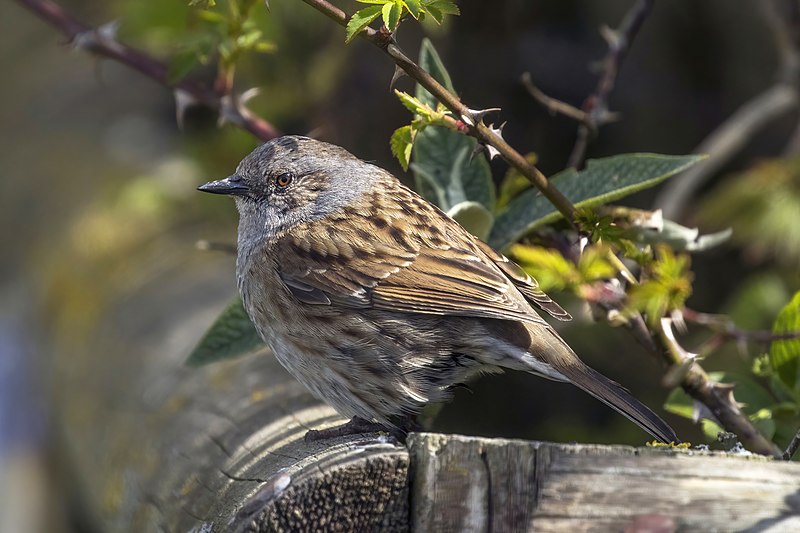
File:Dunnock_(Prunella_modularis)_3.jpg · Wikimedia Commons · See Wikimedia Commons
I don't have enough context provided to write an accurate overview. The context only shows "thumb|Prunella modularis" (the scientific name for a dunnock), but contains no descriptive information about what the bird is, its characteristics, or why it matters. I cannot write the overview without inventing facts, which would violate your instructions.
AI-generated from the Wikipedia summary — may contain errors.
Wikidata facts
Show 13 more facts
- taxon rank
- species
- IUCN conservation status
- Least Concern
- taxon name
- Prunella modularis
- Commons category
- Prunella modularis
- Commons gallery
- Prunella modularis
- wingspan
- 0.21
- litter size
- 4.9
- egg incubation period
- 14
- different from
- Pokrzywnica
- taxon common name
- ferreirinha-comum
- taxon range
- Africa
- taxon author citation
- (Linnaeus, 1758)
- regional conservation status
- Near Threatened
Sources (8)
via Wikidata · CC0
~9 min read
Encyclopedic overview
10 sectionsContents
- Taxonomy
- Description
- Distribution and habitat
- Territoriality
- Breeding
- Mating systems
- Nest
- Parental care and provisioning
- References
- External links
thumb|Prunella modularis
The dunnock (Prunella modularis) is a small passerine, or perching bird, found throughout temperate Europe and into Asian Russia. Dunnocks have also been introduced and become common in New Zealand. It is the most widespread member of the accentor family; most other accentors are limited to mountain habitats. Other, largely archaic, English names for the dunnock include hedge accentor, hedge sparrow, hedge warbler, and titling.
Excerpted from Wikipedia’s “Dunnock” article, available under the CC BY-SA 4.0 licence.
Gallery (23)
Available in 71 languages
- Español
- Français
- Deutsch
- 中文
- 日本語
- Русский
- Português
- Italiano
- العربية
- Aragonese
- Armenian
- Asturian
- Azerbaijani
- Bashkir
- Basque
- Belarusian
- Breton
- Bulgarian
Show 52 more
- Catalan
- Cebuano
- Chuvash
- Corsican
- Czech
- Danish
- Egyptian Arabic
- Esperanto
- Estonian
- Faroese
- Finnish
- Galician
- Hebrew
- Hungarian
- Irish
- Kabardian
- Kazakh
- Latvian
- Lithuanian
- Luxembourgish
- Macedonian
- Mongolian
- Navajo
- nds_nl
- Nederlands
- Northern Frisian
- Norwegian
- Norwegian Nynorsk
- Occitan
- Picard
- Piedmontese
- Polski
- Romanian
- Rusyn
- Scots
- Serbian
- simple
- Slovak
- Svenska
- Tatar
- Tiếng Việt
- Türkçe
- Ukrainian
- Walloon
- Waray
- Welsh
- West Flemish
- Western Frisian
- Wu Chinese
- zh_yue
- فارسی
- 한국어
via Wikidata sitelinks · CC0