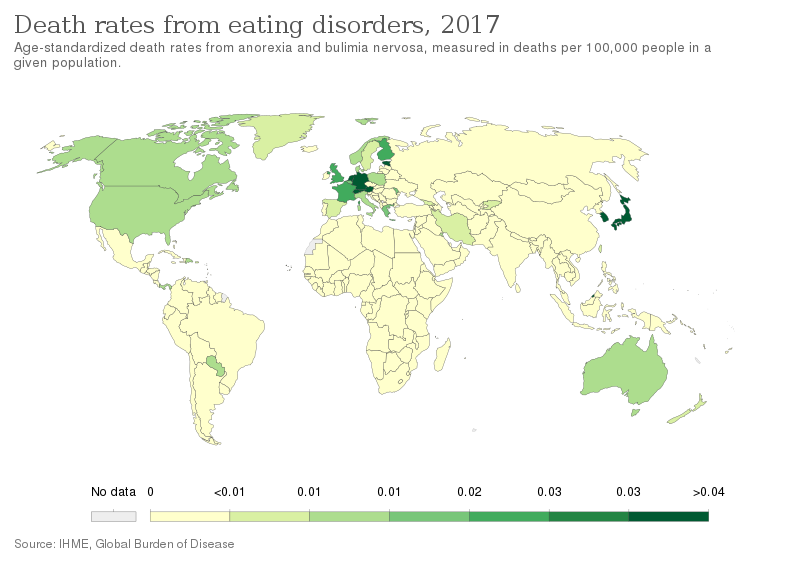
File:Death_rates_from_eating_disorders,_OWID.svg · Wikimedia Commons · See Wikimedia Commons
eating disorder
Sign in to saveAlso known as ED, feeding and eating disorders, feeding disorder, eating disorders
habit of eating either insufficient or excessive food, to the detriment of health
An eating disorder is a harmful habit of eating too little or too much food in ways that damage a person's health. It matters because these patterns can lead to serious physical and mental health problems if left untreated.
AI-generated from the Wikipedia summary — may contain errors.
Key facts
- Specialty
- Neurology , psychiatry , clinical psychology , gastroenterology if caused by GI illness , phoniatrics if caused by dysphagia , dentistry if caused by very bad breath
- Symptoms
- Abnormal eating habits that negatively affect physical or mental health
- Types
- Binge eating disorder , anorexia nervosa , bulimia nervosa , pica , rumination disorder , avoidant/restrictive food intake disorder , night eating syndrome
- Causes
- Multiple
- Risk factors
- Gastrointestinal disorders , history of sexual abuse , bullying , social media , being a dancer or gymnast
- Treatment
- Counseling , proper diet, normal amount of exercise, medications
via Wikipedia infobox
Research
54,924 papers- Eating disorders.ReviewLancet (London, England) · 2020Treasure J, Duarte TA, Schmidt UDOI: 10.1016/S0140-6736(20)30059-3
- Worldwide prevalence of DSM-5 eating disorders among young people.ReviewCurrent opinion in psychiatry · 2022Silén Y, Keski-Rahkonen ADOI: 10.1097/YCO.0000000000000818
- Sleep-Related Eating Disorder.ReviewSleep medicine clinics · 2024Lipford MC, Auger RRDOI: 10.1016/j.jsmc.2023.10.013
- Current approach to eating disorders: a clinical update.Internal medicine journal · 2020Hay PDOI: 10.1111/imj.14691
- The Neurobiology of Eating Disorders.ReviewChild and adolescent psychiatric clinics of North America · 2019Frank GKW, Shott ME, DeGuzman MCDOI: 10.1016/j.chc.2019.05.007
- Psychopharmacologic Management of Eating Disorders.ReviewCurrent psychiatry reports · 2022Muratore AF, Attia EDOI: 10.1007/s11920-022-01340-5
- Discrimination and Eating Disorder Psychopathology: A Meta-Analysis.ReviewBehavior therapy · 2021Mason TB, Mozdzierz P, Wang S et al.DOI: 10.1016/j.beth.2020.05.003
- Contextualising Eating Disorder Concerns for Paediatric Obesity Treatment.ReviewCurrent obesity reports · 2021Lister NB, Baur LA, Paxton SJ et al.DOI: 10.1007/s13679-021-00440-2
via PubMed
Wikidata facts
- Instance of
- mental disorder
- Subclass of
- disease
- Image
- Louis Bataille, 'Deux cas d'anorexie hysterique' Wellcome L0020548 (backcropped).jpg
Show 10 more facts
- topic's main category
- Category:Eating disorders
- Commons category
- Eating disorder
- health specialty
- clinical psychology
- NCI Thesaurus ID
- C89332
- ICPC 2 ID
- P86
- drug or therapy used for treatment
- fluoxetine
- exact match
- identifiers.org/doid/DOID:8670
- ICD-9-CM
- 307.50
- possible treatment
- psychomotor education
- different from
- hunger
Sources (10)
via Wikidata · CC0
~40 min read
Encyclopedic overview
An eating disorder (ED) is a mental disorder defined by abnormal eating behaviors that adversely affect a person's physical or mental health. These behaviors may include eating too much food or too little food, as well as body image issues. Types of eating disorders include binge eating disorder, where the person suffering keeps eating large amounts in a short period of time typically while not being hungry, often leading to weight gain; anorexia nervosa, where the person has an intense fear of gaining weight, thus restricts food and/or overexercises to manage this fear; bulimia nervosa, where individuals eat a large quantity (binging) then try to rid themselves of the food (purging), in an attempt to not gain any weight; pica, where the patient eats non-food items; rumination syndrome, where the patient regurgitates undigested or minimally digested food; avoidant/restrictive food intake disorder (ARFID), where people have a reduced or selective food intake due to some psychological reasons; and a group of other specified feeding or eating disorders. Anxiety disorders, depression and substance abuse are common among people with eating disorders. These disorders do not include obesity. People often experience comorbidity between an eating disorder and OCD.
The causes of eating disorders are not clear, although both biological and environmental factors appear to play a role. Cultural idealization of thinness is believed to contribute to some eating disorders. Individuals who have experienced sexual abuse are also more likely to develop eating disorders. Some disorders such as pica and rumination disorder occur more often in people with intellectual disabilities.
Excerpted from Wikipedia’s “eating disorder” article, available under the CC BY-SA 4.0 licence.