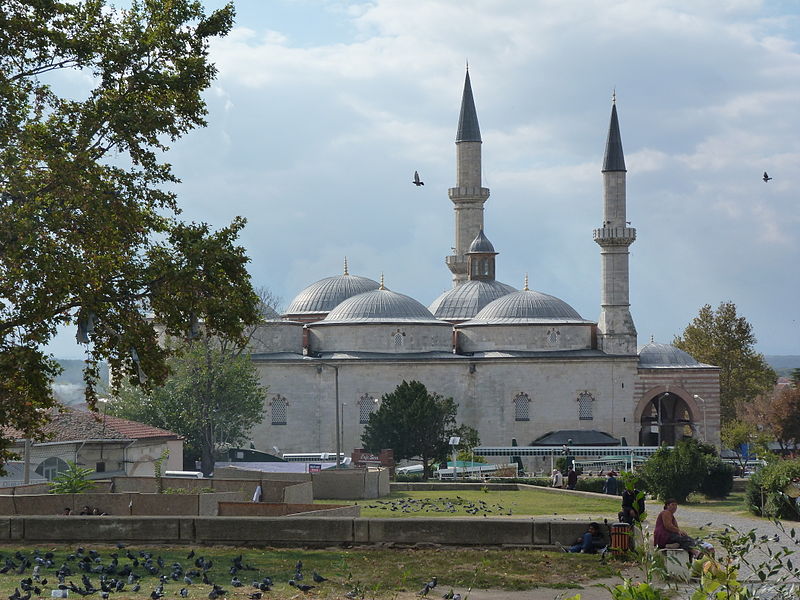
File:Nagymecset_-_Edirne,_2014.10.22_(1).JPG · Wikimedia Commons · See Wikimedia Commons
Edirne
Sign in to saveAlso known as Edirne City, Hadrianopolis, Adrianopolis
Edirne (; ), historically known as Orestias, Orestiada, Adrianople, or Adriana is a city in Turkey, in the northwestern part of the province of Edirne in Eastern Thrace. Situated from the Greek and from the Bulgarian borders, Edirne was the second capital city of the Ottoman Empire from the 1360s to 1453, before Constantinople became its capital.
Edirne is a city in northwestern Turkey near the borders of Greece and Bulgaria that was once the second capital of the Ottoman Empire, serving in that role from the 1360s until Constantinople became the capital in 1453. The city, historically known by names including Adrianople, holds significance as an important historical center from the Ottoman period.
AI-generated from the Wikipedia summary — may contain errors.
Weather now
7-day forecast
via Open-Meteo
Place details
- Locality
- Edirne Merkez
- Country
- Türkiye
- Population
- 180,002
- Timezone
- Europe/Istanbul
via OpenStreetMap · GeoNames
Key facts
- Turkey place.type
- municipality
- Turkey place.name
- Edirne
- Turkey place.image_logo
- Edirne city emblem.png
- Turkey place.province
- Edirne
- Turkey place.district
- Edirne
- Turkey place.leader_party
- CHP
- Turkey place.leader_name
- Filiz Gencan
- Turkey place.elevation_m
- 42
- Turkey place.population_total
- 180002
- Turkey place.population_as_of
- 2022
- Turkey place.postal_code
- 22000
- Turkey place.area_code
- 0284
via Wikipedia infobox
Wikidata facts
- Instance of
- municipality
- Official name
- Адрианополь
- Country
- Ottoman Empire
- Located in
- Adrianople vilayet
- Continent
- Europe
- Population
- 140830
- Elevation
- 42
- Time zone
- UTC+03:00
- Capital of
- Ottoman Empire
- Official website
- edirne.bel.tr
- Image
- Edirne at sunrise 21 52 30 274000.jpeg
- Dialing code
- 284
- Licence plate code
- 22
- Significant event
- Siege of Adrianople
- Connects with
- European route E80
Show 19 more facts
- Commons category
- Edirne
- topic's main category
- Category:Edirne
- twinned administrative body
- Kars
- category for people born here
- Category:Births in Edirne
- category for people who died here
- Category:Deaths in Edirne
- category of associated people
- Category:People from Edirne
- native label
- Edirne
- postal code
- 22 000
- inception
- 0125-00-00
- Commons gallery
- Edirne
- replaces
- Hadrianopolis
- social media followers
- 32727
- urban population
- 174662
- rural population
- 11764
- P12749
- Dième
- taxon especially protected in area
- Bellevalia edirnensis
- located in/on physical feature
- Marmara Region
- name in kana
- エディルネ
Sources (11)
via Wikidata · CC0
Travel guide
Get around
The centre is compact, fairly flat and walkable. The outlying districts are within a long walk, but you might prefer to take a taxi or dolmuş at least one way.
There are also buses running regularly (about every 10 minutes) from the centre to the Otogar (bus station) and to all outlying districts. To board the bus, you can use a Kent Kart (city card, which can be topped up with credit) or a "Tekli QR Bilet" (one-time QR-code ticket), that are sold at some kiosks (büfe). The fare for one ride, as of August 2025, is 36 TL. Alternatively, you can pay in the bus directly with a credit card, for which the fare is 46 TL, as of May 2026. Bus connections can be found on the moovit app.
Do
thumb|Young oil wrestlers Oil-wrestling (yağlı güreş) is practised all over Turkey, but a major competition (which has become the national event) is at Kırkpınar stadium. Wrestlers coat themselves in olive oil then try to grapple their slippery opponent to the ground. Bouts last up to 40 min. There's evidence of the sport from 2650 BC, and the Edirne contest dates from 1360 AD. The 2021 event is expected to be late June / early July but tba. Kırkpınar is on the river island on the approach to Sarayiçi, see above; it's walking distance from city centre. Football: only for die-hard fans. Edirnespor nowadays languish in TFF Third League, soccer's fourth tier in Turkey - and that's after being promoted in 2020.
Buy
Fruit-shaped soaps are primarily used for decoration, and as air-fresheners. Ornamental brooms are traditionally presented to brides. They're found in many souvenir shops, but just think about your carry-on luggage limits. Ottoman covered bazaars: several, two central examples are Arasta next to Selimiye Mosque (signposted “Çarşı Girişi”), and Alipaşa which parallels Saraçlar Cd.
Eat
thumb|220px|Lots of cafes on Saraçlar Cd Liver (ciğer) is the local delicacy, prepared in a distinct Edirne style: whole pieces are dusted with flour, deep fried in vegetable oil, and served with a ferociously hot dried and crunchy pepper. If you don’t care for the smell of liver, you won't notice it in Edirne liver. Eat it with bread and ayran, a salty yogurt drink - these blunt the fire of the pepper. Small eateries that specialise in liver are called ciğerci; there's a cluster in the park by the Old Mosque. If one of your party doesn't like liver, they can fetch something different from another nearby restaurant. Balkan Piliç Lokantasi on Darüleytam Sk is open daily 09:00-21:00. Good food but pricey for the small portions. Ciğerci Niyazi Usta at Ortakapı Cd 9 is open for fried liver daily 09:30-20:30. Cafes that you mainly choose for their location are: - along Saraçlar Cd, the pedestrian mall a block east of the old quarter. - south end of Maritsa Bridge, especially when sunset bathes the old town in lemon and olive oil. - Sera Cafe at Mimar Sinar Cd 8 behind Selimiye Mosque. Almond paste (badem ezmesi) is a local, soft cookie-like dessert of bitter almond. Keçecizade is a chain store selling this and other desserts. Their main outlet is at Hükümet Cd 5 opposite Üç Şerefeli.
Drink
Edirne has many birahanes - cafés that serve alcohol - and see above. A strip along Maarif Cd includes Park Pub, Sezen Café & Pub, English Bar, Füguran and Mahzen.
Sleep
Edirne's accommodation is mostly around Old Quarter and east of centre. Many places are tatty: those listed appear to have been cleaned at least once during 2021.
Stay safe
Floods are a hazard after heavy rain especially in winter. Districts such as Karaağaç may be cut off as the medieval bridges become inundated. Never try to cross a flooded bridge, see local advice on work-around safe routes.
Connect
As of Dec 2020, Edirne has a good 4G signal from all Turkish carriers, which extends along the main highways up to the Greek and Bulgarian borders. 5G access is limited to the city center. Free WiFi can be found in public squares and cafes.
Go next
Uzunköprü, literally "the long bridge", has a remarkable 15th century stone bridge of 174 arches. Keşan further south is just a transport hub, but you have to go that way to reach the beach resorts along the Gulf of Saros. Down the Gallipoli peninsula, the 1915 battlefields and memorials are near Eceabat. Istanbul is the must-see metropolis to the southeast. Kapıkule on the border with Bulgaria, and Pazarkule on the border with Greece, are both just a few kilometres away.
Travel guide from Wikivoyage (CC BY-SA 4.0)
~25 min read
Encyclopedic overview
28 sectionsContents
- Names and etymology
- History
- Roman and Byzantine Period
- Administrative arrangements
- Turkish Republic
- Ecclesiastical history
- Geography
- Climate
- Quarters
- Attractions
- Mosques
- Edirne Palace
- Other religious monuments
- Other historic monuments
- Cuisine
- Festivals
- Economy
- Education
- Universities
- High schools
- Gallery
- Twin cities
- Notable people
- See also
- Notes
- References
- Further reading
- External links
Edirne (; ), historically known as Orestias, Orestiada, Adrianople, or Adriana is a city in Turkey, in the northwestern part of the province of Edirne in Eastern Thrace. Situated from the Greek and from the Bulgarian borders, Edirne was the second capital city of the Ottoman Empire from the 1360s to 1453, before Constantinople became its capital.
The city is a commercial centre for woven textiles, silks, carpets and agricultural products and has a growing tourism industry. It is the seat of Edirne Province and Edirne District. Its population is 180,002 (2022).
Excerpted from Wikipedia’s “Edirne” article, available under the CC BY-SA 4.0 licence.
Gallery (48)
On the map
3 mapped locations
Available in 268 languages
- Español
- Français
- Deutsch
- 中文
- 日本語
- Русский
- Português
- Italiano
- العربية
- हिन्दी
- Abkhazian
- Achinese
- Afrikaans
- Akan
- Albanian
- Albanian
- Amharic
- ami
Show 249 more
- Aragonese
- Armenian
- Arpitan
- Asturian
- Avaric
- Aymara
- azb
- Azerbaijani
- Bahasa Indonesia
- Bangla
- Banjar
- Bashkir
- Basque
- bat_smg
- Bavarian
- be_x_old
- Belarusian
- Bikol
- Bosnian
- Breton
- Buginese
- Bulgarian
- Buriat
- Burmese
- Catalan
- cbk_zam
- cdo
- Cebuano
- Central Kurdish
- Chamorro
- Chechen
- Cherokee
- Cheyenne
- Church Slavic
- Chuvash
- Cornish
- Corsican
- Crimean Tatar
- Croatian
- Czech
- Danish
- Egyptian Arabic
- eml
- Erzya
- Esperanto
- Estonian
- Extremaduran
- Faroese
- Fiji Hindi
- Fijian
- Filipino
- Finnish
- fiu_vro
- Friulian
- Gagauz
- Galician
- Ganda
- Georgian
- Gilaki
- Gorontalo
- Gothic
- Greek
- Haitian Creole
- Hakka Chinese
- Hausa
- Hawaiian
- Hebrew
- Hungarian
- hyw
- Icelandic
- Ido
- Iloko
- Inari Sami
- Ingush
- Interlingua
- Interlingue
- Inuktitut
- Inupiaq
- Irish
- Jamaican Creole English
- Javanese
- Kabardian
- Kabyle
- Kalmyk
- Kara-Kalpak
- Karachay-Balkar
- Kashmiri
- Kazakh
- kbp
- Khmer
- Kikuyu
- Kinyarwanda
- Komi
- Komi-Permyak
- Kongo
- Kurdish
- Kyrgyz
- Ladino
- Lao
- Latgalian
- Latin
- Latvian
- lbe
- Lezghian
- Ligurian
- Limburgish
- Lingala
- Lithuanian
- lld
- Lojban
- Lombard
- Low German
- Lower Sorbian
- Luxembourgish
- Macedonian
- Madurese
- Maithili
- Malagasy
- Malay
- Malayalam
- Maltese
- Manipuri
- Manx
- Māori
- map_bms
- Marathi
- Mari
- Mazanderani
- Minangkabau
- Mingrelian
- Mirandese
- Moksha
- Mongolian
- N’Ko
- nds_nl
- Neapolitan
- Nederlands
- Nepali
- Nias
- Northern Frisian
- Northern Sami
- Northern Sotho
- Norwegian
- Norwegian Nynorsk
- Novial
- nrm
- Nyanja
- Occitan
- Odia
- Old English
- olo
- Oromo
- Ossetic
- Pampanga
- Pangasinan
- Papiamento
- Pashto
- Pennsylvania German
- Picard
- Piedmontese
- Polski
- Pontic
- Punjabi
- pwn
- Quechua
- roa_rup
- roa_tara
- Romanian
- Romany
- Rundi
- Rusyn
- Samoan
- Sango
- Sanskrit
- Santali
- Sardinian
- Saterland Frisian
- Scots
- Scottish Gaelic
- Serbian
- Serbian (Latin)
- Shan
- Shona
- Sicilian
- Silesian
- simple
- Sindhi
- Sinhala
- skr
- Slovak
- Slovenian
- Somali
- Southern Sotho
- Sranan Tongo
- Sundanese
- Svenska
- Swahili
- Swati
- szy
- Tachelhit
- Tahitian
- Tajik
- Talysh
- Taroko
- Tatar
- tay
- Tetum
- Tiếng Việt
- Tok Pisin
- Tongan
- Tsonga
- Tswana
- Tumbuka
- Türkçe
- Turkmen
- Tuvinian
- Udmurt
- Ukrainian
- Upper Sorbian
- Urdu
- Uyghur
- Uzbek
- Venda
- Venetian
- Veps
- Volapük
- Walloon
- Waray
- Welsh
- West Flemish
- Western Frisian
- Western Mari
- Western Panjabi
- Wolof
- Wu Chinese
- Xhosa
- Yakut
- Yiddish
- Yoruba
- Zaza
- Zeelandic
- zh_classical
- zh_min_nan
- zh_yue
- Zhuang
- Zulu
- فارسی
- ไทย
- 한국어
via Wikidata sitelinks · CC0