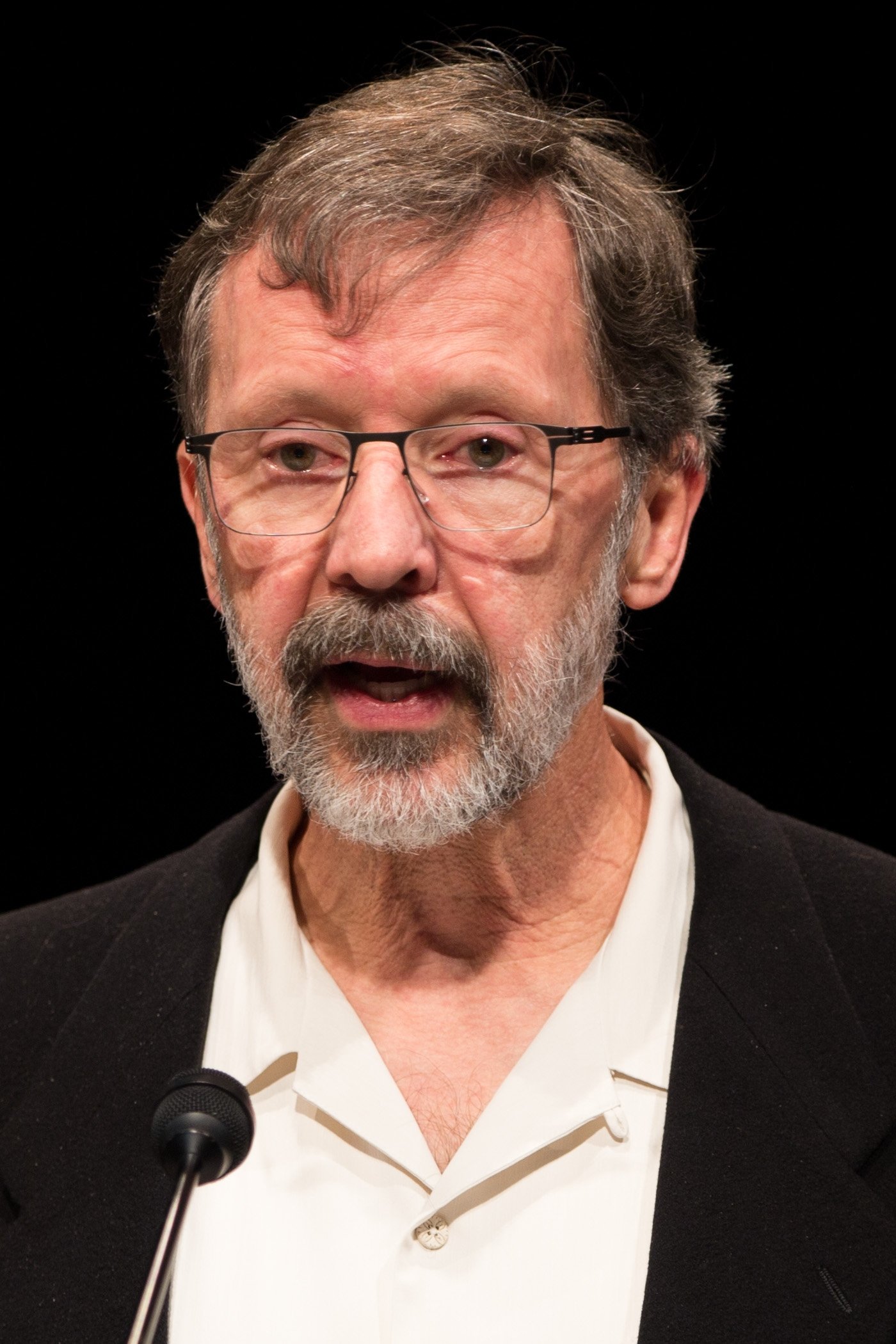
Profile via TMDB · Courtesy of TMDB
Edwin Catmull
Sign in to saveAlso known as Edwin Earl Catmull, Edwin E. Catmull, Ed Catmull
amerikanischer Informatiker
OverviewAI-generated
Edwin Catmull is an American computer scientist, engineer, and executive producer born in Parkersburg, West Virginia, in 1945. He has worked at the New York Institute of Technology, Industrial Light & Magic, Pixar, and Walt Disney Animation Studios. His professional focus includes computer graphics, and he has served as an executive producer and film director.
Catmull received the IEEE John von Neumann Medal, the ACM Fellow distinction, the Turing Award, and the Gordon E. Sawyer Award. He is a member of the National Academy of Engineering and the Association for Computing Machinery. He was educated at the University of Utah and speaks English.
He is the author of works including *Creativity, Inc.* and *HBR's 10 Must Reads on Creativity*. His archives are held at the Computer History Museum. Catmull has aphantasia.
Synthesized by Vinony from 22 facts across 4 sources: Wikidata, Open Library, TMDb, Vinony collections. Generated from structured data (not the Wikipedia text) and checked against those facts — may still contain errors.
Person · Open Library
- Works
- 9
Top works
- HBR's 10 Must Reads on Creativity (with Bonus Article How Pixar Fosters Collective Creativity by Ed Catmull)
- HBR's 10 Must Reads on Creativity
- Creativity, Inc
- Creatividad, S.A.
- Creativity, Inc.
via Open Library + Wikidata
Film & TV
Parkersburg, West Virginia, USA
Edwin Earl "Ed" Catmull (born March 31, 1945) is an American computer scientist who is the co-founder of Pixar and was the President of Walt Disney Animation Studios. He has been honored for his contributions to 3D computer graphics, including the 2019 ACM Turing Award.
Known for
- Inside The Works — Self2026
- LIGHT & MAGIC — Self - Computer Graphics2022
- LIGHT & MAGIC — Self - UC Berkeley, 1981 (archive footage)2022
- LIGHT & MAGIC — Self - Head of Lucasfilm Computer Division, 1979-19852022
- Toy Story at 20: To Infinity and Beyond — Self2015
- Pixar 25 Magic Moments — Self - President / Co-Founder2011
- Industrial Light & Magic: Creating the Impossible — Self2010
- Waking Sleeping Beauty — Self (archive footage)2009
- The Pixar Story — Self2007
- The Pixar Shorts: A Short History2007
via TMDB
Key facts
- Born
- Edwin Earl Catmull , ( 1945-03-31 ) March 31, 1945 (age 81) , Parkersburg, West Virginia , U.S.
- Education
- University of Utah ( BS , MS , PhD )
- Known for
- Texture mapping Catmull–Rom spline Catmull–Clark subdivision surface
- Spouse
- Susan Anderson
- Awards
- Academy Award (1993, 1996, 2001, 2008) IEEE John von Neumann Medal (2006) Computer History Museum Fellow (2013) ACM Turing Award (2019)
- Fields
- Computer science
- Institutions
- New York Institute of Technology Pixar Animation Studios Walt Disney Animation Studios
- Thesis
- A Subdivision Algorithm for Computer Display of Curved Surfaces (1974)
- Doctoral advisor
- Robert E. Stephenson
via Wikipedia infobox
Wikidata facts
- Instance of
- human
- Given name
- Edwin
- Gender
- male
- Citizenship
- United States
- Place of birth
- Parkersburg
- Occupation
- computer scientist
- Employer
- Industrial Light & Magic
- Languages spoken
- English language
- Field of work
- computer graphics
- Image
- VES Awards 89 cropped.jpg
Show 7 more facts
- date of birth
- 1945-03-31
- Commons category
- Ed Catmull
- member of
- Association for Computing Machinery
- streaming media URL
- www.computerhistory.org/collections/catalog/102746613
- archives at
- Computer History Museum
- medical condition
- aphantasia
- short name
- Ed Catmull
Sources (7)
via Wikidata · CC0
Article · Deutsch
Edwin „Ed“ Catmull (* 31. März 1945 in Parkersburg, West Virginia) ist ein amerikanischer Informatiker, der zu vielen wichtigen Entwicklungen in der Computergrafik beigetragen hat. Er ist vierfacher Oscar-Preisträger und erhielt im März 2020 zusammen mit Pat Hanrahan den Turing Award. Schon früh wurde Ed Catmull durch Disney-Filme wie Peter Pan und Pinocchio inspiriert und träumte davon, Animator für Spielfilme zu werden. Mit Blick auf die Realität entschied er, dass seine Talente anderswo liegen würden. Anstatt eine Karriere in der Filmindustrie anzustreben, schrieb er sich an der University of Utah für Physik und Informatik ein. Dort leistete er seine drei fundamentalen Beiträge zur Computergrafik: das Z-Buffering, das Texture Mapping und die B-Splines. Er entwickelte auch einen Algorithmus zum Antialiasing. Allerdings wurde der Z-Buffer bereits Monate zuvor von Wolfgang Straßer in seiner Dissertation beschrieben, ohne dass er dort diese Bezeichnung bekam. In einem frühen Beitrag für die Filmindustrie schuf er 1974 eine animierte Version seiner linken Hand für den Film Futureworld – Das Land von Übermorgen (1976), die Science-Fiction-Version des Films Westworld und der erste Film, der 3D-Computergrafik benutzte. Nach seiner Promotion arbeitete er für George Lucas bei Lucasfilm. Dort half er, das Digital Image Compositing zum Kombinieren mehrerer Bilder zu entwickeln. 1986 gründete Catmull zusammen mit Steve Jobs die Firma Pixar. Bei Pixar war Catmull ein Hauptentwickler des RenderMan-Rendering-Systems, das in Filmen wie Toy Story und Findet Nemo benutzt wurde. 1993 zeichnete die Academy of Motion Picture Arts and Sciences (AMPAS) Catmull mit seinem ersten Academy Award aus, „für die Entwicklung der RenderMan-Software, die aus dreidimensionalen Computerdaten Bilder mit Form und Gestalt erzeugt.“ 1996 erhielt er wieder einen Oscar, „für bahnbrechende Entwicklungen im Image Compositing“. 2001 erhielt er seine dritte Auszeichnung „für beachtliche Fortschritte im Bereich der Darstellung bewegter Bilder wie in Pixars RenderMan gezeigt.“ Im selben Jahr wurde er auch Präsident der Pixar Animation Studios. Nach der Übernahme des Pixar-Studios durch die Walt Disney Company wurde Catmull zusammen mit John Lasseter Präsident der Walt Disney Animation Studios, sowie dessen Tochterunternehmen DisneyToon Studios. 2006 wurde er zweimal ausgezeichnet: Für das Konzept der Subdivision Surfaces als Modellierungstechnik mit einem weiteren Oscar (Technical Achievement Award) und mit der John-von-Neumann-Medaille „für grundlegende Beiträge zur Computergrafik und eine Pionierrolle in der Verwendung von Computeranimationen in Spielfilmen“. Im Jahr 2009 wurde Catmull mit dem Gordon E. Sawyer Award der Academy of Motion Picture Arts and Sciences für sein Lebenswerk ausgezeichnet. 2013 wurde er Fellow des Computer History Museum. Für das Jahr 2019 bekam Catmull zusammen mit Pat Hanrahan im März 2020 den Turing Award für ihre Pionierarbeit an Computer Generated Imagery. Catmull ist Mormone.
Abstract from DBpedia / Wikipedia · CC BY-SA