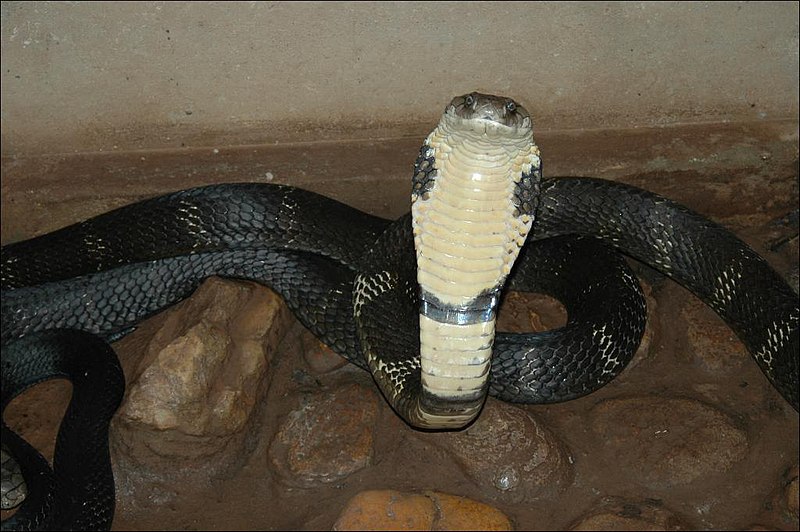
File:King-Cobra.jpg · Wikimedia Commons · See Wikimedia Commons
Elapidae
Sign in to saveAlso known as Elapid, Elapids
Elapidae (, commonly known as elapids , from , variant of "sea-fish") is a family of snakes characterized by their permanently erect fangs at the front of the mouth. Most elapids are venomous, with the exception of the genus Emydocephalus. Many members of this family exhibit a threat display of rearing upwards while spreading out a neck flap. Elapids are endemic to tropical and subtropical regions around the world, with terrestrial forms in Asia, Australia, Africa, and the Americas and marine forms in the Pacific and Indian Oceans. Members of the family have a wide range of sizes, from the whi
OverviewAI-generated
Elapidae is a family of snakes within the order Squamata and phylum Chordata. This taxon is classified as an accepted family in the kingdom Animalia. Its habitat includes marine, brackish, and freshwater environments. The group is also referred to as コブラ科.
Records indicate 296,847 occurrences and 732 iDigBio records from institutions such as USNM, ANWC, MADUG-UG, CMN, and SUI. These records originate from countries including the United States, Australia, Mexico, and Papua New Guinea. The family is the source of snake venom. It is referenced by 698 other encyclopedia articles and has a PubMed count of 2,577.
Synthesized by Vinony from 32 facts across 7 sources: Wikidata, GBIF, PubMed, Gbif Occ, WoRMS, iDigBio, Vinony graph. Generated from structured data (not the Wikipedia text) and checked against those facts — may still contain errors.
Species
コブラ科
Elapidae
FAMILY
- KingdomAnimalia
- PhylumChordata
- ClassSquamata
- OrderSquamata
- FamilyElapidae
眼镜蛇科(学名Elapidae)又名蝙蝠蛇科,客家話稱之為嘭頭蛇,此科的成员皆为剧毒蛇类,主要栖息于热带或亚热带地区,包括亚洲、非洲、美洲、澳大利亚等地,当中包括眼镜蛇属、眼鏡王蛇屬、曼巴蛇属、环蛇属、太攀蛇属、虎蛇屬、珊瑚蛇等著名的成员。目前已有约61属包括325个物种被确认。
via GBIF
Museum specimens
- Specimen records
- 732
- With media
- 1
- Family
- Elapidae
- Collections
- USNM, ANWC, MADUG-UG, CMN, SUI, MSUM
- Recorded in
- United States, Australia, Mexico, Papua New Guinea, Unknown Or Invalid, Canada, India, South Africa
Research
2,577 papers- Molecular phylogeny reveals distinct evolutionary lineages of the banded krait, Bungarus fasciatus (Squamata, Elapidae) in Asia.ReviewScientific reports · 2023Biakzuala L, Lalremsanga HT, Santra V et al.DOI: 10.1038/s41598-023-28241-8
- A Review of the Proteomic Profiling of African Viperidae and Elapidae Snake Venoms and Their Antivenom Neutralisation.ReviewToxins · 2022Offor BC, Muller B, Piater LADOI: 10.3390/toxins14110723
- Bites, bugs, and blood.Wilderness & environmental medicine · 2015McIntosh SE, Cushing TA, Keyes LE et al.DOI: 10.1016/j.wem.2015.03.026
- Molecular evolution of toxin genes in Elapidae snakes.ReviewMolecular diversity · 2006Tamiya T, Fujimi TJDOI: 10.1007/s11030-006-9049-x
- Sexual dimorphism in skull size and shape of Laticauda colubrina (Serpentes: Elapidae).PeerJ · 2023Borczyk BDOI: 10.7717/peerj.16266
- Systematics of Calliophis intestinalis with the Resurrection of Calliophis nigrotaeniatus (Elapidae, Serpentes).Zoological science · 2020Fukuyama I, Vogel G, Matsui M et al.DOI: 10.2108/zs200100
- [Venomous and poisonous animals. III. Elapidae snake envenomation].ReviewMedecine tropicale : revue du Corps de sante colonial · 2007Chippaux JP
- Proteomic characteristics of six snake venoms from the Viperidae and Elapidae families in China and their relation to local tissue necrosis.Toxicon : official journal of the International Society on Toxinology · 2023Qin WG, Zhuo ZP, Hu H et al.DOI: 10.1016/j.toxicon.2023.107317
via PubMed
Wikidata facts
- Instance of
- taxon
- Image
- 12 - The Mystical King Cobra and Coffee Forests.jpg
Show 5 more facts
- Commons category
- Elapidae
- taxon name
- Elapidae
- taxon rank
- family
- Commons gallery
- Elapidae
- this taxon is source of
- snake venom
via Wikidata · CC0
~19 min read
Encyclopedic overview
12 sectionsContents
- Description
- Dentition
- Behavior
- Distribution
- Venom
- Taxonomy
- Conservation
- See also
- Explanatory notes
- References
- Further reading
- External links
Elapidae (, commonly known as elapids , from , variant of "sea-fish") is a family of snakes characterized by their permanently erect fangs at the front of the mouth. Most elapids are venomous, with the exception of the genus Emydocephalus. Many members of this family exhibit a threat display of rearing upwards while spreading out a neck flap. Elapids are endemic to tropical and subtropical regions around the world, with terrestrial forms in Asia, Australia, Africa, and the Americas and marine forms in the Pacific and Indian Oceans. Members of the family have a wide range of sizes, from the white-lipped snake to the king cobra. Most species have neurotoxic venom that is channeled by their hollow fangs, and some may contain other toxic components in varying proportions. The family includes 55 genera with around 360 species and over 170 subspecies.
==Description== Terrestrial elapids look similar to the Colubridae; almost all have long, slender bodies with smooth scales, a head covered with large shields (and not always distinct from the neck), and eyes with rounded pupils. Also like colubrids, their behavior is usually quite active and fast, with most of the females being oviparous (egg-layers). Exceptions to these generalizations occur; for example, death adders (Acanthophis) have commonalities with the Viperidae family, such as shorter, stout bodies, rough/keeled scales, broad heads, cat-like pupils and ovoviviparous (internal hatchings with live births). Furthermore, they can also be sluggish, ambush predators with partially fragmented head shields, similar to rattlesnakes or Gaboon vipers.
Excerpted from Wikipedia’s “Elapidae” article, available under the CC BY-SA 4.0 licence.
Gallery (11)
Available in 70 languages
- Español
- Français
- Deutsch
- 中文
- 日本語
- Русский
- Português
- Italiano
- العربية
- हिन्दी
- Afrikaans
- Armenian
- azb
- Azerbaijani
- Bahasa Indonesia
- Bangla
- Basque
- be_x_old
Show 51 more
- Belarusian
- Bulgarian
- Catalan
- Cebuano
- Croatian
- Czech
- Danish
- Egyptian Arabic
- Esperanto
- Estonian
- Filipino
- Finnish
- Galician
- Georgian
- Hebrew
- Hungarian
- Icelandic
- Kannada
- Kazakh
- Kurdish
- Latin
- Latvian
- Lithuanian
- Malay
- Navajo
- Nederlands
- Northern Frisian
- Norwegian
- Ossetic
- Polski
- Romanian
- Scots
- Serbian
- simple
- Slovak
- Slovenian
- Svenska
- Tajik
- Tatar
- Tiếng Việt
- Türkçe
- Ukrainian
- Urdu
- Uzbek
- Waray
- Western Panjabi
- Wu Chinese
- zh_yue
- فارسی
- ไทย
- 한국어
via Wikidata sitelinks · CC0