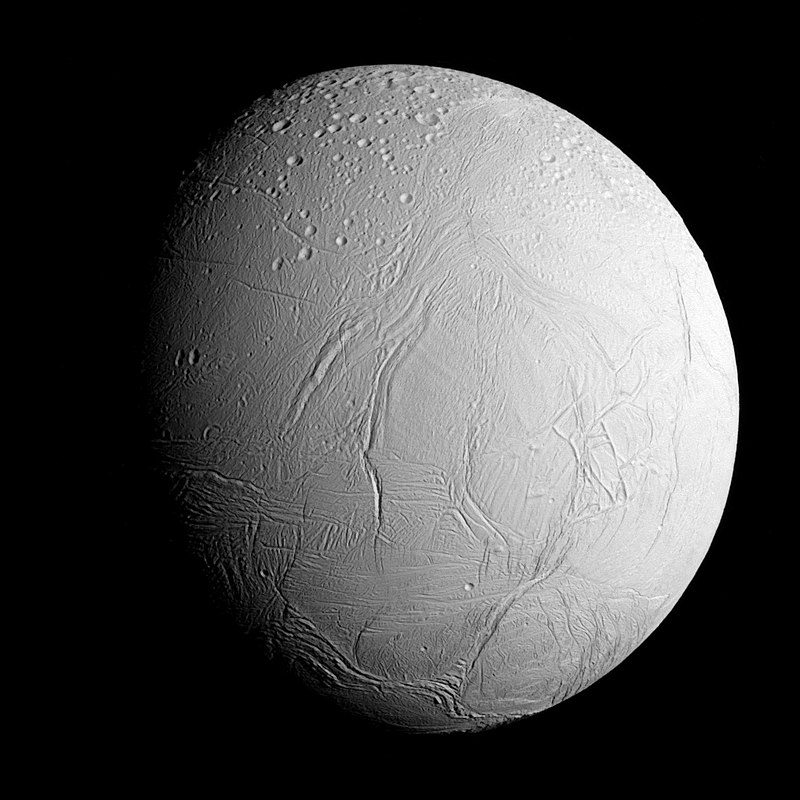
File:PIA17202_-_Approaching_Enceladus.jpg · Wikimedia Commons · See Wikimedia Commons
Enceladus
Sign in to saveAlso known as Saturn II, Enceladus (moon)
Enceladus is the sixth-largest moon of Saturn and the 18th largest in the Solar System. It is about in diameter, about a tenth of that of Saturn's largest moon, Titan. It is covered by clean, freshly deposited snow hundreds of meters thick, making it one of the most reflective bodies of the Solar System. Consequently, its surface temperature at noon reaches only , far colder than a light-absorbing body would be. Despite its small size, Enceladus has a wide variety of surface features, ranging from old, heavily cratered regions to young, tectonically deformed terrain.
Enceladus is a small moon of Saturn covered in thick, highly reflective snow that makes it one of the brightest objects in our solar system and keeps its surface extremely cold. Scientists find it interesting because despite its modest size, it displays a surprisingly diverse range of surface features, from ancient cratered regions to younger, tectonically active terrain.
AI-generated from the Wikipedia summary — may contain errors.
Key facts
- Planet.name
- Enceladus
- Planet.mpc_name
- Saturn II
- Planet.named_after
- Ἐγκέλαδος Enkélados
- Planet.adjectives
- Enceladean
- Planet.image
- PIA17202 - Approaching Enceladus.jpg
- Planet.caption
- Enceladus imaged by the Cassini orbiter, October 2015
- Planet.note
- yes
- Planet.background
- Thistle
- Planet.discoverer
- William Herschel
- Planet.discovered
- August 28, 1789
- Planet.periapsis
- km
- Planet.apoapsis
- km
- Planet.inclination
- 0.009° (to Saturn's equator)
- Planet.satellite_of
- Saturn
- Planet.dimensions
- 513.2 × 502.8 × 496.6 km
- Planet.mean_radius
- ( Earths, Moons)
- Planet.mass
- (1.8 Earths)
- Planet.surface_grav
- (0.0116 g)
via Wikipedia infobox
Wikidata facts
- Instance of
- regular moon
- Named after
- Enceladus
- Parent body
- Saturn
- Radius
- 252.1
- Mass
- 108043390000000000000
- Orbital period
- 1.370
- Image
- PIA17202 - Approaching Enceladus.jpg
- Connects with
- E Ring
Show 14 more facts
- Commons category
- Enceladus
- apparent magnitude
- 11.8
- orbital eccentricity
- 0.0047
- discoverer or inventor
- William Herschel
- time of discovery or invention
- 1789-08-28
- topic's main category
- Category:Enceladus
- Commons gallery
- Enceladus
- semi-major axis of an orbit
- 237948
- category for maps or plans
- Category:Surface features of Enceladus
- orbital inclination
- 0.009
- volume as quantity
- 1.370218
- albedo
- 1.3750
- temperature
- 145
- on focus list of Wikimedia project
- Wikipedia:Vital articles/Level/4
Sources (7)
via Wikidata · CC0
~52 min read
Encyclopedic overview
37 sectionsContents
- History
- Discovery
- Naming
- Orbit and rotation
- Source of the E ring
- Physical characteristics
- Shape and size
- Internal structure
- Subsurface ocean
- Composition
- Possible heat sources
- Tidal heating
- Radioactive heating
- Chemical factors
- Surface features
- Snow
- Impact craters
- Tectonic features
- Smooth plains
- South polar region
- South polar plumes
- Origin
- Mimas–Enceladus paradox
- Proto-Enceladus hypothesis
- Date of formation
- Potential habitability
- Hydrothermal vents
- Exploration
- ''Voyager'' missions
- ''Cassini''
- Proposed mission concepts
- See also
- References
- Informational notes
- Citations
- Further reading
- External links
Enceladus is the sixth-largest moon of Saturn and the 18th largest in the Solar System. It is about in diameter, about a tenth of that of Saturn's largest moon, Titan. It is covered by clean, freshly deposited snow hundreds of meters thick, making it one of the most reflective bodies of the Solar System. Consequently, its surface temperature at noon reaches only , far colder than a light-absorbing body would be. Despite its small size, Enceladus has a wide variety of surface features, ranging from old, heavily cratered regions to young, tectonically deformed terrain.
Enceladus was discovered on August 28, 1789, by William Herschel, but little was known about it until the two Voyager spacecrafts, Voyager 1 and Voyager 2, flew by Saturn in 1980 and 1981. In 2005, the spacecraft Cassini started multiple close flybys of Enceladus, revealing its surface and environment in greater detail. In particular, Cassini discovered water-rich plumes venting from the south polar region. Cryovolcanoes near the south pole shoot geyser-like jets of water vapour, molecular hydrogen, other volatiles, and solid material, including sodium chloride crystals and ice particles, into space, totalling about per second. More than 100 geysers have been identified. Some of the water vapour falls back as snow, now several hundred metres thick; the rest escapes and supplies most of the material making up Saturn's E ring. According to NASA scientists, the plumes are similar in composition to comets. In 2014, NASA reported that Cassini had found evidence for a large south polar subsurface ocean of liquid water with a thickness of around . The existence of Enceladus's subsurface ocean has since been mathematically modelled and replicated.
Excerpted from Wikipedia’s “Enceladus” article, available under the CC BY-SA 4.0 licence.
Gallery (44)
Available in 91 languages
- Español
- Français
- Deutsch
- 中文
- 日本語
- Русский
- Português
- Italiano
- العربية
- हिन्दी
- Afrikaans
- Albanian
- Aragonese
- Armenian
- azb
- Azerbaijani
- Bahasa Indonesia
- Bashkir
Show 72 more
- Basque
- Belarusian
- Bosnian
- Bulgarian
- Burmese
- Catalan
- cdo
- Central Kurdish
- Chuvash
- Corsican
- Croatian
- Czech
- Danish
- Esperanto
- Estonian
- Fiji Hindi
- Filipino
- Finnish
- Galician
- Georgian
- Greek
- Hebrew
- Hungarian
- Ido
- Irish
- Javanese
- Kazakh
- Komi
- Latin
- Latvian
- Lithuanian
- Lombard
- Luxembourgish
- Macedonian
- Malay
- Malayalam
- Manx
- Marathi
- Mirandese
- Mongolian
- Nederlands
- Norwegian
- Norwegian Nynorsk
- Occitan
- Polski
- Romanian
- Serbian
- Serbian (Latin)
- Sicilian
- simple
- Slovak
- Slovenian
- Sranan Tongo
- Svenska
- Tamil
- Tatar
- Tiếng Việt
- Toki Pona
- Türkçe
- Ukrainian
- Urdu
- Uzbek
- Waray
- Welsh
- Western Panjabi
- Wu Chinese
- zh_classical
- zh_min_nan
- zh_yue
- فارسی
- ไทย
- 한국어
via Wikidata sitelinks · CC0