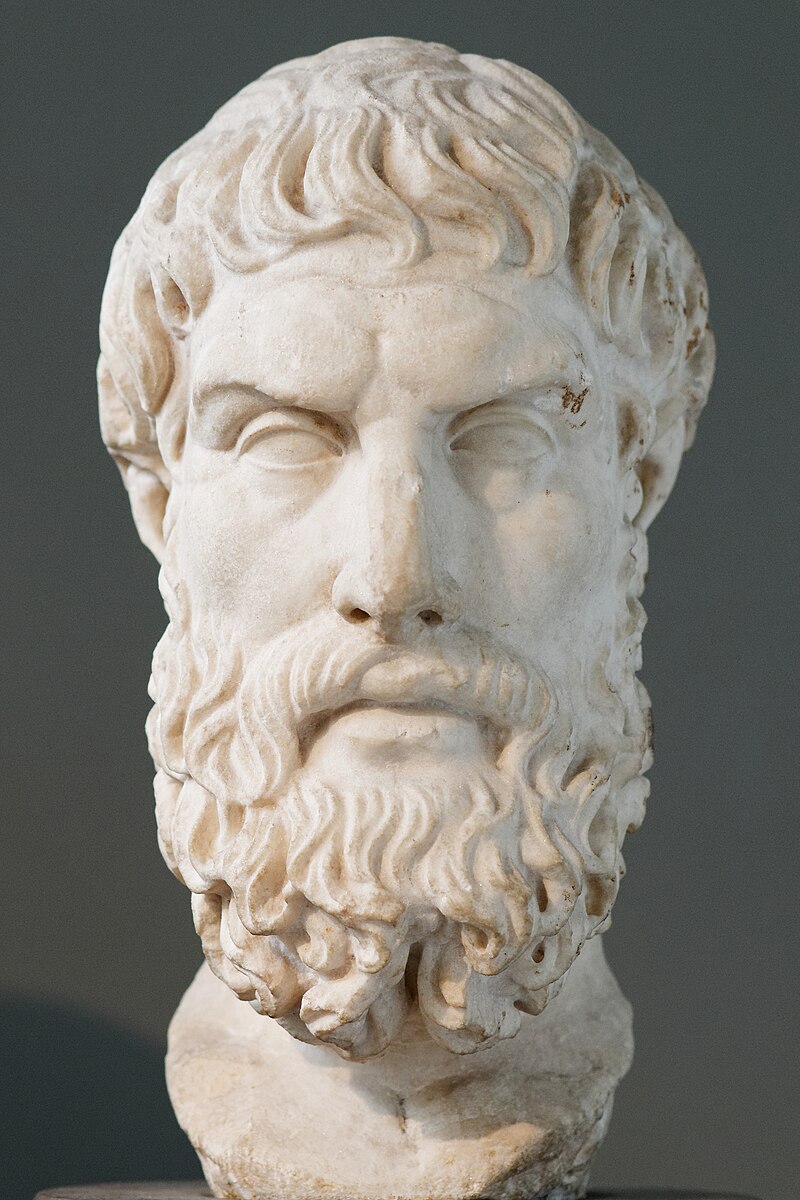
File:Epikouros_BM_1843.jpg · Wikimedia Commons · See Wikimedia Commons
Epicurus
Sign in to saveAlso known as Epíkouros, Epikouros
Epicurus (, ; ; 341–270 BC) was an ancient Greek philosopher who founded Epicureanism, a highly influential school of philosophy; it asserted that philosophy's purpose is to attain as well as to help others attain tranquil lives, characterized by freedom from fear and the absence of pain.
OverviewAI-generated
Epicurus (Ἐπίκουρος) was a male philosopher and writer of Classical Athens who lived during the Hellenistic period. He was a student of Nausiphanes and was influenced by Aristippus, Democritus, and Pyrrho. He founded the movement known as Epicureanism and wrote in Ancient Greek. His notable works include *Epicvrvs' morals*, *Physica et meteorologica duabus epistolis eiusdem comprehensa Graeca emendavit atque interpretatus est J. G. Schneider*, *Frammenti inediti della Etica di Epicuro*, *Fragmente*, and *Kyriai doxai*.
He was a member of the deme Gargettos and practiced the Ancient Greek religion. Epicurus had students including Hermarchus, Polyaenus of Lampsacus, Leonteus of Lampsacus, and Themista of Lampsacus. He died in 270 BCE in Athens from kidney stone disease. He was buried in Athens.
Synthesized by Vinony from 27 facts across 3 sources: Wikidata, Open Library, Europeana Sparql. Generated from structured data (not the Wikipedia text) and checked against those facts — may still contain errors.
Person · Open Library
- Born
- 341 BC
- Died
- 270 BC
- Works
- 80
Top works
- Epicvrvs' morals
- Physica et meteorologica duabus epistolis eiusdem comprehensa Graeca emendavit atque interpretatus est J. G. Schneider
- Frammenti inediti della Etica di Epicuro
- Fragmente
- Kyriai doxai
via Open Library + Wikidata
Key facts
- Philosopher.name
- Epicurus
- Philosopher.image
- Epikouros BM 1843.jpg
- Philosopher.caption
- Roman marble bust of Epicurus
- Philosopher.region
- Western philosophy
- Philosopher.birth_date
- February 341 BC
- Philosopher.birth_place
- Samos, Greece
- Philosopher.death_date
- 270 BC (aged about 72)
- Philosopher.death_place
- Athens, Greece
- Philosopher.era
- Hellenistic philosophy
- Philosopher.school_tradition
- Epicureanism
- Philosopher.notable_ideas
- Attributed:
via Wikipedia infobox
Wikidata facts
- Instance of
- human
- Gender
- male
- Citizenship
- Classical Athens
- Place of death
- Athens
- Occupation
- writer
- Languages spoken
- Ancient Greek
- Religion
- Ancient Greek religion
- Student of
- Nausiphanes
- Field of work
- philosophy
- Movement
- Epicureanism
- Image
- Epikouros BM 1843.jpg
- Work location
- Classical Athens
- Residence
- Gargettos
Show 17 more facts
- Commons category
- Epicurus
- date of birth
- 0341-00-00
- date of death
- 0270-00-00
- Commons gallery
- Epicurus
- influenced by
- Pyrrho
- topic's main category
- Category:Epicurus
- time period
- Hellenistic period
- member of the deme
- Gargettos
- name in native language
- Ἐπίκουρος
- manner of death
- natural causes
- cause of death
- kidney stone disease
- writing language
- Ancient Greek
- place of burial
- Athens
- on focus list of Wikimedia project
- Wikipedia:Vital articles/Level/4
- P8168
- Cayman
- maintained by WikiProject
- WikiProject Mathematics
- significant place
- Gargettos
via Wikidata · CC0
Works in European collections
18 objects attributed to Epicurus, held across European museums, libraries & archives · via Europeana

La morale d'Epicure
La Morale d'Épicure, avec des reflexions

Barátság

Philosophia Epicurea
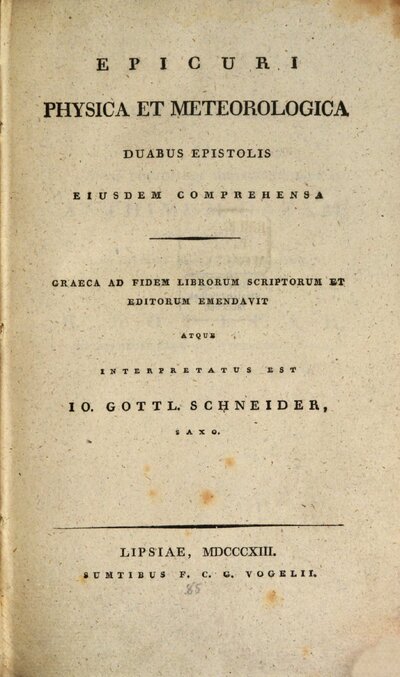
Physica et meteorologica

Epicvri Philosophia, 3. Philosophiae Epicvri Pars Tertia, Qvae Est Ethica, Seu De Moribvs

Philosophia Epicurea

Epicuri ab H. Usenero recogniti specimen

Epicvri Philosophia, 2. Epicvri Meteorologia, Hoc Est, Illa Physicae Pars, Qvae Est De Rebvs Sublime Visis
Untitled

Untitled

Untitled

Untitled

Untitled
Untitled

Untitled
Untitled
Untitled
~58 min read
Encyclopedic overview
49 sectionsContents
- Life
- Upbringing and influences
- Teaching career
- Death
- Philosophy
- Physics
- Epistemology
- Criteria of truth
- Principle of Multiple Explanations
- Epilogism
- Ethics
- Politics
- Theology
- Epicurean paradox<!--'Epicurean paradox', 'Riddle of Epicurus', and 'Epicurus' trilemma' redirect here-->
- Death
- Works
- ''On Nature''
- ''Canon''
- ''Principal Doctrines''
- Tetrapharmakos
- Letters of Epicurus
- ''Letter to Herodotus''
- ''Letter to Pythocles''
- ''Letter to Menoeceus''
- ''Letter to Mother''
- ''Vatican Sayings''
- Legacy
- Ancient Epicureanism
- Middle Ages
- Renaissance
- Revival
- Modern
- References
- Bibliography
- Primary source texts
- Philodemus
- Lucretius
- Aetius
- Plutarch
- Lucian of Samosata
- Diogenes of Oenoanda
- Sextus Empiricus
- Diogenes Laërtius
- Lactantius
- Epicurea
- Modern compilations
- Sources
- Further reading
- External links
Epicurus (, ; ; 341–270 BC) was an ancient Greek philosopher who founded Epicureanism, a highly influential school of philosophy; it asserted that philosophy's purpose is to attain as well as to help others attain tranquil lives, characterized by freedom from fear and the absence of pain.
Epicurus advocated that people were best able to pursue philosophy by living a self-sufficient life surrounded by friends; he and his followers were known for eating simple meals and discussing a wide range of philosophical subjects at "The Garden", the school he established in Athens. Epicurus taught that although the gods exist, they have no involvement in human affairs. Like the earlier philosopher Democritus, Epicurus claimed that all occurrences in the natural world are ultimately the result of tiny, invisible particles known as atoms moving and interacting in empty space, though Epicurus also deviated from Democritus by proposing the idea of atomic "swerve", which holds that atoms may deviate from their expected course, thus permitting humans to possess free will in an otherwise deterministic universe.
Excerpted from Wikipedia’s “Epicurus” article, available under the CC BY-SA 4.0 licence.
Gallery (38)
Available in 99 languages
- Español
- Français
- Deutsch
- 中文
- 日本語
- Русский
- Português
- Italiano
- العربية
- हिन्दी
- Afrikaans
- Albanian
- Aragonese
- Armenian
- Asturian
- Azerbaijani
- Bahasa Indonesia
- Bangla
Show 80 more
- Bashkir
- Basque
- Belarusian
- Bosnian
- Breton
- Bulgarian
- Burmese
- Catalan
- Central Kurdish
- Chuvash
- Croatian
- Czech
- Danish
- Egyptian Arabic
- Esperanto
- Estonian
- Filipino
- Finnish
- Galician
- Georgian
- Greek
- Hebrew
- Hungarian
- hyw
- Icelandic
- Ido
- Irish
- Javanese
- Kabyle
- Kazakh
- Kyrgyz
- Latin
- Latvian
- Lingua Franca Nova
- Lithuanian
- Macedonian
- Malagasy
- Malay
- Malayalam
- Mazanderani
- Mingrelian
- Nederlands
- Newari
- Nias
- Norwegian
- Occitan
- Pampanga
- Pashto
- Piedmontese
- Polski
- Punjabi
- Romanian
- Sardinian
- Scots
- Scottish Gaelic
- Serbian
- Serbian (Latin)
- Sicilian
- simple
- Slovak
- Slovenian
- Standard Moroccan Tamazight
- Svenska
- Swahili
- Tamil
- Tatar
- Tiếng Việt
- Türkçe
- Ukrainian
- Urdu
- Uzbek
- Volapük
- Walloon
- Waray
- Western Panjabi
- Wu Chinese
- zh_min_nan
- zh_yue
- فارسی
- 한국어
via Wikidata sitelinks · CC0