File:Stem-histology-cross-section-tag.svg · Wikimedia Commons · See Wikimedia Commons
epidermis
Sign in to saveoutermost single layer of cells in plants. the outer protective layer of cells of a plant, which may be thickened by a cuticle
Research
69,072 papers- The skin barrier: Epidermis vs environment.Experimental dermatology · 2018
- Beyond being innervated: the epidermis actively shapes sensory dendritic patterning.Open biology · 2019
- The human epidermis.The Proceedings of the Nutrition Society · 1995
- Retinoids and the epidermis.Biochemical Society transactions · 1988
- Origin of the epidermis in parasitic platyhelminths.International journal for parasitology · 1997
via PubMed
Wikidata facts
- Has part
- stomata
Show 3 more facts
- Commons category
- Plant epidermis
- different from
- epidermis
- on focus list of Wikimedia project
- Wikipedia:Vital articles/Level/4
Sources (2)
via Wikidata · CC0
~10 min read
Encyclopedic overview
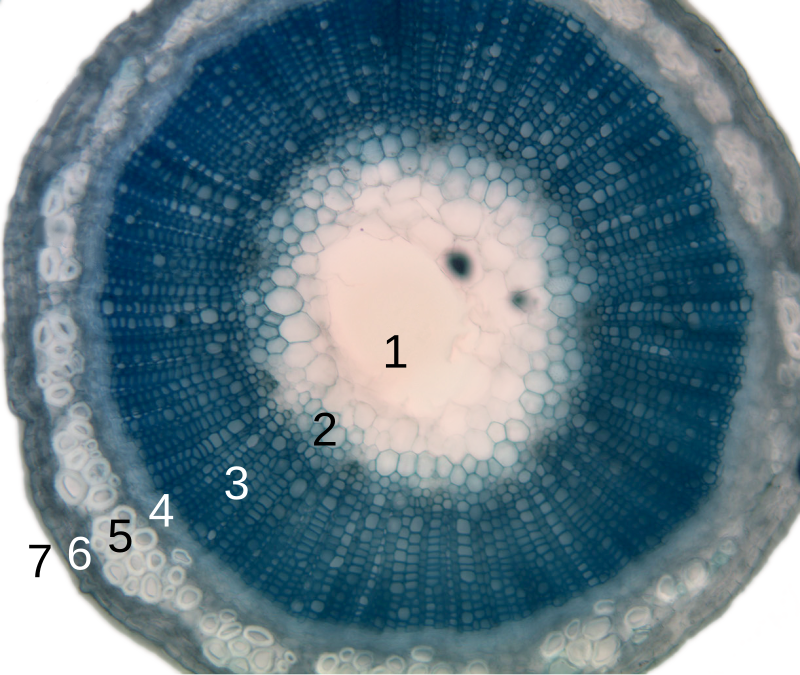
Cross-section of a flax plant stem: pith protoxylem xylem phloem sclerenchyma (bast fibre) cortex epidermis
The epidermis (from the Greek ἐπιδερμίς, meaning "over-skin") is a single layer of cells that covers the leaves, flowers, roots and stems of plants. It forms a boundary between the plant and the external environment. The epidermis serves several functions: it protects against water loss, regulates gas exchange, secretes metabolic compounds, and (especially in roots) absorbs water and mineral nutrients. The epidermis of most leaves shows dorsoventral anatomy: the upper (adaxial) and lower (abaxial) surfaces have somewhat different construction and may serve different functions. Woody stems and some other stem structures such as potato tubers produce a secondary covering called the periderm that replaces the epidermis as the protective covering.
Excerpted from Wikipedia’s “epidermis” article, available under the CC BY-SA 4.0 licence.