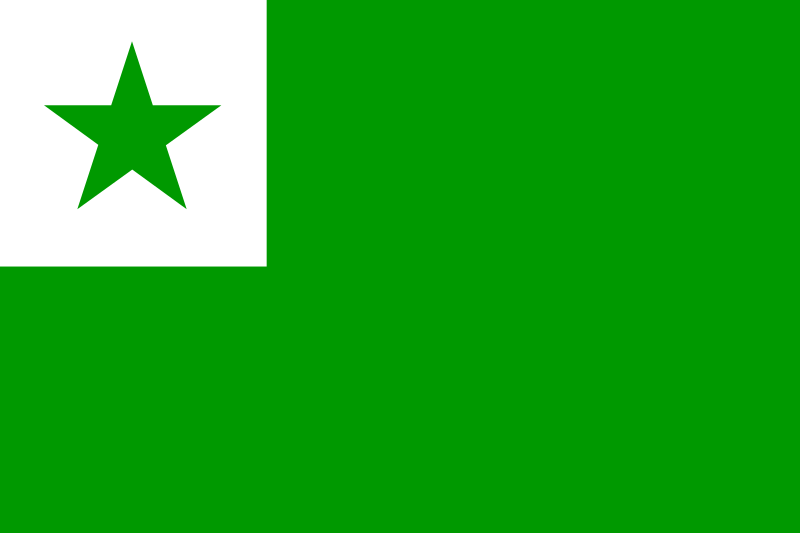
File:Flag_of_Esperanto.svg · Wikimedia Commons · See Wikimedia Commons
AI overview
Esperanto is an artificial language created in 1887 by L. L. Zamenhof to serve as a universal second language that would help people from different countries communicate with each other. Though it never achieved widespread adoption globally, it remains the most widely spoken constructed auxiliary language in the world and has maintained a community of speakers and enthusiasts since its creation.
AI-generated from the Wikipedia summary — may contain errors.
Key facts
- Language.name
- Esperanto
- Language.states
- 120 countries; nowhere an official language
- Language.speakers
- Native:
- Language.date
- 2022
- Language.speakers2
- L2: estimated 30,000 to 2 million Sidney Culbert: Around 2 million Amri Wandel: Above 2 million Svend Vendelbo: 30,000–180,000
- Language.familycolor
- Constructed language
- Language.fam1
- Constructed language
- Language.fam2
- International auxiliary language
- Language.fam3
- A posteriori language
- Language.ancestor
- Proto-Esperanto
- Language.creator
- L. L. Zamenhof
- Language.created
- 1887
- Language.setting
- International: most parts of the world
- Language.posteriori
- Primarily Romance and Germanic languages, with some influence of Slavic, and Greek
- Language.script
- Latin script (Esperanto alphabet)Esperanto Braille
- Language.agency
- Akademio de Esperanto
- Language.iso1
- eo
- Language.iso2
- epo
via Wikipedia infobox
Wikidata facts
- Instance of
- modern language
- Country
- Esperantujo
- Anthem
- La Espero
- Country of origin
- Russian Empire
- Follows
- Proto-Esperanto
- Movement
- Esperanto movement
- Creator
- L. L. Zamenhof
- Image
- Flag of Esperanto.svg
- Flag
- Esperanto flag
- Has use
- second language
Show 41 more facts
- topic's main Wikimedia portal
- Portal:Esperanto
- number of speakers, writers, or signers
- 60000
- hashtag
- Esperanto
- language regulatory body
- Academy of Esperanto
- native label
- Esperanto
- discoverer or inventor
- L. L. Zamenhof
- influenced by
- French
- inception
- 1887-07-26
- history of topic
- history of Esperanto
- has tense
- future tense
- on focus list of Wikimedia project
- Wikipedia:List of articles all languages should have
- Stack Exchange site URL
- esperanto.stackexchange.com
- IRC channel URL
- irc://irc.freenode.net/esperanto
- topic's main category
- Category:Esperanto
- linguistic typology
- subject–verb–object
- category for films in this language
- Category:Esperanto-language films
- Commons category
- Esperanto
- studied by
- interlinguistics
- writing system
- Esperanto Braille
- has grammatical case
- nominative case
- Wikimedia language code
- eo
- used by
- Esperantist
- dedicated heritage entity
- Nacia Esperanto-Muzeo, Gray
- uses capitalization for
- toponym
- signed form
- Signuno
- P10369
- Wales
- topic has template
- Template:Eo icon
- P11012
- television
- Stack Exchange tag
- tex.stackexchange.com/tags/esperanto
- described at URL
- inthelandofinventedlanguages.com/index.php?page=languages&id=83
- social media followers
- 27674
- practiced by
- Esperantist
- foundational text
- Unua Libro
- location of formation
- Warsaw
- culture
- Esperanto culture
- has grammatical number
- plural
- category for music in this language
- Category:Esperanto-language music
- female form of label
- la langue espéranto
- NCI Thesaurus ID
- C210835
Sources (15)
via Wikidata · CC0
Gallery (34)
On the map
Available in 218 languages
- Español
- Français
- Deutsch
- 中文
- 日本語
- Русский
- Português
- Italiano
- العربية
- हिन्दी
- Abkhazian
- abstract
- Adyghe
- Afrikaans
- Albanian
- Albanian
- Amharic
- Angika
Show 199 more
- Aragonese
- Armenian
- Arpitan
- Asturian
- Aymara
- azb
- Azerbaijani
- Bahasa Indonesia
- Bambara
- Bangla
- Bashkir
- Basque
- bat_smg
- Bavarian
- be_x_old
- Belarusian
- Betawi
- Bikol
- Bosnian
- Breton
- Bulgarian
- Buriat
- Burmese
- Catalan
- cbk_zam
- cdo
- Cebuano
- Central Kurdish
- Chechen
- Church Slavic
- Chuvash
- Colognian
- Cornish
- Crimean Tatar
- Croatian
- Czech
- Danish
- Egyptian Arabic
- eml
- Erzya
- Esperanto
- Estonian
- Faroese
- Fiji Hindi
- Filipino
- Finnish
- fiu_vro
- Fula
- Galician
- Georgian
- Gothic
- Greek
- Guarani
- Haitian Creole
- Hakka Chinese
- Hausa
- Hawaiian
- Hebrew
- Hungarian
- Icelandic
- Ido
- Iloko
- Interlingua
- Interlingue
- Inupiaq
- Irish
- Javanese
- Kalmyk
- Kannada
- Kanuri
- Kara-Kalpak
- Kashubian
- Kazakh
- kbp
- kge
- Kikuyu
- Kinyarwanda
- Komi
- Kotava
- Kurdish
- Kyrgyz
- Ladino
- Latgalian
- Latin
- Latvian
- Lezghian
- Ligurian
- Limburgish
- Lingala
- Lingua Franca Nova
- Lithuanian
- Lojban
- Lombard
- Low German
- Lower Sorbian
- Luxembourgish
- Macedonian
- Malagasy
- Malay
- Malayalam
- Maltese
- Manipuri
- Marathi
- Mazanderani
- Minangkabau
- Mingrelian
- Mirandese
- Moksha
- Mongolian
- Moroccan Arabic
- nds_nl
- Neapolitan
- Nederlands
- Nepali
- Newari
- Northern Frisian
- Northern Sami
- Norwegian
- Norwegian Nynorsk
- Novial
- nrm
- Occitan
- Old English
- olo
- Ossetic
- Palatine German
- Papiamento
- Pashto
- Picard
- Piedmontese
- Polski
- Punjabi
- Quechua
- Romanian
- Romansh
- Rundi
- Rusyn
- Sanskrit
- Santali
- Sardinian
- Saterland Frisian
- Scots
- Scottish Gaelic
- Serbian
- Serbian (Latin)
- Shona
- Sicilian
- Silesian
- simple
- Sinhala
- Slovak
- Slovenian
- Somali
- South Ndebele
- Southern Altai
- Sundanese
- Svenska
- Swahili
- Swati
- Tajik
- Tamil
- Tatar
- Telugu
- Tiếng Việt
- Tok Pisin
- Toki Pona
- Türkçe
- Udmurt
- Ukrainian
- Upper Sorbian
- Urdu
- Uyghur
- Uzbek
- Venetian
- Veps
- Volapük
- Walloon
- Waray
- Welsh
- West Flemish
- Western Frisian
- Western Panjabi
- wikifunctions
- Wolof
- Wu Chinese
- Xhosa
- Yakut
- Yiddish
- Yoruba
- Zaza
- Zeelandic
- zh_classical
- zh_min_nan
- zh_yue
- Zhuang
- Zulu
- فارسی
- ไทย
- 한국어
via Wikidata sitelinks · CC0