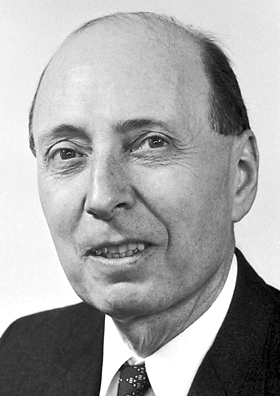
File:Wigner.jpg · Wikimedia Commons · See Wikimedia Commons
Eugene Wigner
Sign in to saveAlso known as Eugene Paul Wigner, P.E. Wigner
Hungarian-American physicist and mathematician (1902–1995)
OverviewAI-generated
Eugene Wigner was born on 1902-11-17 and died on 1995-01-01. He held an Erdős number of 3.
Wigner received one Nobel Prize. His work is recognized in several collections, including the Royal Society collection, the Nobel Laureates collection, the Nobel Physics collection, the American Academy Arts Sciences collection, and the National Medal Of Science collection.
Synthesized by Vinony from 10 facts across 3 sources: Wikidata, Nobel Prize, Vinony collections. Generated from structured data (not the Wikipedia text) and checked against those facts — may still contain errors.
Nobel Prize
- The Nobel Prize in Physics1963
“for his contributions to the theory of the atomic nucleus and the elementary particles, particularly through the discovery and application of fundamental symmetry principles”
Shared · 1/2 portion
Wikidata facts
- Instance of
- human
- Part of
- The Martians
- Given name
- Pál
- Gender
- male
- Citizenship
- United States
- Place of birth
- Budapest
- Place of death
- Princeton
- Occupation
- nuclear physicist
- Educated at
- Technische Universität Berlin
- Employer
- Oak Ridge National Laboratory
- Languages spoken
- Hungarian
- Native language
- Hungarian
- Notable work
- Wigner's theorem
- Participant in
- Manhattan Project
- Doctoral advisor
- Michael Polanyi
- Student of
- László Rátz
- Doctoral student
- Frederick Seitz
- Field of work
- physics
- Image
- Wigner.jpg
Show 14 more facts
- Commons category
- Eugene Wigner
- date of birth
- 1902-11-17
- date of death
- 1995-01-01
- Erdős number
- 3
- nominated for
- Nobel Prize in Physics
- manner of death
- natural causes
- ethnic group
- Jewish people
- cause of death
- pneumonia
- relative
- Gabriel Andrew Dirac
- name in native language
- Wigner Jenő Pál
- on focus list of Wikimedia project
- Wikipedia:Vital articles/Level/4
- maintained by WikiProject
- WikiProject Mathematics
- interested in
- physics
Sources (12)
via Wikidata · CC0
~26 min read
Encyclopedic overview
Eugene Paul Wigner (Hungarian: Wigner Jenő Pál, pronounced [ˈviɡnɛr ˈjɛnøː ˈpaːl]; November 17, 1902 – January 1, 1995) was a Hungarian-American theoretical physicist who also contributed to mathematical physics. He received the Nobel Prize in Physics in 1963 "for his contributions to the theory of the atomic nucleus and the elementary particles, particularly through the discovery and application of fundamental symmetry principles".
A graduate of the Technical Hochschule Berlin (now Technische Universität Berlin), Wigner worked as an assistant to Karl Weissenberg and Richard Becker at the Kaiser Wilhelm Institute in Berlin, and David Hilbert at the University of Göttingen. Wigner and Hermann Weyl were responsible for introducing group theory into physics, particularly the theory of symmetry in physics. Along the way he performed ground-breaking work in pure mathematics, in which he authored a number of mathematical theorems. In particular, Wigner's theorem is a cornerstone in the mathematical formulation of quantum mechanics. He is also known for his research into the structure of the atomic nucleus. In 1930, Princeton University recruited Wigner, along with John von Neumann, and he moved to the United States, where he obtained citizenship in 1937.
Excerpted from Wikipedia’s “Eugene Wigner” article, available under the CC BY-SA 4.0 licence.
Gallery (5)
Available in 87 languages
- Español
- Français
- Deutsch
- 中文
- 日本語
- Русский
- Português
- Italiano
- العربية
- हिन्दी
- Afrikaans
- Armenian
- Asturian
- azb
- Azerbaijani
- Bahasa Indonesia
- Bangla
- Basque
Show 68 more
- Belarusian
- Bosnian
- Bulgarian
- Catalan
- Central Kurdish
- Croatian
- Czech
- Danish
- Egyptian Arabic
- Esperanto
- Estonian
- Finnish
- Galician
- Georgian
- Greek
- Haitian Creole
- Hakka Chinese
- Hebrew
- Hungarian
- Ido
- Interlingua
- Irish
- Kannada
- Kazakh
- Latin
- Latvian
- Lithuanian
- Lombard
- Macedonian
- Malagasy
- Malay
- Marathi
- Mazanderani
- Mingrelian
- Nederlands
- Newari
- Norwegian
- Norwegian Nynorsk
- Occitan
- Polski
- Punjabi
- Romanian
- Sanskrit
- Scots
- Scottish Gaelic
- Serbian
- Serbian (Latin)
- simple
- Slovak
- Slovenian
- Svenska
- Swahili
- Tajik
- Tamil
- Tatar
- Tiếng Việt
- Türkçe
- Ukrainian
- Urdu
- Uzbek
- Waray
- Western Panjabi
- Wu Chinese
- Yoruba
- zh_min_nan
- zh_yue
- فارسی
- 한국어
via Wikidata sitelinks · CC0