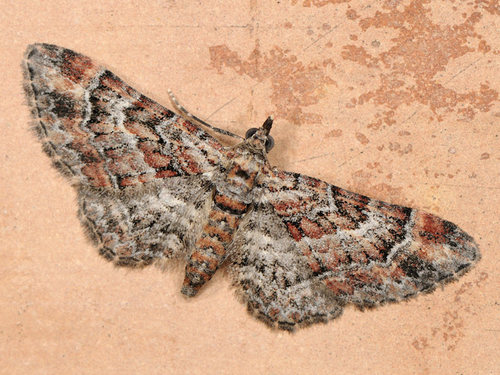
(c) Paolo Mazzei, some rights reserved (CC BY-NC), uploaded by Paolo Mazzei · cc-by-nc
Eupithecia
Sign in to saveEupithecia is the largest genus of moths of the family Geometridae, and the namesake and type genus of tribe Eupitheciini. Species in the genus are, like those of other genera in the tribe, commonly known as pugs. The genus is highly speciose, with over 1400 species, and members of the genus are present in most of the world with exception of Australasia. Roughly a quarter of described Eupithecia species occur in the Neotropical realm, where they have an especially high species diversity in the montane rain forests of the Andes. The genus includes a few agricultural pest species, such as the cu
Species
Double-striped Pug
GENUS
- KingdomAnimalia
- PhylumArthropoda
- ClassInsecta
- OrderLepidoptera
- FamilyGeometridae
via GBIF
Museum specimens
- Specimen records
- 1,780
- With media
- 77
- Family
- Geometridae
- Collections
- ECOSUR, DMNS, UAM, CSU, YPM, UMNH
- Recorded in
- Mexico, United States, Tanzania
Wikidata facts
- Instance of
- taxon
- Parent taxon
- Eupitheciini
- Image
- Eupithecia centaureata01.jpg
Show 6 more facts
- taxon common name
- grotnik
- taxon rank
- genus
- taxon name
- Eupithecia
- Commons category
- Eupithecia
- topic's main category
- Category:Eupithecia
- has host
- Pinus brutia
Sources (2)
via Wikidata · CC0
~33 min read
Encyclopedic overview
25 sectionsContents
- Species
- A
- B
- C
- D
- E
- F
- G
- H
- I
- J-K
- L
- M
- N
- O
- P
- Q-R
- S
- T
- U-V
- W-Z
- Species of unknown status
- References
- Other sources
- External links
Eupithecia is the largest genus of moths of the family Geometridae, and the namesake and type genus of tribe Eupitheciini. Species in the genus are, like those of other genera in the tribe, commonly known as pugs. The genus is highly speciose, with over 1400 species, and members of the genus are present in most of the world with exception of Australasia. Roughly a quarter of described Eupithecia species occur in the Neotropical realm, where they have an especially high species diversity in the montane rain forests of the Andes. The genus includes a few agricultural pest species, such as the currant pug moth, Eupithecia assimilata, which is a pest on hops, and the cloaked pug moth, Eupithecia abietaria, which is a cone pest in spruce seed orchards.
Adult specimens of Eupithecia are typically small, often between 12 and 35 mm, with muted colours, and display a large amount of uniformity between species. As a result, identification of a specimen as part of genus Eupithecia is generally easy, but identifying the exact species is difficult and often reliant on examination of the dissected genitals. Most species share a characteristic resting pose in which the forewings are held flat at a right angle to the body—that is, the costal margins of both forewings form a more-or-less horizontal line—while the hindwings are largely covered by the forewings. They are generally nocturnal.
Excerpted from Wikipedia’s “Eupithecia” article, available under the CC BY-SA 4.0 licence.
Gallery (8)
Available in 15 languages
- Español
- Français
- Deutsch
- 中文
- Русский
- العربية
- Cebuano
- Egyptian Arabic
- Finnish
- Nederlands
- Norwegian
- Svenska
- Tiếng Việt
- Waray
via Wikidata sitelinks · CC0