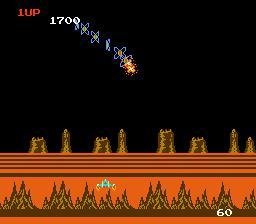
Exerion · RAWG · Courtesy of RAWG
Exerion
Sign in to saveAlso known as Arcade Archives Exerion
is a 1983 shoot 'em up video game developed by Kawa Denshi Giken and published by Jaleco for arcades. It was released in North America by Taito. The player controls a starship and must fire at enemies on the screen while avoiding projectiles. The game uses a pseudo-3D scrolling background, giving a sense of depth, and the player's ship has a sense of inertia while it is being controlled with the joystick.
Game details · IGDB
Exerion is a vertical shoot 'em up released by Jaleco in 1983 and licensed to Taito for distribution in the United States. Screenshot from arcade version Exerion is a shoot 'em up game featuring parallax effects and inertia simulation, something notable for 1983. The player travels around strange scenarios shooting aliens. The player has two types of guns: fast single shot (limited) or slow double shot (unlimited). In 1984, along with the MSX1 port of the original, a sequel was released titled Exerion II: Zorni for the MSX1, with similar gameplay to the original. There were plans for an N…
- Released
- 1983
- Genres
- Shooter, Arcade
- Platforms
- Arcade, SG-1000, Wii, Wii U, MSX
- Game modes
- Single player, Multiplayer
- Developer
- Jaleco, Jaleco
- Publisher
- Sega, Jaleco, HAMSTER, Jaleco
Wikidata facts
- Instance of
- video game
- Genre
- shoot 'em up
- Country of origin
- Japan
- Publisher
- Hamster Corporation
- Platform
- Q19610114
- Game mode
- single-player video game
Show 4 more facts
- publication date
- 2020-01-09
- CPU
- Zilog Z80
- input device
- joystick
- superfamicom.org URL
- superfamicom.org/famicom/info/exerion
Sources (2)
via Wikidata · CC0
~2 min read
Encyclopedic overview
6 sectionsContents
- Gameplay
- Reception
- Legacy
- Notes
- References
- External links
is a 1983 shoot 'em up video game developed by Kawa Denshi Giken and published by Jaleco for arcades. It was released in North America by Taito. The player controls a starship and must fire at enemies on the screen while avoiding projectiles. The game uses a pseudo-3D scrolling background, giving a sense of depth, and the player's ship has a sense of inertia while it is being controlled with the joystick.
Exerion was ported to the MSX, Family Computer, and SG-1000. Two sequels were released.
Excerpted from Wikipedia’s “Exerion” article, available under the CC BY-SA 4.0 licence.