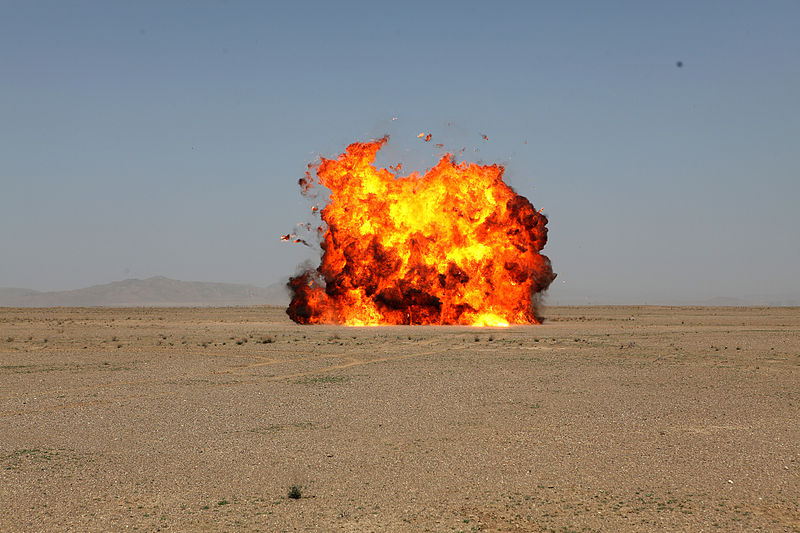
File:A_detonation_erupts_as_U.S._Marines_with_the_1st_Explosive_Ordnance_Disposal_Company,_Combat_Logistics_Regiment_2_conduct_a_demolition_operation_in_Helmand_province,_Afghanistan,_March_17,_2013_130317-M-KS710-206.jpg · Wikimedia Commons · See Wikimedia Commons
explosion
Sign in to saveAlso known as bang, blast, burst, boom, kaboom, exploding, explode
thumb|upright=1.35|Explosion of unserviceable ammunition and other military items thumb|upright=1.35|The explosion of the Castle Nectar nuclear bomb.
An explosion is a rapid, violent release of energy that creates a shock wave and can cause significant destruction. Explosions matter because they can result from various sources—including ammunition, military operations, or nuclear devices—and pose serious safety and security concerns to people and infrastructure.
AI-generated from the Wikipedia summary — may contain errors.
Research
58,217 papersvia PubMed
Wikidata facts
- Subclass of
- hazard
- Image
- Explosions.jpg
Show 14 more facts
- has immediate cause
- pressure
- partially coincident with
- combustion
- has cause
- fracture
- Commons category
- Explosions
- topic's main category
- Category:Explosions
- opposite of
- implosion
- Commons gallery
- Explosion
- described by source
- National Encyclopedia of Uzbekistan
- Unicode character
- 💥
- hashtag
- Boom
- has effect
- aerosol
- contributing factor of
- aerosol
- different from
- detonation
- exact match
- purl.obolibrary.org/obo/ENVO_03000090
via Wikidata · CC0
~14 min read
Encyclopedic overview
24 sectionsContents
- Causes
- Astronomical
- Chemical
- Electrical and magnetic
- Mechanical and vapor
- Nuclear
- Properties
- Force
- Velocity
- Evolution of heat
- Initiation of reaction
- Fragmentation
- Rapid unscheduled disassembly
- Notable examples
- Chemical
- Nuclear
- Volcanic
- Stellar
- Airbursts/Impact events
- Transport/Aviation
- Other
- Etymology
- See also
- References
thumb|upright=1.35|Explosion of unserviceable ammunition and other military items thumb|upright=1.35|The explosion of the Castle Nectar nuclear bomb.
An explosion is a rapid expansion in volume of a given amount of matter associated with an extreme outward release of energy, usually with the generation of high temperatures and release of high-pressure gases. Explosions may also be generated by a slower expansion that would normally not be forceful, but is not allowed to expand, so that when whatever is containing the expansion is broken by the pressure that builds as the matter inside tries to expand, the matter expands forcefully. An example of this is a volcanic eruption created by the expansion of magma in a magma chamber as it rises to the surface. Supersonic explosions created by high explosives are known as detonations and travel through shock waves. Subsonic explosions are created by low explosives through a slower combustion process known as deflagration.
Excerpted from Wikipedia’s “explosion” article, available under the CC BY-SA 4.0 licence.
Gallery (13)
Available in 67 languages
- Español
- Français
- Deutsch
- 中文
- 日本語
- Русский
- Português
- Italiano
- العربية
- हिन्दी
- Albanian
- Armenian
- Asturian
- Azerbaijani
- Bahasa Indonesia
- Basque
- Belarusian
- Bosnian
Show 48 more
- Breton
- Bulgarian
- Catalan
- Central Kurdish
- Chuvash
- Croatian
- Czech
- Danish
- Esperanto
- Estonian
- Finnish
- Georgian
- Greek
- Hebrew
- Hungarian
- Icelandic
- Ido
- Kannada
- Kazakh
- kbp
- Latvian
- Malay
- Nederlands
- Norwegian
- Norwegian Nynorsk
- Occitan
- Polski
- Quechua
- Romanian
- Serbian
- Serbian (Latin)
- simple
- Slovak
- Slovenian
- Somali
- Svenska
- Swahili
- Telugu
- Tiếng Việt
- Türkçe
- Ukrainian
- Urdu
- Uzbek
- Western Frisian
- Wu Chinese
- zh_yue
- فارسی
- 한국어
via Wikidata sitelinks · CC0