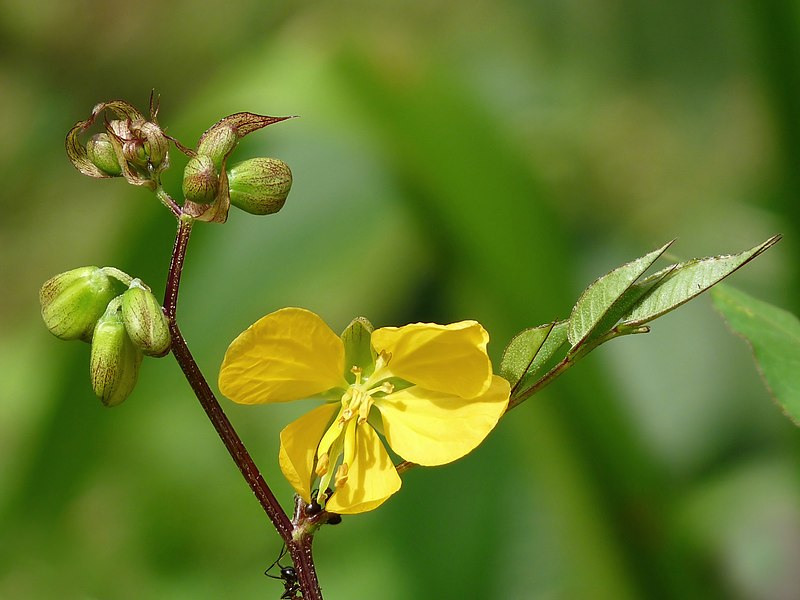
File:Senna_occidentalis.jpg · Wikimedia Commons · See Wikimedia Commons
Fabales
Sign in to saveFabales is an order of flowering plants included in the rosid group of the eudicots in the Angiosperm Phylogeny Group II classification system. In the APG II circumscription, this order includes the families Fabaceae or legumes (including the subfamilies Caesalpinioideae, Mimosoideae, and Faboideae), Quillajaceae, Polygalaceae or milkworts (including the families Diclidantheraceae, Moutabeaceae, and Xanthophyllaceae), and Surianaceae. Under the Cronquist system and some other plant classification systems, the order Fabales contains only the family Fabaceae. In the classification system of Dahl
OverviewAI-generated
Fabales is an order within the class Magnoliopsida of the phylum Tracheophyta in the kingdom Plantae. The taxon, which has the common name 豆目, is classified under the parent taxa Rosanae, Rosidae, and fabids. Its scientific name is Fabales, and it holds an accepted status according to the World Register of Marine Species (WoRMS). The order was described by Bromhead in 1838.
Records for Fabales are held by institutions including the UCMP and the Instituto Nacional de Pesquisas da Amazônia (INPA). These records are associated with the United States and Brasil. The WoRMS database lists the habitat for this taxon as marine, brackish, and freshwater. Additionally, the taxon is included in the Wikipedia Vital Articles Level 4 focus list.
Synthesized by Vinony from 30 facts across 6 sources: Wikidata, GBIF, Gbif Occ, iDigBio, WoRMS, Vinony graph. Generated from structured data (not the Wikipedia text) and checked against those facts — may still contain errors.
Species
マメ目
Fabales
ORDER
- KingdomPlantae
- PhylumTracheophyta
- ClassMagnoliopsida
- OrderFabales
豆目(学名:Fabales)是真双子叶植物蔷薇类植物之下豆类植物的一个目。 目录 1 分类 1.1 种系发生学 2 参考文献 3 參见 分类 在克朗奎斯特分类法中,豆目只包括豆科一科,2009年的被子植物APG III分类法採用的豆目內包括的分類群有四個科[1],共有754屬,约20,055種[2]。其中豆科佔了最大的數量。四科如下: 豆科 Fabaceae Lindl. (1836), nom. cons. 遠志科 Polygalaceae Hoffmanns. & Link (1809), nom. cons. 皂皮樹科 Quillajaceae D.Don (1831) 海人樹科 Surianaceae Arn. (1834), nom. cons. 种系发生学 豆目各科的亲缘关系如下[1][2]: 豆目 Fabales 遠志科 Polygalaceae 海人樹科 Surianaceae 豆科 Fabaceae 皂皮樹科 Quillajaceae 参考文献 ^ 1.0 1.1 Angiosperm Phylogeny Group (2009). An update of the Angiosperm Phylogeny Group classification for the orders and families of flowering plants: APG III. Botanical Journal of the Linnean Society 161(2): 105-121.(英文) ^ 2.0 2.1 Fabales. In Stevens, P. F. (2001 onwards). Angiosperm Phylogeny Website. Version 9, June 2008 [and more or less continuously updated since]. 參见 豆类 这是一篇與植物相關的小作品。你可以通过编辑或修订扩充其内容。 查 论 编 维基共享资源中相关的多媒体资源:豆目 取自“https://zh.wikipedia.org/w/index.php?title=豆目&oldid=51984512” 分类:豆目 隐藏分类: 物种微格式条目 含有拉丁語的條目 全部小作品 植物小作品
via GBIF
Museum specimens
- Specimen records
- 1,220
- With media
- 911
- Collections
- UCMP, INSTITUTO NACIONAL DE PESQUISAS DA AMAZÔNIA (INPA)
- Recorded in
- United States, Brasil
Wikidata facts
Show 6 more facts
- Commons category
- Fabales
- taxon rank
- order
- taxon name
- Fabales
- topic's main category
- Category:Fabales
- taxon common name
- 豆目
- on focus list of Wikimedia project
- Wikipedia:Vital articles/Level/4
Sources (2)
via Wikidata · CC0
~3 min read
Encyclopedic overview
4 sectionsContents
- Distribution
- Phylogeny
- Gallery
- References
Fabales is an order of flowering plants included in the rosid group of the eudicots in the Angiosperm Phylogeny Group II classification system. In the APG II circumscription, this order includes the families Fabaceae or legumes (including the subfamilies Caesalpinioideae, Mimosoideae, and Faboideae), Quillajaceae, Polygalaceae or milkworts (including the families Diclidantheraceae, Moutabeaceae, and Xanthophyllaceae), and Surianaceae. Under the Cronquist system and some other plant classification systems, the order Fabales contains only the family Fabaceae. In the classification system of Dahlgren the Fabales were in the superorder Fabiflorae (also called Fabanae) with three families corresponding to the subfamilies of Fabaceae in APG II. The other families treated in the Fabales by the APG II classification were placed in separate orders by Cronquist, the Polygalaceae within its own order, the Polygalales, and the Quillajaceae and Surianaceae within the Rosales.
The Fabaceae, as the third-largest plant family in the world, contain most of the diversity of the Fabales, the other families making up a comparatively small portion of the order's diversity. Research in the order is largely focused on the Fabaceae, due in part to its great biological diversity, and to its importance as food plants. The Polygalaceae are fairly well researched among plant families, in part due to the large diversity of the genus Polygala, and other members of the family being food plants for various Lepidoptera (butterfly and moth) species. While taxonomists using molecular phylogenetic techniques find strong support for the order, questions remain about the morphological relationships of the Quillajaceae and Surianaceae to the rest of the order, due in part to limited research on these families.
Excerpted from Wikipedia’s “Fabales” article, available under the CC BY-SA 4.0 licence.
Gallery (9)
Available in 71 languages
- Español
- Français
- Deutsch
- 中文
- 日本語
- Русский
- Português
- Italiano
- العربية
- Afrikaans
- Asturian
- Azerbaijani
- Bahasa Indonesia
- Basque
- be_x_old
- Belarusian
- Bosnian
- Bulgarian
Show 52 more
- Catalan
- Cebuano
- Corsican
- Croatian
- Czech
- Danish
- Egyptian Arabic
- Esperanto
- Estonian
- Filipino
- Finnish
- Galician
- Greek
- Hebrew
- Hungarian
- Icelandic
- Iloko
- Javanese
- Kurdish
- Latin
- Latvian
- Lithuanian
- Luxembourgish
- Macedonian
- Malagasy
- Malay
- Malayalam
- Mingrelian
- Nederlands
- Northern Frisian
- Norwegian
- Norwegian Nynorsk
- Polski
- Romanian
- Scots
- Serbian
- Serbian (Latin)
- simple
- Slovenian
- Sundanese
- Svenska
- Telugu
- Tiếng Việt
- Türkçe
- Ukrainian
- Waray
- West Flemish
- Wu Chinese
- zh_yue
- فارسی
- ไทย
- 한국어
via Wikidata sitelinks · CC0