File:USB_flash_drive.JPG · Wikimedia Commons · See Wikimedia Commons
flash memory
Sign in to saveelectronic non-volatile computer storage device
Flash memory is a type of electronic storage device that keeps your data even when the power is turned off, making it useful for saving files permanently. It matters because it's fast, reliable, and widely used in everyday devices like smartphones, USB drives, and solid-state drives.
AI-generated from the Wikipedia summary — may contain errors.
Wikidata facts
- Image
- Flash memory cards size.jpg
Show 6 more facts
- used by
- memory card
- ACM Classification Code (2012)
- 10003452
- Commons category
- Flash memory
- topic's main category
- Category:Solid-state computer storage media
- different from
- random-access memory
- Stack Exchange tag
- stackoverflow.com/tags/flash-memory
via Wikidata · CC0
~40 min read
Encyclopedic overview
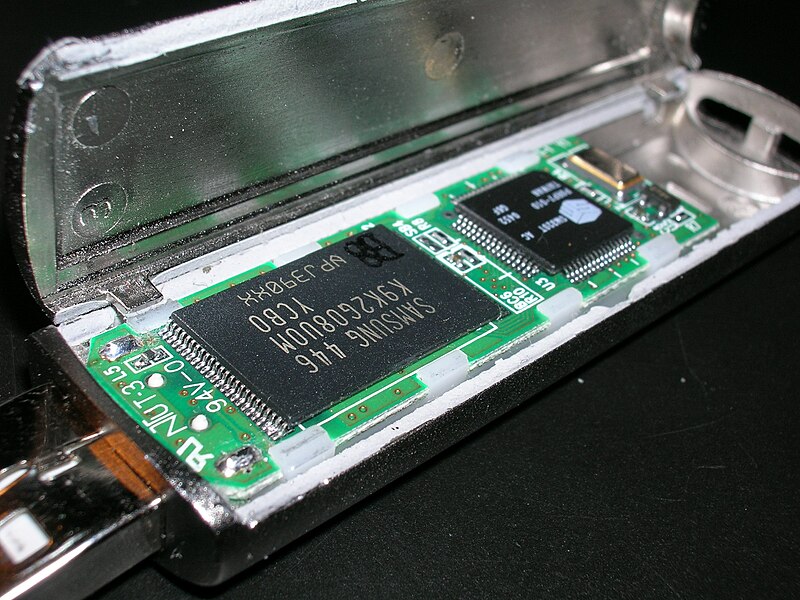
A disassembled USB flash drive in 2005. The chip on the left is flash memory. The Silicon Motion controller is on the right.
Flash memory is an electronic non-volatile computer memory storage medium that can be electrically erased and reprogrammed. The two main types of flash memory, NOR flash and NAND flash, are named for the NOR and NAND logic gates. Both use the same cell design, consisting of floating-gate MOSFETs. They differ at the circuit level, depending on whether the state of the bit line or word lines is pulled high or low; in NAND flash, the relationship between the bit line and the word lines resembles a NAND gate; in NOR flash, it resembles a NOR gate.
Excerpted from Wikipedia’s “flash memory” article, available under the CC BY-SA 4.0 licence.
Gallery (12)
Available in 62 languages
- Español
- Français
- Deutsch
- 中文
- 日本語
- Русский
- Português
- Italiano
- العربية
- हिन्दी
- Afrikaans
- Albanian
- Armenian
- Azerbaijani
- Bahasa Indonesia
- Bangla
- Basque
- Belarusian
Show 43 more
- Bosnian
- Bulgarian
- Catalan
- Croatian
- Czech
- Danish
- Esperanto
- Estonian
- Finnish
- Greek
- Hebrew
- Hungarian
- Interlingua
- Javanese
- Kara-Kalpak
- Kazakh
- Latin
- Latvian
- Lithuanian
- Malay
- Mari
- Nederlands
- Norwegian
- Polski
- Quechua
- Romanian
- Serbian
- Serbian (Latin)
- simple
- Slovak
- Slovenian
- Svenska
- Tamil
- Tiếng Việt
- Türkçe
- Ukrainian
- Urdu
- Wu Chinese
- Zaza
- zh_yue
- فارسی
- ไทย
- 한국어
via Wikidata sitelinks · CC0