Encyclopedia of Life · EOL (see source)
Flemingia
Sign in to saveFlemingia is a genus of plants in the family Fabaceae. It is native sub-Saharan Africa, Yemen, tropical Asia, and Australasia. In Asia the species are distributed in Bhutan, Burma, China, India; Indonesia, Laos, Malaysia, Nepal, Pakistan, Papua New Guinea, Philippines, Sri Lanka, Taiwan, Thailand and Vietnam. The genus was erected in 1812.
Species
Genus
- PhylumAnnelida
- ClassPolychaeta
- OrderTerebellida
- FamilyFlabelligeridae
Flemingia es un género de plantas con flores con 88 especies perteneciente a la familia Fabaceae. La especie tipo es Flemingia strobilifera (L.) W.T.Aiton[1] Índice 1 Especies seleccionadas 2 sinonimia 3 Referencias 4 Enlaces externos Especies seleccionadas Flemingia abrupta Flemingia affinis Flemingia angusta Flemingia angustifolia Flemingia bhottea Flemingia bhutanica sinonimia Luorea Necker ex Jaume St.Hil., Nouv. Bull. Sci. Soc. Philom. Paris 3: 193. 1812, nom. rej. Maughania St.Hil., Nouv. Bull. Sci. Soc. Philom. Paris 3: 216. 1813. Ostryodium Desv., J. Bot. Agric. 1: 119. 1813. Referencias ↑ «Flemingia». Tropicos.org. Missouri Botanical Garden. Consultado el 26 de noviembre de 2010.
via · Kew POWO
Museum specimens
- Specimen records
- 197
- With media
- 138
- Family
- Fabaceae
- Collections
- MICH, A, MEL, NY, CAS, BRIT
- Recorded in
- Nepal, China, Australia, Indonesia, Congo, The Democratic Republic Of The, Philippines, Jamaica, Papua New Guinea
Wikidata facts
Show 6 more facts
- Commons category
- Flemingia
- taxon rank
- genus
- topic's main category
- Category:Flemingia
- taxon common name
- 千斤拔属
- taxon name
- Flemingia
Sources (2)
via Wikidata · CC0
~3 min read
Encyclopedic overview
7 sectionsContents
- Description
- Diversity
- Uses
- Traditional use
- Species
- References
- External links
Flemingia is a genus of plants in the family Fabaceae. It is native sub-Saharan Africa, Yemen, tropical Asia, and Australasia. In Asia the species are distributed in Bhutan, Burma, China, India; Indonesia, Laos, Malaysia, Nepal, Pakistan, Papua New Guinea, Philippines, Sri Lanka, Taiwan, Thailand and Vietnam. The genus was erected in 1812.
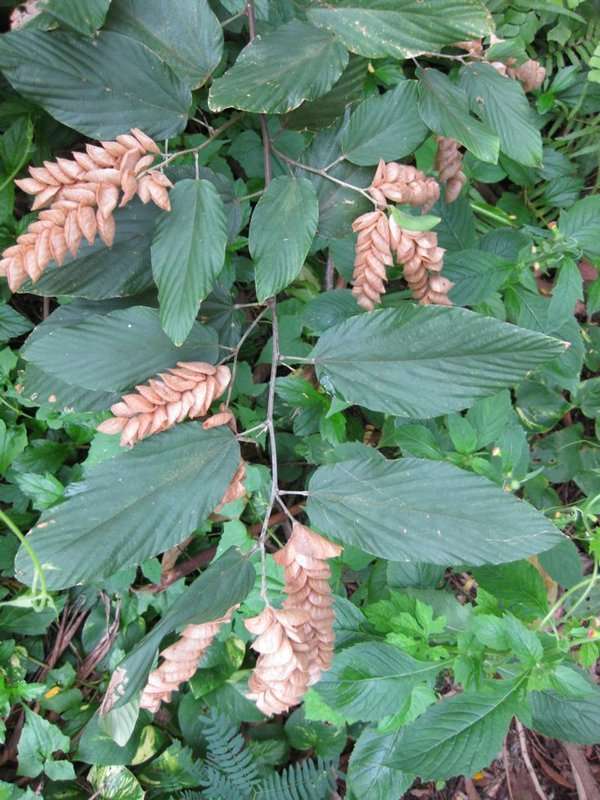
==Description== Members of Flemingia are shrubs, or herbs (or subshrubs); evergreen, or deciduous and perennial. They are generally about 0.2–1.5 m high. The stem is prostrate but weak. Leaves are small to medium-sized; not fasciculate, but alternate. The stem and leaves are pubescent, with dense hairs. Leaf blades are flat dorsoventrally. Flowers are aggregated in ‘inflorescences’; not crowded at the stem bases; in racemes, or in heads, or in panicles. Fruits are aerial, about 6–15 mm long; non-fleshy and hairy.
Excerpted from Wikipedia’s “Flemingia” article, available under the CC BY-SA 4.0 licence.
Gallery (2)
Available in 16 languages
- Español
- Français
- 中文
- Русский
- Português
- Assamese
- Azerbaijani
- Bahasa Indonesia
- Cebuano
- Svenska
- Tiếng Việt
- Türkçe
- Waray
- Zhuang
- فارسی
via Wikidata sitelinks · CC0