File:Syntax_tree.svg · Wikimedia Commons · See Wikimedia Commons
formal language
Sign in to saveset of strings of symbols that may be constrained by rules that are specific to it; words whose letters are taken from an alphabet and are well-formed according to a specific set of rules
A formal language is a set of words made from letters of a specific alphabet, where each word must follow particular rules to be considered valid or "well-formed." Formal languages matter because they provide precise, rule-based systems for communication—from computer programming to mathematics—where clarity and lack of ambiguity are essential.
AI-generated from the Wikipedia summary — may contain errors.
Wikidata facts
- Subclass of
- formal system
- Image
- Syntax tree.svg
- Has use
- foundations of mathematics
Show 6 more facts
- topic's main category
- Category:Formal languages
- Commons category
- Formal languages
- has characteristic
- formal semantics
- Stack Exchange tag
- proofassistants.stackexchange.com/tags/formal-languages
- opposite of
- natural language
- maintained by WikiProject
- WikiProject Mathematics
via Wikidata · CC0
~21 min read
Encyclopedic overview
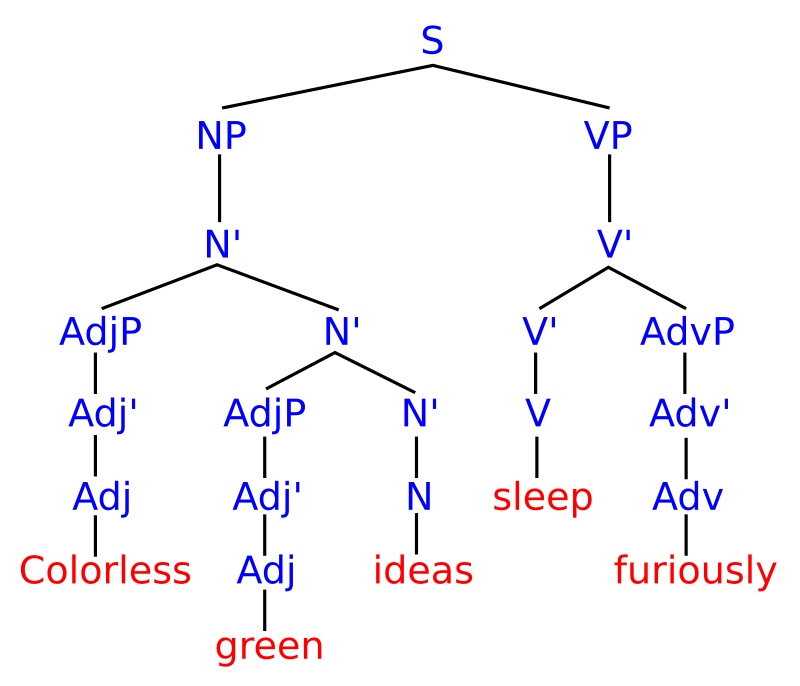
Structure of the syntactically well-formed, although thoroughly nonsensical, English sentence, "Colorless green ideas sleep furiously" (historical example from Chomsky 1957) In logic, mathematics, computer science, and linguistics, a formal language is a set of strings whose symbols are taken from a set called "alphabet".
The alphabet of a formal language consists of symbols that concatenate into strings (also called "words"). Words that belong to a particular formal language are sometimes called well-formed words. A formal language is often defined by means of a formal grammar such as a regular grammar or context-free grammar.
Excerpted from Wikipedia’s “formal language” article, available under the CC BY-SA 4.0 licence.