English
Free Period in the Amsterdam Orphanage
Also known as The Courtyard of the Orphanage in Amsterdam
painting by Max Liebermann at the Städel Museum, Frankfurt, Germany
Described at
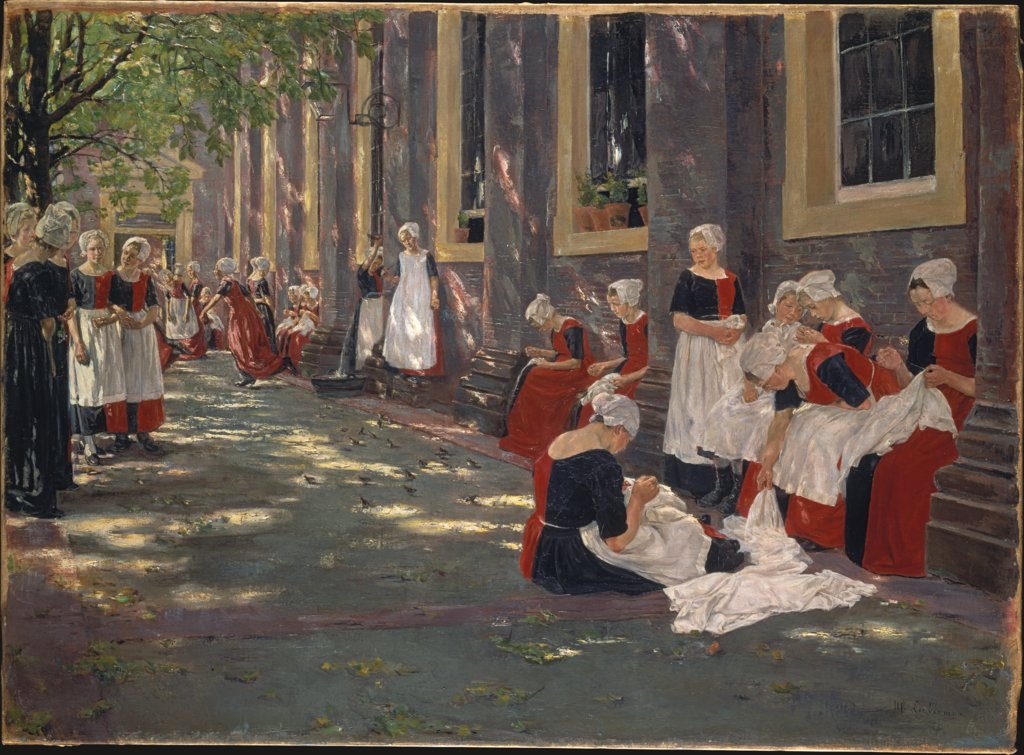
The Courtyard of the Orphanage in Amsterdam: Free Period in the Amsterdam Orphanage - Digital Collection
painting (artwork) by Max Liebermann
staedelmuseum.de →Acquired in 1900, stolen 1945 at the external storage, reacquired 1964, property of Städelscher Museums-Verein e.V. Conservative circles taunted Liebermann as the “apostle of ugliness”. Nevertheless, the Städelscher Museums-Verein showed courage and providence when it acquired this early key work immediately after it was founded in 1899. Liebermann had sketched the inmates of the ‘Burgerweeshuis’ in Amsterdam. It was only later that he executed the oil painting in his Munich studio. This work was created at a turning point, when Liebermann left behind the shades of brown of his realist phase and adopted the lighter palette of Impressionism. Under the direction of the influential figure Leopold Sonnemann, a member of the Reichstag and the founder and owner of the 'Frankfurter Zeitung', the Städelscher Museums-Verein was established in 1899 as an institution for the collective furtherance of art. The eighty-odd members of the society celebrated their first purchase in 1900 with the acquisition of Max Liebermann's painting 'The Courtyard of the Orphanage in Amsterdam', which was the subject of lively controversy at the time. The Berlin artist was the main representative of German Impressionism and hence in opposition to the imperial concept of art, which was reflected in battle scenes and public victory monuments. But the painting also met with rejection within the ranks of the society. Sonnemann reacted promptly: he undertook to pay part of the purchase price himself and at the same time threatened to resign. In view of this radical step, people backed down and the modern age entered the museum in the form of this painting. In unserem Kunst Stück zur Ausstellung "Dialog der Meisterwerke. Hoher Besuch zum Jubiläum" treffen vier verschiedene Gemälde von Max Liebermann (1847–1935) aufeinander, die sich alle einem gemeinsamen Bildmotiv widmen: der Darstellung von arbeitenden Näherinnen im Waisenhaus von Amsterdam, das Max Liebermann selbst mehrmals besuchte, um das dortige Leben als Motiv für diese Ölgemälde zu studieren. Entdecken Sie in rund zwei Minuten spannende Details zu den vier Kunstwerken aus ungewöhnlichen Blickwinkeln. Dialog der Meisterwerke. Hoher Besuch zum Jubiläum (7. Oktober 2015 bis 24. Januar 2016): Die Ausstellung „Dialog der Meisterwerke. Hoher Besuch zum Jubiläum“ wurde gefördert durch die DZ Bank als Corporate Sponsor und die Förderer Kulturfonds Frankfurt RheinMain gGmbH, Art Mentor Foundation Lucerne sowie der Kulturstiftung der Länder. Für Untertitel klicken Sie bitte auf das Untertitel-Symbol am rechten unteren Rand des Videos. / For subtitles please click the captions icon at the bottom of the video. Acquired in 1900, stolen 1945 at the external storage, reacquired 1964, property of Städelscher Museums-Verein e.V. 61E(AMSTERDAM) names of cities and villages (AMSTERDAM) 61F(ST. LUCIENKLOSTER, Amsterdam) names of historical buildings, sites, streets, etc. (ST. LUCIENKLOSTER, Amsterdam) 46A31 orphanage 31D13 adolescent, young woman, maiden 41A51 courtyard 41D443 (other forms of) needlework, e.g.: crocheting, knitting, embroidering 41D2(+82) clothes, costume (+ women's clothes) Ideally, the provenance information documents an object’s origins from the time it was created until the date when it found its way into the collection. It contains the following details, provided they are known: The successive ownership records are separated from each other by a semicolon. Art-technology findings and/or documentation regarding conservation and restoration are available for this work. If interested, please contact [email protected] .