File:Frigg_by_Doepler.jpg · Wikimedia Commons · See Wikimedia Commons
Frigg
Sign in to saveAlso known as Frigga
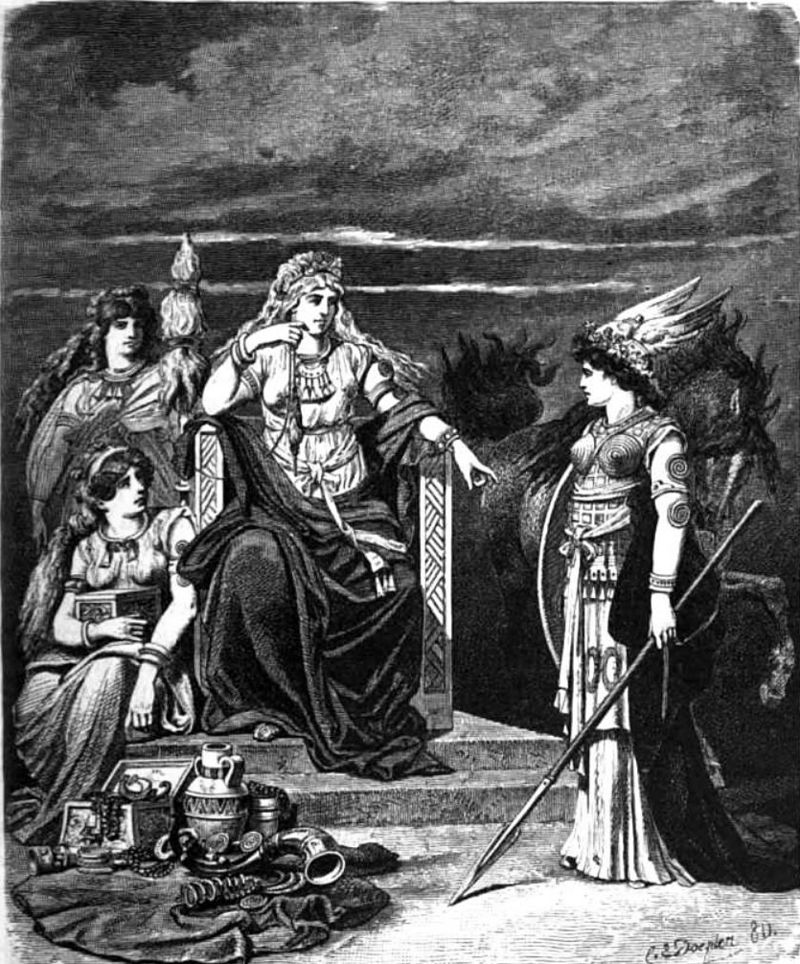
thumb|Frigg sits enthroned and facing the spear-wielding goddess Gná, flanked by two goddesses, one of whom ([[Fulla) carries her eski, a wooden box. Illustrated (1882) by Carl Emil Doepler.]] Frigg (, , , Old Swedish: Frigg, genitive: Friggiar, etc, Early Modern Swedish: etc; ; ; ; ; ) is a goddess, one of the Æsir, in Germanic mythology. In Norse mythology, the source of most surviving information about her, she is associated with marriage, prophecy, clairvoyance and motherhood, and dwells in the wetland halls of Fensalir. The names ultimately stem from the Proto-Germanic theonym *Frijjō. Ne
Frigg is a goddess in Germanic and Norse mythology who is associated with marriage, prophecy, clairvoyance, and motherhood. She is one of the Æsir (a group of gods) and dwells in the wetland halls of Fensalir, making her an important figure in the surviving Norse mythological texts.
AI-generated from the Wikipedia summary — may contain errors.
Wikidata facts
- Instance of
- goddess
- Part of
- Ásynjur
- Gender
- female
- Spouse
- Odin
- Child
- Hodhr
- Father
- Fjörgynn
- Image
- FriggSpinning.jpg
- Residence
- Fensalir
- Said to be same as
- Hlín
Show 7 more facts
- Commons category
- Frigg
- described by source
- skaldic poetry
- topic's main category
- Category:Frigg
- name in native language
- Frigg
- worshipped by
- Norse mythology
- different from
- Frigga
- present in work
- Lokasenna
Sources (3)
via Wikidata · CC0
~20 min read
Encyclopedic overview
17 sectionsContents
- Name and origin
- Etymology
- Origin of Frigg
- Origin of ''Friday''
- Attestations
- ''Origo Gentis Langobardorum'' and ''Historia Langobardorum''
- Second Merseburg Incantation
- ''Poetic Edda''
- ''Prose Edda''
- ''Heimskringla'' and sagas
- Archaeological record
- Scholarly reception and interpretation
- Modern influence
- See also
- Notes
- References
- External links
thumb|Frigg sits enthroned and facing the spear-wielding goddess Gná, flanked by two goddesses, one of whom ([[Fulla) carries her eski, a wooden box. Illustrated (1882) by Carl Emil Doepler.]] Frigg (, , , Old Swedish: Frigg, genitive: Friggiar, etc, Early Modern Swedish: etc; ; ; ; ; ) is a goddess, one of the Æsir, in Germanic mythology. In Norse mythology, the source of most surviving information about her, she is associated with marriage, prophecy, clairvoyance and motherhood, and dwells in the wetland halls of Fensalir. The names ultimately stem from the Proto-Germanic theonym *Frijjō. Nearly all sources portray her as the wife of the god Odin.
In Old High German and Old Norse sources, she is specifically connected with Fulla, but she is also associated with the goddesses Lofn, Hlín, Gná, and ambiguously with the Earth, otherwise personified as an apparently separate entity Jörð (Old Norse: 'Earth'). The children of Frigg and Odin include the gleaming god Baldr.
Excerpted from Wikipedia’s “Frigg” article, available under the CC BY-SA 4.0 licence.
Gallery (24)
Available in 70 languages
- Español
- Français
- Deutsch
- 中文
- 日本語
- Русский
- Português
- Italiano
- العربية
- Afrikaans
- Albanian
- Armenian
- Azerbaijani
- Bahasa Indonesia
- Bashkir
- Basque
- Bavarian
- Belarusian
Show 51 more
- Bikol
- Breton
- Bulgarian
- Burmese
- Catalan
- Cebuano
- Croatian
- Czech
- Danish
- Egyptian Arabic
- Esperanto
- Estonian
- Faroese
- Finnish
- Galician
- Georgian
- Greek
- Hebrew
- Hungarian
- Icelandic
- Interlingua
- Irish
- Latin
- Latvian
- Lingua Franca Nova
- Lithuanian
- Luxembourgish
- Macedonian
- nds_nl
- Nederlands
- Norwegian
- Norwegian Nynorsk
- Occitan
- Polski
- Romanian
- Serbian
- Serbian (Latin)
- simple
- Slovak
- Slovenian
- Svenska
- Tiếng Việt
- Türkçe
- Ukrainian
- Uzbek
- West Flemish
- Wu Chinese
- zh_yue
- فارسی
- ไทย
- 한국어
via Wikidata sitelinks · CC0