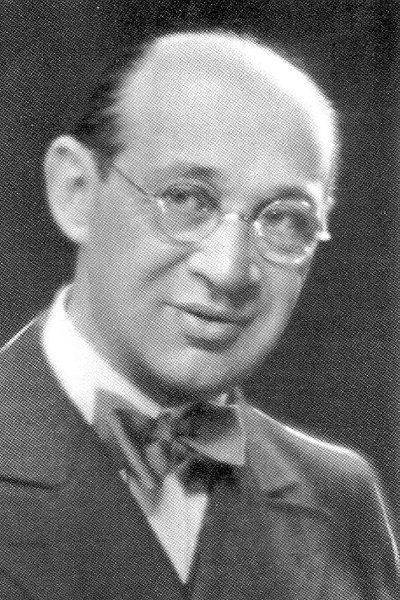
Profile via TMDB · Courtesy of TMDB
Fritz Grünbaum
Sign in to saveAlso known as Franz Grunbaum, Franz Friedrich Grünbaum
Austrian cabaret artist, art collector and Holocaust victim (1880–1941)
Person · Open Library
- Born
- 1880
- Died
- 1941
- Works
- 3
Top works
- Zur Photometrie der Absorptionsspektren von Lösungen
- Mein Annerl!
- Aufs Küssen versessen!
via Open Library + Wikidata
Film & TV
Brünn, Moravia, Austria-Hungary [now Brno, Czech Republic]
Known for
- The Man Without a Name — Anwalt Gablinsky1932
- Girls to Marry — Sigurd Bernstein1932
- For Once I'd Like to Have No Troubles — Chef des Konfektionshauses1932
- A Song, A Kiss, A Girl — Adolph Münzer1932
- The Upright Sinner — Kalapka1931
- The Theft of the Mona Lisa — Angeblicher Bilderdieb1931
- Poor as a Church Mouse — Schünzl1931
via TMDB
Music · MusicBrainz
- Type
- Person
- Gender
- Male
- Origin
- Austria
- Active from
- 1880-04-07
- Active to
- 1941-01-14
Discography
via MusicBrainz · CC0
Listeners · Last.fm
- Listeners
- 169
- Total plays
- 323
Tags
Fritz Grünbaum (April 7, 1880 in Brno, Moravia as Franz Friedrich Grünbaum – January 14, 1941 at the Dachau concentration camp, Germany) was an Austrian Jewish cabaret artist, operetta and pop song writer, director, actor and master of ceremonies. During his childhood and adolescence Grünbaum lived with his family in Brünn which were dealing in art. At an age of 18 years, he attended law school in Vienna which he concluded, in fact, as a doctor, but more and more he began to show interest for
Described at
SUPREME COURT, APPELLATE DIVISION, FIRST DEPARTMENT, John W. Sweeny, Jr.,J.P. Rosalyn H. Richter Peter Tom Cynthia S. Kern Anil C. Singh,JJ. 8172 Index 161799/15 x Timothy Reif, et al., Plaintiffs-Respondents, -against- Richard Nagy, et al., Defendants-Appellants. x Defendants appeal from an order of the Supreme Court, New York County (Charles E. Ramos, J.), entered on or about June 11, 2018, which, inter alia, granted plaintiffs’ motion for summary judgment on their claims of replevin and conversion directing defendants to return the Artworks to plaintiffs, and for an award of damages, costs, and attorneys’ fees. Nixon Peabody LLP, New York (Thaddeus J. Stauber and Kristin M. Jamberdino of counsel), for appellants. Dunnington Bartholow & Miller LLP, New York (Raymond J. Dowd and Samuel A. Blaustein of counsel), for respondents. SINGH, J. This controversy stems from art allegedly looted by the Nazis during World War II. We are asked to decide whether Supreme Court properly granted plaintiffs, Timothy Reif and David Frankel, as co-executors of the estates of Leon Fischer and Milos Vavra (collectively plaintiffs), summary judgment on their claims for conversion and replevin. We find that plaintiffs made a prima facie showing of entitlement to judgment as a matter of law that they have superior title to two pieces of art by Egon Schiele, “Woman Hiding Her Face (1912)” and “Woman in a Black Pinafore (1911)” (collectively the Artworks), and that defendants Richard Nagy and Richard Nagy Ltd. (collectively defendants) failed to raise a triable issue of material fact. Background Plaintiffs are the legally declared heirs of Fritz Grunbaum (Grunbaum), a well-known Jewish Viennese cabaret artist and art collector. 1 Grunbaum admired the Viennese modern artist, Egon Schiele, and amassed an 81-piece collection of his work before World War II. After the Nazi invasion of Austria on March 12, 1 Grunbaum was also a doctor of the law and veteran of World War I. His jokes often targeted the Nazis. His fame in Vienna was such that there is a square named after him, “Fritz Grunbaum Platz.” 2 1938, Grunbaum attempted to escape with his wife, Elisabeth “Lilly” (nee Herzl) Grunbaum (Elisabeth), to Czechoslovakia, but was apprehended and arrested by the Nazis on or about March 22, 1938. From the time of his arrest until his murder on or about January 14, 1941, Grunbaum remained imprisoned in various concentration camps, including Buchenwald and Dachau. Throughout Grunbaum’s imprisonment Elisabeth endeavored to secure his release so that they could flee to family abroad. Her sister, Mathilde Lukacs (Mathilde), and brother-in-law, Sigmund Lukacs (Sigmund) (collectively the Lukacses) had fled Vienna to escape Nazi persecution of the Jews. Sigmund had been arrested at the same time as Grunbaum but was released two months later on condition that he would leave Austria. He and Mathilde escaped to Belgium on August 26, 1938, where they resided until 1941 when they fled to Brussels. Elisabeth remained in Austria hoping Grunbaum would be released, as promised by certain German officers. However, starting on Kristallnacht 2 and continuing 2 Kristallnacht, German for “crystal night” or “night of broken glass,” occurred on November 9–10, 1938. During these days, Nazis attacked Jewish persons and destroyed their property. The name Kristallnacht refers to the litter of broken glass left in the streets after these organized riots took place (see [last accessed June 10, 2019]). Quoting historians, plaintiffs’ expert Petropolous notes that Kristallnacht “inaugurated the definitive 3 . . . now Buchenwalde,” as still possessing 5,791 RM worth of “pictures and graphics.” Prior to fleeing Austria, the Lukacses’ were also forced to inventory their assets. In her property registration dated July 15, 1938, Mathilde reported a total of 22 pictures, without further detail, which were valued at 400 RM. This inventory corresponded with the Lukacses’ “moving notice,” whic
Excerpt from a page describing this subject · 40,000 chars · not written by Vinony
Wikidata facts
- Instance of
- human
- Given name
- Friedrich
- Gender
- male
- Citizenship
- Austria
- Place of birth
- Brno
- Place of death
- Dachau
- Occupation
- art collector
- Languages spoken
- German
- Field of work
- cabaret
- Image
- Fritz Grünbaum.jpg
- Work location
- Vienna
- Residence
- Vienna
- Significant event
- restitution of Nazi-looted art
Show 10 more facts
- Commons category
- Fritz Grünbaum
- name in native language
- Fritz Grünbaum
- birth name
- Franz Friedrich Grünbaum
- place of detention
- Dachau concentration camp
- date of birth
- 1880-04-07
- date of death
- 1941-01-14
- writing language
- German
- manner of death
- homicide
- subject has role
- Holocaust victim
via Wikidata · CC0
Available in 11 languages
via Wikidata sitelinks · CC0