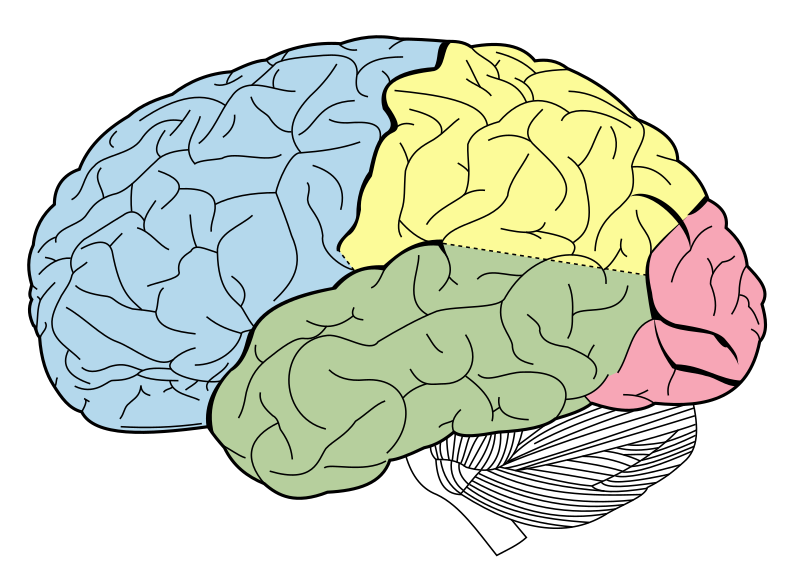
File:Lobes_of_the_brain_NL.svg · Wikimedia Commons · See Wikimedia Commons
frontal lobe
Sign in to savepart of the brain that, because of how large it is, it's responsible for many functions, such as motor control, executive functions, language production, emotional regulation, working memory, and personality
Key facts
- Part of
- Cerebrum
- Artery
- Anterior cerebral , Middle cerebral
- Latin
- lobus frontalis
- Acronym
- FL
- Mesh
- D005625
- Neurolex id
- birnlex_928
- Ta98
- A14.1.09.110
via Wikipedia infobox
Research
113,944 papers- Frontal lobe seizures: overview and update.Journal of neurology · 2022
- The anatomy of the human frontal lobe.Handbook of clinical neurology · 2019
- Frontal lobe epilepsy.Journal of clinical neuroscience : official journal of the Neurosurgical Society of Australasia · 2011
- Frontal lobe seizures.The neurologist · 2011
- Frontal lobe epilepsy.Epileptic disorders : international epilepsy journal with videotape · 2004
via PubMed
Wikidata facts
- Part of
- cerebral hemisphere
- Has part
- primary motor cortex
- Image
- Frontal lobe animation.gif
Show 3 more facts
- Commons category
- Frontal lobe
- NCI Thesaurus ID
- C12352
- topic's main category
- Category:Frontal lobe
Sources (7)
via Wikidata · CC0
~13 min read
Encyclopedic overview
The frontal lobe is the largest lobe of the vertebrate brain and the most anterior lobe of the cerebral hemispheres. The anatomical groove known as the central sulcus separates the frontal lobe from the parietal lobe, and the deeper anatomical groove called the lateral sulcus separates the frontal lobe from the temporal lobe. The most anterior ventral, orbital end of the frontal lobe is known as the frontal pole, which is one of the three so-called poles of the cerebrum.
The outer, multifurrowed surface of the frontal lobe is called the frontal cortex. Like all cortical tissue, the frontal cortex is a thin layer of gray matter making up the outer portion of the brain. The frontal cortex is further subdivided into several anatomical and functional structures, including those of the motor cortex (the premotor cortex, the nonprimary motor cortex, the primary motor cortex) and the prefrontal cortex (e.g., the dorsolateral prefrontal cortex).
Excerpted from Wikipedia’s “frontal lobe” article, available under the CC BY-SA 4.0 licence.