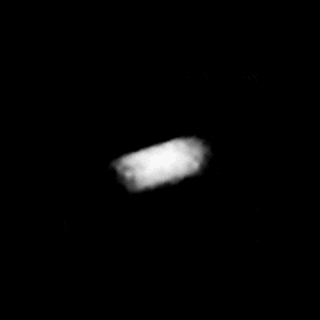
File:Galatea_moon.jpg · Wikimedia Commons · See Wikimedia Commons
Galatea is a small moon that orbits Neptune, discovered in 1989 by the Voyager 2 spacecraft. It is notable for its close proximity to Neptune's ring system, which makes it scientifically important for understanding how planetary rings form and are maintained.
AI-generated from the Wikipedia summary — may contain errors.
Wikidata facts
- Instance of
- shepherd moon
- Named after
- Galatea
- Parent body
- Neptune
- Radius
- 88
- Mass
- 3.7
- Orbital period
- 0.42874431
- Image
- Galatea moon.jpg
Show 10 more facts
- Commons gallery
- Galatea (moon)
- discoverer or inventor
- Voyager 2
- Commons category
- Galatea (moon)
- provisional designation
- S/1989 N 4
- time of discovery or invention
- 1989-07-28
- albedo
- 0.08
- apparent magnitude
- 21.9
- orbital eccentricity
- 0.00004
- semi-major axis of an orbit
- 61593
- orbital inclination
- 0.052
via Wikidata · CC0
~2 min read
Encyclopedic overview
Galatea /ɡæləˈtiːə/, also known as Neptune VI, is the fourth-closest inner moon of Neptune, and fifth-largest moon of Neptune. It is named after Galatea, one of the fifty Nereids of Greek legend, with whom Cyclops Polyphemus was vainly in love.
Discovery
Excerpted from Wikipedia’s “Galatea” article, available under the CC BY-SA 4.0 licence.
Gallery (2)
Available in 67 languages
- Español
- Français
- Deutsch
- 中文
- 日本語
- Русский
- Português
- Italiano
- العربية
- हिन्दी
- Afrikaans
- Aragonese
- Armenian
- azb
- Azerbaijani
- Bahasa Indonesia
- Bangla
- Basque
Show 48 more
- Belarusian
- Bosnian
- Bulgarian
- Burmese
- Catalan
- cdo
- Central Kurdish
- Croatian
- Czech
- Danish
- Esperanto
- Estonian
- Filipino
- Finnish
- Galician
- Greek
- Haitian Creole
- Hebrew
- Hungarian
- Komi
- Latvian
- Lithuanian
- Low German
- Macedonian
- Malayalam
- Nederlands
- Norwegian
- Norwegian Nynorsk
- Polski
- Romanian
- Serbian
- simple
- Slovak
- Slovenian
- Svenska
- Tajik
- Tamil
- Tiếng Việt
- Türkçe
- Ukrainian
- Urdu
- Waray
- Welsh
- Wu Chinese
- zh_min_nan
- zh_yue
- فارسی
- 한국어
via Wikidata sitelinks · CC0