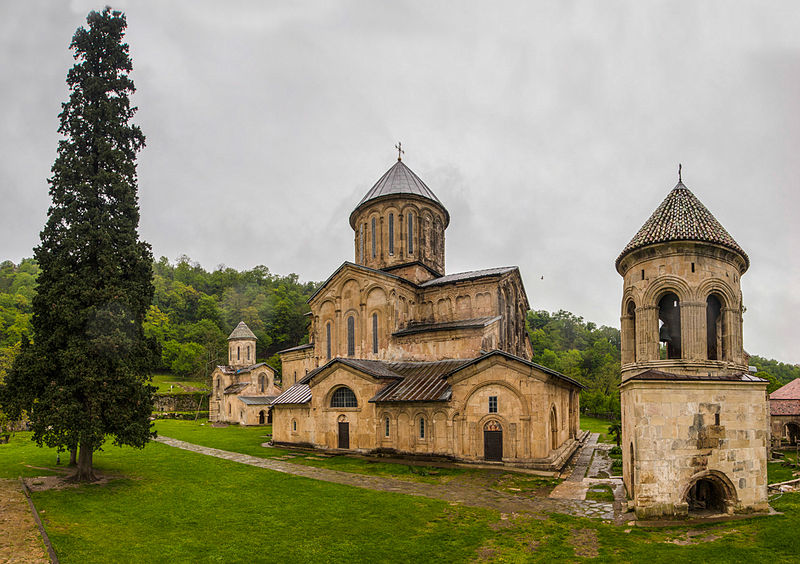
File:Gelati_Monastery_1.jpg · Wikimedia Commons · See Wikimedia Commons
Gelati Monastery
Sign in to savemonastery in Georgia, Caucasus
Gelati Monastery is a medieval religious complex located in Georgia in the Caucasus region, known for its architectural and artistic significance in Georgian Orthodox Christian culture. It represents an important center of learning and spiritual life from its medieval period and stands as a notable example of Georgian architectural heritage.
AI-generated from the Wikipedia summary — may contain errors.
Key facts
- Affiliation
- Georgian Orthodox Church
- Location
- Kutaisi , Imereti , Georgia
- Type
- Monastery
- Style
- Georgian
- Founder
- David IV of Georgia ("David the Builder")
- Completed
- Church of the Virgin, 1106; , Churches of St. George and St. Nicholas, 13th century
- Criteria
- iv
- Designated
- 1994 (18th session )
- Region
- Europe and North America
- Date of entry in the registry
- October 3, 2007 ; 18 years ago ( 2007-10-03 )
via Wikipedia infobox
Wikidata facts
- Instance of
- monastery
- Country
- Georgia (country)
- Located in
- Kutaisi
- Area
- 4.2
- Founded by
- David IV of Georgia
- Official website
- whc.unesco.org/en/list/710
- Image
- Gelati Monastery 1.jpg
- Significant event
- list of World Heritage in Danger
Show 6 more facts
- Commons category
- Gelati Monastery
- Commons Institution page
- Gelati Monastery, Kutaisi, Georgia
- heritage designation
- World Heritage Site
- inception
- 1106-00-00
- native label
- გელათის მონასტერი
- Christian liturgical rite
- Georgian Orthodox Church
Sources (2)
via Wikidata · CC0
~7 min read
Encyclopedic overview
Gelati (Georgian: გელათის მონასტერი [g̊e̞ɫät̪ʰi]) is a medieval monastic complex near Kutaisi in the Imereti region of western Georgia. One of the first monasteries in Georgia, it was founded in 1106 by King David IV of Georgia as a monastic and educational center.
The monastery is a UNESCO World Heritage Site and was a cultural, educational and scientific center in medieval Georgia. It is an exemplar of the Georgian Golden Age and a gold aesthetic is employed in the paintings and buildings. It was built to celebrate the Orthodox Christian faith in Georgia; some murals found inside the Gelati Monastery church date back to the 12th century.
Excerpted from Wikipedia’s “Gelati Monastery” article, available under the CC BY-SA 4.0 licence.