File:Geologic_time_scale_-_spiral_-_ICS_colours_(light)_-_path_text.svg · Wikimedia Commons · See Wikimedia Commons
geologic time scale
Sign in to saveAlso known as GTS, geologic timescale, geological time scale, geological timescale
a system of chronological dating that classifies geological strata (stratigraphy) in time
The geologic time scale is a system that scientists use to organize and date the layers of rock in Earth's crust, helping them understand when different geological events and life forms existed. It matters because it provides a framework for studying Earth's history and how our planet and its life have changed over billions of years.
AI-generated from the Wikipedia summary — may contain errors.
Wikidata facts
- Instance of
- time standard
- Subclass of
- chronological dating
- Official website
- stratigraphy.org/chart
Show 5 more facts
- standards body
- International Commission on Stratigraphy
- Commons category
- Geologic time scale
- topic's main category
- Category:Geologic time scales
- studied by
- biostratigraphy
- on focus list of Wikimedia project
- Wikipedia:Vital articles/Level/4
via Wikidata · CC0
~39 min read
Encyclopedic overview
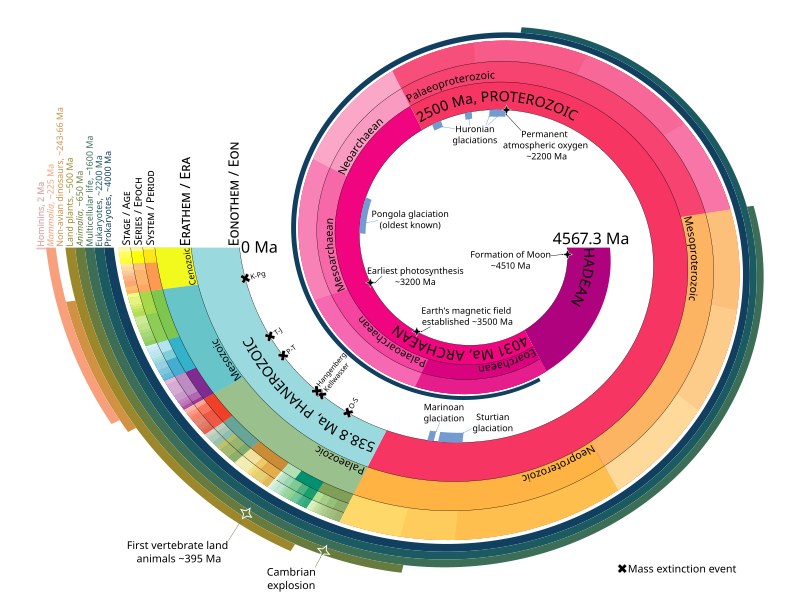
The geologic time scale, proportionally represented as a log-spiral with some major events in Earth's history. A megaannum (Ma) represents one million (10) years.
The geologic time scale or geological time scale describes how geologic time is divided into standardised intervals. It uses the rock record together with the principles of chronostratigraphy to place rock sequences into their relative age positions, and geochronology techniques, such as radiometric dating, to precisely date the boundaries between them. It is used primarily by Earth scientists (including geologists, paleontologists, geophysicists, geochemists, and paleoclimatologists) to describe the timing and relationships of events in geologic history. The time scale has been developed through the study of rock layers and the observation of their relationships and identifying features such as lithologies, paleomagnetic properties, and fossils. The definition of standardised international units of geological time is the responsibility of the International Commission on Stratigraphy (ICS), a constituent body of the International Union of Geological Sciences (IUGS), whose primary objective is to precisely define global chronostratigraphic units of the International Chronostratigraphic Chart (ICC) that are used to define divisions of geological time. The chronostratigraphic divisions are in turn used to define geochronologic units.
Excerpted from Wikipedia’s “geologic time scale” article, available under the CC BY-SA 4.0 licence.
Gallery (3)
Available in 96 languages
- Español
- Français
- Deutsch
- 中文
- 日本語
- Русский
- Português
- Italiano
- العربية
- हिन्दी
- Afrikaans
- Albanian
- Albanian
- Asturian
- Azerbaijani
- Bahasa Indonesia
- Bangla
- Bashkir
Show 77 more
- Basque
- Belarusian
- Bhojpuri
- Bosnian
- Breton
- Bulgarian
- Burmese
- Catalan
- Cornish
- Croatian
- Czech
- Danish
- Esperanto
- Estonian
- Filipino
- Finnish
- Galician
- Georgian
- Greek
- Haitian Creole
- Hausa
- Hebrew
- Hungarian
- Icelandic
- Interlingua
- Irish
- Kannada
- Kazakh
- Latgalian
- Latin
- Latvian
- Lingua Franca Nova
- Lithuanian
- Luxembourgish
- Macedonian
- Malagasy
- Malay
- map_bms
- Mongolian
- Nederlands
- Northern Frisian
- Norwegian
- Norwegian Nynorsk
- nrm
- Occitan
- Pashto
- Polski
- rki
- Romanian
- Serbian
- Serbian (Latin)
- simple
- Sindhi
- Slovak
- Slovenian
- Sundanese
- Svenska
- Swahili
- Tamil
- Telugu
- Tiếng Việt
- Türkçe
- Ukrainian
- Urdu
- Uzbek
- Venetian
- Walloon
- Waray
- West Flemish
- Wu Chinese
- Yakut
- zh_classical
- zh_min_nan
- zh_yue
- فارسی
- ไทย
- 한국어
via Wikidata sitelinks · CC0