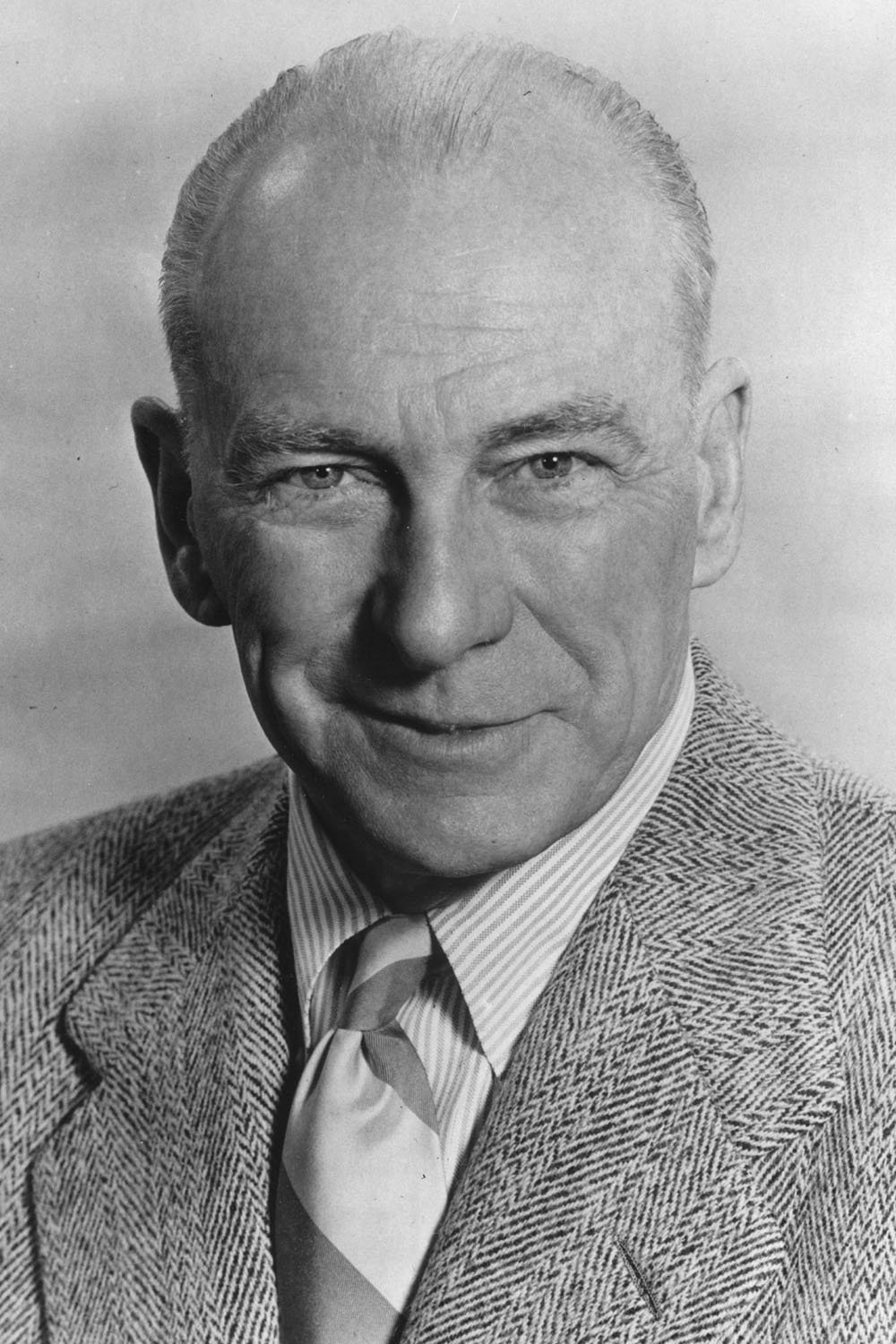
Profile via TMDB · Courtesy of TMDB
George Abbott
Sign in to saveAlso known as George Francis Abbott
American writer and director (1887-1995)
OverviewAI-generated
George Abbott was born on June 25, 1887, and died on January 31, 1995. His professional work period began in 1915.
He is recognized in the Pulitzer Prize collection and the Kennedy Center Honors collection.
Synthesized by Vinony from 9 facts across 3 sources: Wikidata, Firecrawl, Vinony collections. Generated from structured data (not the Wikipedia text) and checked against those facts — may still contain errors.
Film & TV
Forestville, New York, USA
From Wikipedia, the free encyclopedia. George Francis Abbott (June 25, 1887 – January 31, 1995) was an American theater producer and director, playwright, screenwriter, and film director and producer whose career spanned more than eight decades. Description above from the Wikipedia article George Abbott, licensed under CC-BY-SA, full list of contributors on Wikipedia
Known for
- Vaudeville — Self1997
- The Kennedy Center Honors — Self1978
- Great Performances — Self1971
- The Colgate Comedy Hour — Self1950
- The Impostor — Lem1918
via TMDB
Described at

George Abbott - The Official Masterworks Broadway Site
masterworksbroadway.com →One of the most important and admired men in the entire history of Broadway – indeed, some have said that he WAS the history of Broadway –, George Abbott ( b. Forestville, NY, 25 June 1887; d. Miami Beach, FL, 31 January 1995 ) was a theater director and producer, playwright, screenwriter, and film director and producer whose career spanned more than nine decades. He had a hand, one way or another, in the most historically and artistically significant New York productions of the twentieth century: Broadway (1926), Three Men on a Horse (1935), Brother Rat (1936), On Your Toes (1936), Room Service (1937), The Boys from Syracuse (1938), Too Many Girls (1939), Pal Joey (1940), On the Town (1944), High Button Shoes (1947), Where’s Charley? (1948), Call Me Madam (1950), Wonderful Town (1953), The Pajama Game (1954), Damn Yankees (1955), Once Upon a Mattress (1959), Fiorello ! (1959), A Funny Thing Happened on the Way to the Forum (1961), Flora the Red Menace (1965), and 103 other shows, giving a boost to the early careers of (among others) Sylvia Field, Helen Hayes, Shirley Booth, Garson Kanin, Rodgers and Hart, Ray Bolger, Eddie Albert, Jose Ferrer, Eddie Bracken, Gene Kelly, Leonard Bernstein, Betty Comden and Adolph Green, Nancy Walker, Jerome Robbins, Allyn Ann McLerie, Harold Prince, Carol Haney, Bob Fosse, Carol Burnett, Jack Gilford, and Liza Minnelli. Abbott had 40 films to his credit as screenwriter, director, or producer, among them All Quiet on the Western Front (1930), The Fall Guy (1930), and the film adaptations of his Broadway hits; his featured screen actors included Jean Arthur, Lew Ayres, and Gene Tierney. He received over thirty prestigious honors and awards, though he set little store by them. When George Francis Abbott was a boy, his father was twice elected mayor of Salamanca, in upstate New York. The family moved to Cheyenne, Wyoming, when he was eleven, and the teenaged George got jobs as a Western Union messenger and a ranch hand. He was not a promising student, and appeared to be headed toward juvenile delinquency, so he was sent to Kearney Military Academy in Nebraska, where they cured his slouching posture (he measured six feet two inches) as well as his unruly tendencies. Just after the turn of the century, the Abbotts moved back East to Hamburg, where George often took advantage of a trolley line to theaters in nearby Buffalo. Graduating from Hamburg High School in 1907, he went on to the University of Rochester for a B.A. in 1911. The University Dramatic Club performed his play Perfectly Harmless that year, and Abbott proceeded to Harvard to take a course in playwriting from George Pierce Baker. One of his plays, The Head of the Family , was performed by the Harvard Dramatic Club, and another, The Man in the Manhole , won a $100 prize from Boston’s Bijou Theatre, where he was working as an assistant stage manager. After a few more lackluster acting parts, George Abbott took on the role of “Texas,” a roistering cowboy in Zander the Great . The play didn’t last long, but Abbott (playing a character he had actually lived) was chosen one of the best performers of 1923, and his name was made. For another two years he played cowboys, until his first play was produced on Broadway, The Fall Guy , co-written with James Gleason. The next few years saw collaborations between Abbott and a variety of other playwrights, setting a pattern for him, and for Broadway production in general, of cooperation and common effort. His first big hit (at 603 performances), a joint effort with Philip Dunning who also co-directed, was Broadway (1926) with Sylvia Field. Another pattern that showed itself at this time was Abbott’s tireless activity, moving directly without a break from one project to another, whether they were successful or not. Several of his scripts ( Love ‘em and Leave ‘em , A Holy Terror , The Fall Guy ) were quickly adapted for films, and Abbott was well represented on the silver screen from 1929 through the
Excerpt from a page describing this subject · 11,765 chars · not written by Vinony
Wikidata facts
- Instance of
- human
- Given name
- George
- Family name
- Abbott
- Gender
- male
- Citizenship
- United States
- Place of birth
- Forestville
- Place of death
- Miami Beach
- Spouse
- Mary Sinclair
- Occupation
- autobiographer
- Languages spoken
- English language
- Native language
- English language
- Field of work
- director
- Image
- George Abbott 1928 (cropped).jpg
- Work location
- New York City
Show 14 more facts
- date of birth
- 1887-06-25
- date of death
- 1995-01-31
- manner of death
- natural causes
- cause of death
- stroke
- nominated for
- Tony Award for Best Musical
- start of work period
- 1915-00-00
- Commons category
- George Abbott
- related category
- Category:Films directed by George Abbott
- described at URL
- www.masterworksbroadway.com/artist/george-abbott
- different from
- George Abbot
- subject has role
- centenarian
- writing language
- English language
- birth name
- George Francis Abbott
- Commons Creator page
- George Abbott
Sources (8)
via Wikidata · CC0