
File:Georges_Sorel.jpg · Wikimedia Commons · See Wikimedia Commons
Georges Sorel was a French philosopher and sociologist who developed influential ideas about society and social change. His work matters because his theories about collective action and social movements shaped political thinking in the early 20th century and continue to influence how we understand social conflict and change today.
AI-generated from the Wikipedia summary — may contain errors.
Wikidata facts
- Instance of
- human
- Given name
- Georges
- Gender
- male
- Citizenship
- France
- Place of birth
- Cherbourg-Octeville
- Place of death
- Boulogne-Billancourt
- Occupation
- trade unionist
- Languages spoken
- French
- Native language
- French
- Field of work
- philosophy
- Image
- Georges Sorel.jpg
Show 7 more facts
- date of birth
- 1847-11-02
- date of death
- 1922-08-29
- Commons category
- Georges Sorel
- name in native language
- Georges Sorel
- ethnic group
- French
- writing language
- French
- described by source
- Granat Encyclopedic Dictionary
Sources (2)
via Wikidata · CC0
Works in European collections
12 objects attributed to Georges Sorel, held across European museums, libraries & archives · via Europeana

Introduction à l'économie moderne

Réflexions sur la violence
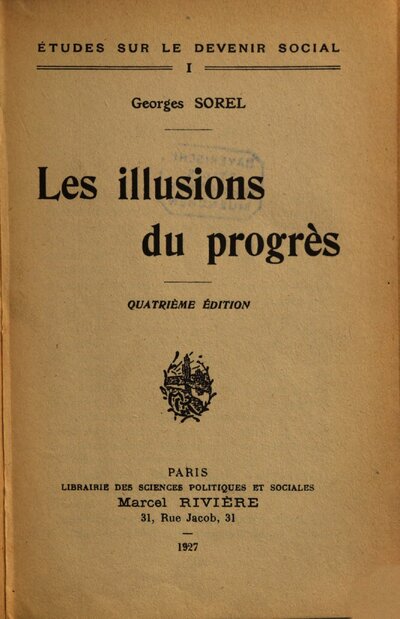
Les illusions du progrès

D'Aristote à Marx : (l'ancienne et la nouvelle métaphysique)
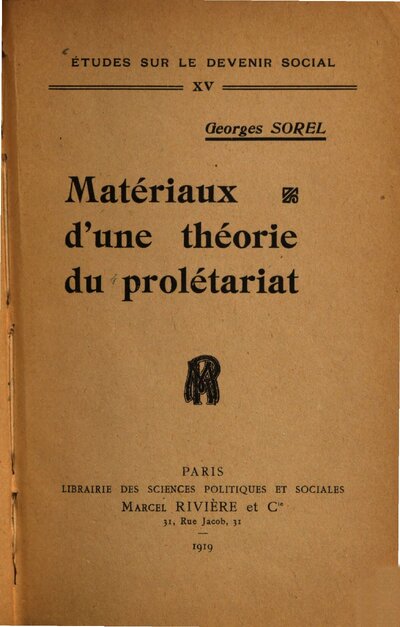
Matériaux d'une théorie du prolétariat
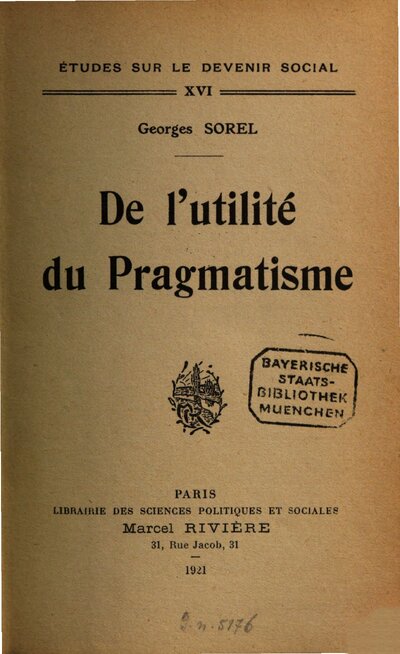
De l'utilité du pragmatisme

La valeur sociale de l'art : conférence faite à l'École des Hautes Études Sociales
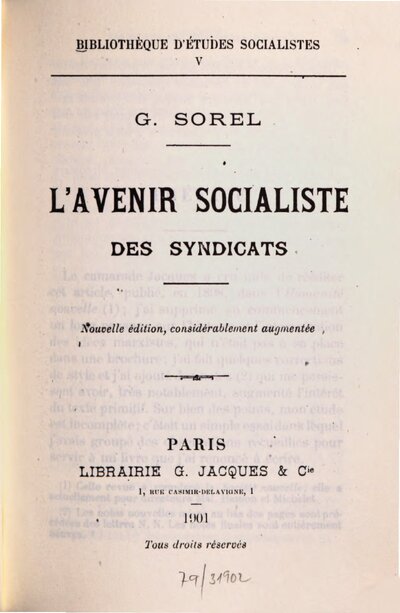
L' avenir socialiste des syndicats

La ruine du monde antique : conception matérialiste de l'histoire
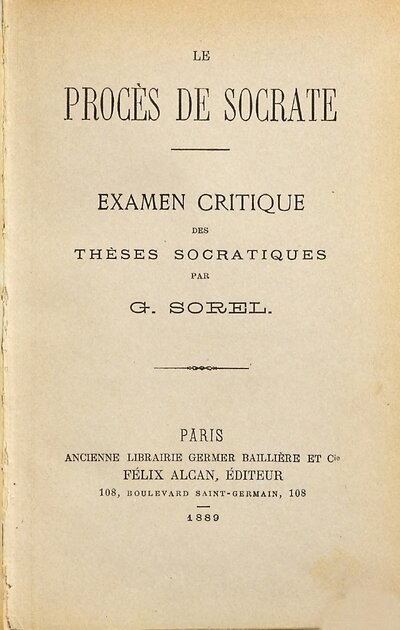
Le procès de Socrate : examen crit. des thèses Socratiques
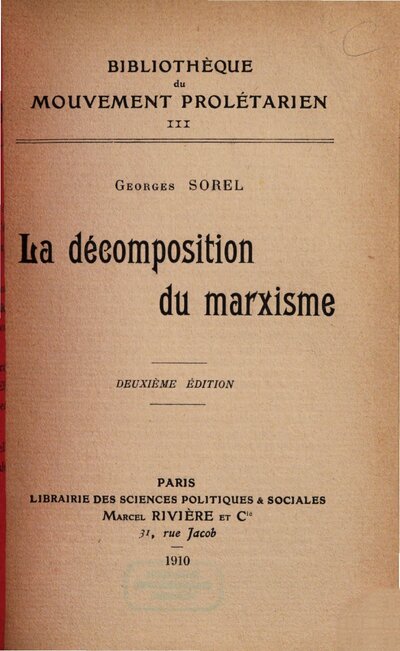
La décomposition du marxisme
Untitled
~23 min read
Encyclopedic overview
Georges Eugène Sorel (/səˈrɛl/; French: [ʒɔʁʒ øʒɛn sɔʁɛl]; 2 November 1847 – 29 August 1922) was a French social thinker, political theorist, historian, and later journalist. He has inspired theories and movements grouped under the name of Sorelianism. His social and political philosophy owed much to his reading of Proudhon, Karl Marx, Giambattista Vico, Henri Bergson (whose lectures at the Collège de France he attended), and later William James. His notion of the power of myth in collective agency inspired socialists, anarchists, Marxists, and fascists. Together with his defense of violence, the power of myth is the contribution for which he is most often remembered.
Politically he evolved from his early liberal-conservative positions towards Marxism, social-democracy, and eventually syndicalism. Between 1909 and 1910 he was marginally involved with Charles Maurras' Action Française, and between 1911 and 1913 he wrote for the politically transversal L'Indépendance, established together with Édouard Berth – one of Sorel's main disciples – and Georges Valois, closer to Maurrassian circles. After a long silence during the war, Sorel came out in favour of Lenin and moved towards Bolshevist positions until his death in 1922.
Excerpted from Wikipedia’s “Georges Sorel” article, available under the CC BY-SA 4.0 licence.