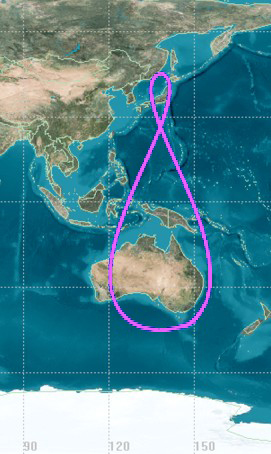
File:Qzss-45-0.09.jpg · Wikimedia Commons · See Wikimedia Commons
geosynchronous orbit
Sign in to saveAlso known as GSO
orbit with a period matching Earth's orbit at a fixed longitude but not necessarily a fixed latitude
Wikidata facts
- Subclass of
- synchronous orbit
- Parent body
- Earth
Show 3 more facts
- short name
- GSO
- Commons category
- Geosynchronous orbit
- on focus list of Wikimedia project
- Wikipedia:Vital articles/Level/4
Sources (2)
via Wikidata · CC0
~16 min read
Encyclopedic overview
Animation (not to scale) showing geosynchronous satellite orbiting the Earth
A geosynchronous orbit (sometimes abbreviated GEO) is an Earth-centered orbit with an orbital period that matches Earth's rotation on its axis, 23 hours, 56 minutes, and 4 seconds (one sidereal day). The synchronization of rotation and orbital period means that, for an observer on Earth's surface, an object in geosynchronous orbit returns to exactly the same position in the sky after a period of one sidereal day. Over the course of a day, the object's position in the sky may remain still or trace out a path, typically in a figure-8 form, whose precise characteristics depend on the orbit's inclination and eccentricity. A circular geosynchronous orbit has a constant altitude of 35,786 km (22,236 mi).
Excerpted from Wikipedia’s “geosynchronous orbit” article, available under the CC BY-SA 4.0 licence.