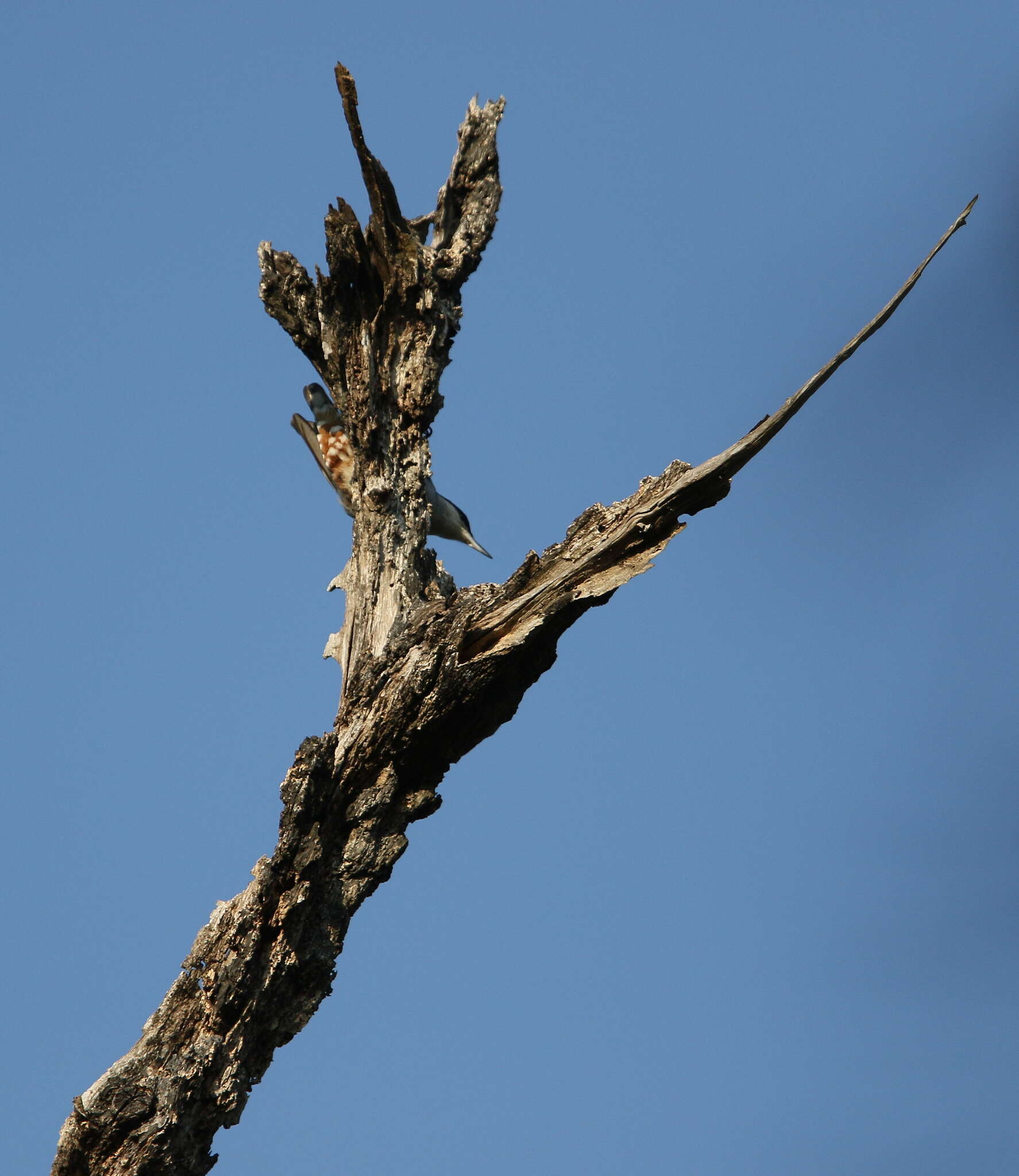
Encyclopedia of Life · EOL (see source)
Species
Endangeredオニゴジュウカラ(Sitta magna)は、鳥綱スズメ目ゴジュウカラ科ゴジュウカラ属に分類される鳥類。
via IUCN
Wikidata facts
Show 7 more facts
- taxon rank
- species
- IUCN conservation status
- Endangered status
- taxon name
- Sitta magna
- Commons category
- Sitta magna
- taxon common name
- 巨䴓
- litter size
- 3
- short name
- S. magna
Sources (2)
via Wikidata · CC0
~13 min read
Encyclopedic overview
The giant nuthatch (Sitta magna) is a species of bird in the family Sittidae. It is the longest of the nuthatches, measuring 19.5 cm (7.7 in) in length. Its upperparts are bluish grey, with the front (from crown to upper back) being light grey, contrasting with the darker rest of the back. The bird has two very thick black eyebrow lines and light grey underparts, with whitish cheeks and throat, and a belly more or less washed with buff and cinnamon. For a nuthatch, it has a long beak and tail. The female can be distinguished from the male by its duller eye features and its upperparts having less contrast between the crown, nape, and lower back. The calls are powerful and made up of repetitions of simple patterns. The species gleans its food from the trunks and branches of trees, especially pines, and feeds on insects and berries. It nests around March, in the hole of a tree and without masking the entrance, and the nest has about three young.
The giant nuthatch is distributed from southwest China to east-central Myanmar, northwest Thailand, and probably to the far northwest of Laos. Its altitudinal distribution varies by region, but ranges from around 1,000 m (3,280 ft) up to at least 3,350 m (10,990 ft) in China. It forages in pine stands, in particular old Pinus kesiya (Khasi pine), present on mountain ridges, among the oak-chestnut groves. Two subspecies are distinguished, S. m. magna and S. m. ligea, differing mainly in length and width of the beak. The giant nuthatch is threatened by the destruction of its habitat, and is very local in occurrence. The population is difficult to assess and seems to have been overestimated, so in 2013 the International Union for Conservation of Nature changed its status from "vulnerable" to "endangered".
Excerpted from Wikipedia’s “Giant Nuthatch” article, available under the CC BY-SA 4.0 licence.