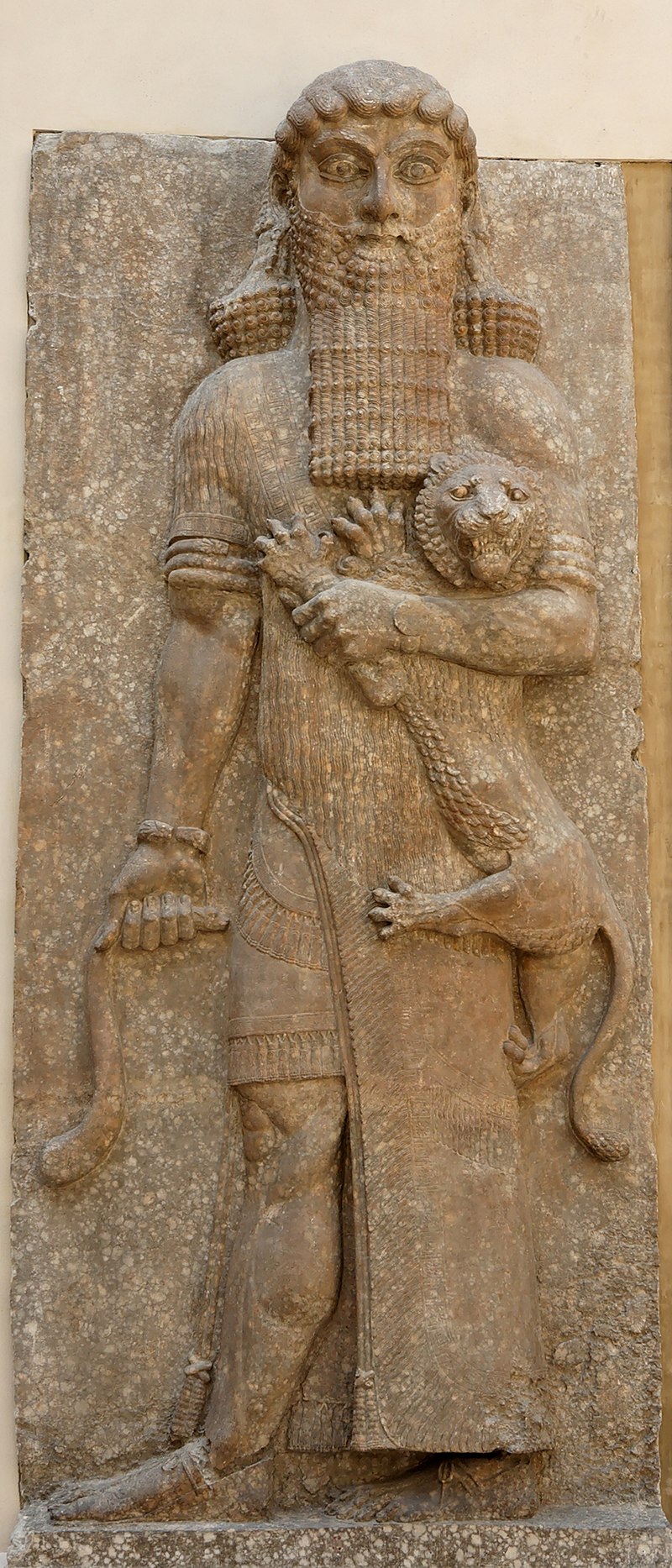
File:Hero_lion_Dur-Sharrukin_Louvre_AO19862.jpg · Wikimedia Commons · See Wikimedia Commons
Gilgamesh
Sign in to saveAlso known as Bilgamesh, Gilgamish, Izdubar, Gilgamec, Gilgameš
Gilgamesh (, ; ; originally ) was a hero in ancient Mesopotamian mythology and the protagonist of the Epic of Gilgamesh, an epic poem written in Akkadian during the late 2nd millennium BC. He was possibly a historical king of the Sumerian city-state of Uruk, who was posthumously deified. His rule probably would have taken place sometime in the beginning of the Early Dynastic Period, 2900–2350 BC, though he became a major figure in Sumerian legend during the Third Dynasty of Ur ().
Gilgamesh was a legendary hero in ancient Mesopotamian mythology, possibly based on a real king of the city-state of Uruk, whose adventures were recorded in the Epic of Gilgamesh, an epic poem written in Akkadian during the late 2nd millennium BC. His story became a major part of Sumerian legend and remains one of the earliest known works of literature.
AI-generated from the Wikipedia summary — may contain errors.
Key facts
- Royalty.type
- Mesopotamian
- Royalty.name
- Gilgamesh
- Royalty.succession
- King of Uruk
- Royalty.image
- Hero lion Dur-Sharrukin Louvre AO19862.jpg
- Royalty.caption
- Possible representation of Gilgamesh as Master of Animals, grasping a lion in his left arm and snake in his right hand, in an Assyrian palace relief (713–706 BC), from Dur-Sharrukin, now held in the Louvre
- Royalty.reign
- c. 2900–2350 BC (EDI)
- Royalty.predecessor
- Dumuzid
- Royalty.issue
- Ur-Nungal
- Royalty.father
- Lugalbanda (in Sumerian poetry)
- Royalty.mother
- Ninsun (in Sumerian poetry)
- Royalty.successor
- Ur-Nungal
via Wikipedia infobox
Wikidata facts
- Gender
- male
- Place of birth
- Uruk
- Place of death
- Uruk
- Child
- Ur-Nungal
- Father
- Lugalbanda
- Mother
- Ninsun
- Position held
- Lugal
- Image
- Hero lion Dur-Sharrukin Louvre AO19862.jpg
- Said to be same as
- Dhu'l-Qarnayn
Show 7 more facts
- topic's main category
- Category:Gilgamesh
- Commons category
- Gilgamesh
- floruit
- 3000-00-00
- present in work
- Sumerian King List
- described by source
- Pauly–Wissowa
- end of work period
- 2700-00-00
- start of work period
- 2800-00-00
Sources (1)
via Wikidata · CC0
~34 min read
Encyclopedic overview
19 sectionsContents
- Name
- Historical king
- Deification and legendary exploits
- Sumerian poems
- "Gilgamesh, Enkidu, and the Netherworld"
- Subsequent poems
- ''Epic of Gilgamesh''
- In Mesopotamian art
- Later influence
- In antiquity
- Modern rediscovery
- Early modern interpretations
- Modern interpretations and cultural significance
- See also
- Notes
- References
- Bibliography
- Further reading
- External links
Gilgamesh (, ; ; originally ) was a hero in ancient Mesopotamian mythology and the protagonist of the Epic of Gilgamesh, an epic poem written in Akkadian during the late 2nd millennium BC. He was possibly a historical king of the Sumerian city-state of Uruk, who was posthumously deified. His rule probably would have taken place sometime in the beginning of the Early Dynastic Period, 2900–2350 BC, though he became a major figure in Sumerian legend during the Third Dynasty of Ur ().
Tales of Gilgamesh's legendary exploits are narrated in five surviving Sumerian poems. The earliest of these is likely "Gilgamesh, Enkidu, and the Netherworld", in which Gilgamesh comes to the aid of the goddess Inanna and drives away the creatures infesting her huluppu tree. She gives him two unknown objects, a mikku and a pikku, which he loses. After Enkidu's death, his shade tells Gilgamesh about the bleak conditions in the Underworld. The poem Gilgamesh and Aga describes Gilgamesh's revolt against his overlord Aga of Kish. Other Sumerian poems recount Gilgamesh's defeat of the giant Huwawa and the Bull of Heaven, while a fifth, poorly preserved poem relates the account of his death and funeral.
Excerpted from Wikipedia’s “Gilgamesh” article, available under the CC BY-SA 4.0 licence.
Gallery (34)
Available in 95 languages
- Español
- Français
- Deutsch
- 中文
- 日本語
- Русский
- Português
- Italiano
- العربية
- हिन्दी
- Afrikaans
- Albanian
- Albanian
- Amharic
- Armenian
- Asturian
- azb
- Azerbaijani
Show 76 more
- Bahasa Indonesia
- Balinese
- Bangla
- Bashkir
- Basque
- Bavarian
- Belarusian
- Bosnian
- Breton
- Bulgarian
- Catalan
- Central Kurdish
- Chuvash
- Croatian
- Czech
- Danish
- Egyptian Arabic
- Esperanto
- Estonian
- Filipino
- Finnish
- Galician
- Georgian
- Greek
- Hebrew
- Hungarian
- Icelandic
- Ido
- Interlingua
- Irish
- Kannada
- Kazakh
- Kurdish
- Latin
- Latvian
- Ligurian
- Limburgish
- Lithuanian
- Lombard
- Malagasy
- Malay
- Mingrelian
- nds_nl
- Nederlands
- Norwegian
- Occitan
- Picard
- Polski
- Romanian
- Rusyn
- Sardinian
- Serbian
- Serbian (Latin)
- Sicilian
- simple
- Slovak
- Slovenian
- Sundanese
- Svenska
- Swahili
- Tajik
- Tamil
- Telugu
- Tiếng Việt
- Toki Pona
- Türkçe
- Ukrainian
- Urdu
- Uzbek
- Waray
- Western Frisian
- Wu Chinese
- Zaza
- فارسی
- ไทย
- 한국어
via Wikidata sitelinks · CC0