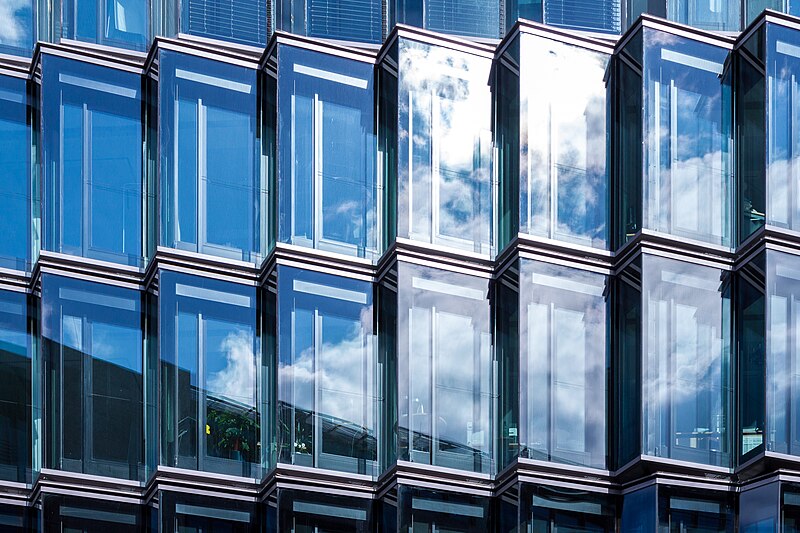
File:Fassade_Wilhelmstrasse_65,_Berlin-Mitte,_160417,_ako.jpg · Wikimedia Commons · See Wikimedia Commons
glass
Sign in to savethumb|300px|A glass building facade|alt=Refer to caption
Glass is a hard, transparent material commonly used in buildings and other applications. It matters because it allows light to pass through while providing structural support and protection, making it essential for windows, doors, and modern architecture.
AI-generated from the Wikipedia summary — may contain errors.
Research
174,104 papers- Google Glass in the Dermatology Clinic: Changing How We See the World.ReviewSkinmed · 2022Pandher K, Prabhu I, Albornoz CA et al.
- Biomolecular glass with amino acid and peptide nanoarchitectonics.Science advances · 2023Xing R, Yuan C, Fan W et al.DOI: 10.1126/sciadv.add8105
- Glass-matrix biocomposites.Journal of biomedical materials research · 2000Verné E, Brovarone CV, Milanese DDOI: 10.1002/1097-4636(2000)53:4<408::aid-jbm15>3.0.co;2-o
- Current status of photoprotection by window glass, automobile glass, window films, and sunglasses.ReviewPhotodermatology, photoimmunology & photomedicine · 2013Almutawa F, Vandal R, Wang SQ et al.DOI: 10.1111/phpp.12022
- Wearing glasses.Minnesota medicine · 2009Meyer CR
- [Binocular magnifying-glass].Revue de stomatologie · 1955LE HUCHE R
- Sun-glasses.Nursing times · 1977Weale RA
- Sugar-based microemulsion glass templates.Journal of the American Chemical Society · 2004Gao F, Ho CC, Co CCDOI: 10.1021/ja0467115
via PubMed
Wikidata facts
- Subclass of
- building material
- Has part
- silicon dioxide
- Image
- Glas halbvoll.JPG
Show 16 more facts
- tensile modulus of elasticity
- 48000
- Commons category
- Glass
- topic's main category
- Category:Glass
- Commons gallery
- Glass
- different from
- crystal
- embodied energy
- 15
- recycling code
- 72
- shear modulus
- 26.2
- Poisson's ratio
- 0.25
- described by source
- Pauly–Wissowa
- exact match
- purl.obolibrary.org/obo/ENVO_01000480
- described at URL
- hedendaagsesieraden.nl/2023/11/18/glas
- history of topic
- history of glass
- maintained by WikiProject
- WikiProject Physics
- has characteristic
- brittleness
- practiced by
- materials science
Sources (8)
via Wikidata · CC0
~40 min read
Encyclopedic overview
33 sectionsContents
- Microscopic structure
- Formation from a supercooled liquid
- Occurrence in nature
- History
- Physical properties
- Optical
- Other
- Reputed flow
- Types
- Silicate glasses
- Soda–lime glass
- Borosilicate glass
- Lead glass
- Aluminosilicate glass
- Other oxide additives
- Glass-ceramics
- Fibreglass
- Non-silicate glasses
- Amorphous metals
- Polymers
- Molecular liquids and molten salts
- Production
- Colour
- Uses
- Architecture and windows
- Tableware
- Packaging
- Laboratories
- Optics
- Modern glass art
- See also
- References
- External links
thumb|300px|A glass building facade|alt=Refer to caption
Glass is an amorphous (non-crystalline) solid. Because it is often transparent and chemically inert, glass has found widespread practical, technological, and decorative use in window panes, tableware, and optics. Some common objects made of glass are named after the material, e.g., a "glass" for drinking, "glasses" for vision correction, and a "magnifying glass".
Excerpted from Wikipedia’s “glass” article, available under the CC BY-SA 4.0 licence.
Gallery (38)
Available in 154 languages
- Español
- Français
- Deutsch
- 中文
- 日本語
- Русский
- Português
- Italiano
- العربية
- हिन्दी
- abstract
- Afrikaans
- Albanian
- Albanian
- Amharic
- Aragonese
- Aramaic
- Armenian
Show 135 more
- Assamese
- Asturian
- Avaric
- azb
- Azerbaijani
- Bahasa Indonesia
- Balinese
- Bangla
- Banjar
- Bashkir
- Basque
- bat_smg
- be_x_old
- Belarusian
- Betawi
- Bosnian
- Breton
- Bulgarian
- Buriat
- Burmese
- Catalan
- Central Kurdish
- Chechen
- Chuvash
- Cornish
- Croatian
- Czech
- Danish
- Egyptian Arabic
- eml
- Esperanto
- Estonian
- Extremaduran
- Faroese
- Fiji Hindi
- Fijian
- Filipino
- Finnish
- Galician
- gcr
- Georgian
- Greek
- Guarani
- Haitian Creole
- Hebrew
- Hungarian
- Icelandic
- Ido
- Iloko
- Interlingua
- Interlingue
- Irish
- Jamaican Creole English
- Kabardian
- Kabyle
- Kalmyk
- Kannada
- Kara-Kalpak
- Kazakh
- Komi
- Kurdish
- Kyrgyz
- Latin
- Latvian
- Ligurian
- Limburgish
- Lithuanian
- lld
- Lombard
- Low German
- Macedonian
- Malay
- Malayalam
- Maltese
- Marathi
- Minangkabau
- Mongolian
- Moroccan Arabic
- Neapolitan
- Nederlands
- Nepali
- Newari
- Northern Frisian
- Norwegian
- Norwegian Nynorsk
- Occitan
- Ossetic
- Pashto
- Piedmontese
- Polski
- Punjabi
- Quechua
- Romanian
- Rusyn
- Sardinian
- Scots
- Serbian
- Serbian (Latin)
- Sicilian
- simple
- Sindhi
- Slovak
- Slovenian
- Sundanese
- Svenska
- Swahili
- syl
- Tamil
- Tatar
- Telugu
- Tiếng Việt
- Toki Pona
- Tongan
- Türkçe
- Ukrainian
- Urdu
- Uyghur
- Uzbek
- Venetian
- Veps
- Waray
- Wayuu
- Welsh
- Western Panjabi
- Wu Chinese
- Yakut
- Yiddish
- zh_classical
- zh_min_nan
- zh_yue
- Zhuang
- Zulu
- فارسی
- ไทย
- 한국어
via Wikidata sitelinks · CC0