Encyclopedia of Life · EOL (see source)
Gomphidiaceae
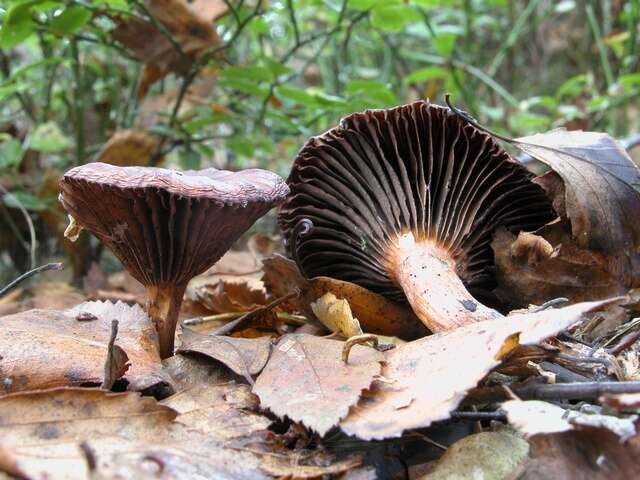
Sign in to saveThe Gomphidiaceae are a family of mushroom-forming fungi in the order Boletales. Unlike other boletes, all members of Gomphidiaceae (except for Gomphogaster) are agarics, having gills instead of pores. Member genera include Chroogomphus, Cystogomphus, Gomphidius and Gomphogaster, the last being a monotypic genus (i.e. with a single species) that may be incorporated into Gomphidius in the future after molecular assessment. The similarly named genus Gomphus is unrelated to this family. Another genus Brauniellula has since been sunk into Chroogomphus.
Species
FAMILY
- KingdomFungi
- PhylumBasidiomycota
- ClassAgaricomycetes
- OrderBoletales
- FamilyGomphidiaceae
铆钉菇科(學名:Gomphidiaceae)是担子菌门牛肝菌目的一個科,其下有四個屬。有別於典型牛肝菌,本科類群中除了單型屬囊铆钉菇属(英语:Cystogomphus)為腹菌外,均為傘菌(英语:Agaric),產孢的子實層位於蕈褶上,而非子實體上的孔狀構造。釘菇屬(英语:Gomphus (fungus))的學名與俗名均與本科相似,但與本科並無關聯。
via GBIF
Museum specimens
- Specimen records
- 2
- Family
- Gomphidiaceae
- Collections
- TENN-F, GB
- Recorded in
- United States, Spain
Wikidata facts
Show 4 more facts
- Commons category
- Gomphidiaceae
- taxon name
- Gomphidiaceae
- taxon rank
- family
- topic's main category
- Category:Gomphidiaceae
Sources (1)
via Wikidata · CC0
~2 min read
Encyclopedic overview
2 sectionsContents
- References
- Further reading
The Gomphidiaceae are a family of mushroom-forming fungi in the order Boletales. Unlike other boletes, all members of Gomphidiaceae (except for Gomphogaster) are agarics, having gills instead of pores. Member genera include Chroogomphus, Cystogomphus, Gomphidius and Gomphogaster, the last being a monotypic genus (i.e. with a single species) that may be incorporated into Gomphidius in the future after molecular assessment. The similarly named genus Gomphus is unrelated to this family. Another genus Brauniellula has since been sunk into Chroogomphus.
Like all agarics, this group was formerly classified in Agaricales. Nonetheless, many of the microscopic features of these fungi, such as spore shape, strongly suggested an affinity with Boletales. This was later confirmed through molecular phylogenetic investigation, which demonstrated that Gomphidiaceae are more closely related to boletes than the "true" agarics of the Agaricales and that the development of gills in this group was an independent evolutionary event from the development of gills in the Agaricales. Molecular phylogenetic investigations have also demonstrated Gomphidiaceae are nested well within Boletales, being more closely related to Suillaceae than to Boletaceae, a finding that is supported by chemotaxonomic investigation of these groups.
Excerpted from Wikipedia’s “Gomphidiaceae” article, available under the CC BY-SA 4.0 licence.