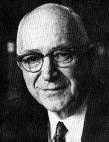
File:Gordon_Allport.gif · Wikimedia Commons · See Wikimedia Commons
Gordon Allport was an American psychologist who lived from 1897 to 1967 and made significant contributions to understanding personality and human nature. His work matters because he helped shape modern psychology by developing influential theories about how personality traits work and how prejudice forms in society.
AI-generated from the Wikipedia summary — may contain errors.
Key facts
- Born
- November 11, 1897, Montezuma, Indiana , US
- Died
- October 9, 1967 (1967-10-09) (aged 69), Cambridge, Massachusetts , US
- Alma mater
- Harvard
- Fields
- Psychology
- Thesis
- An experimental study of the traits of personality (1922)
via Wikipedia infobox
Wikidata facts
- Instance of
- human
- Gender
- male
- Citizenship
- United States
- Place of birth
- Montezuma
- Place of death
- Cambridge
- Sibling
- Floyd Henry Allport
- Occupation
- research fellow
- Employer
- Harvard University
- Languages spoken
- English language
- Doctoral student
- Jerome Bruner
- Field of work
- psychology
- Image
- Gordon Allport.gif
Show 8 more facts
- date of birth
- 1897-11-11
- date of death
- 1967-00-00
- member of
- American Psychological Association
- name in native language
- Gordon Willard Allport
- Commons category
- Gordon Allport
- on focus list of Wikimedia project
- Wikipedia:Vital articles/Level/4
- place of burial
- Mount Auburn Cemetery
- interested in
- social psychology
Sources (8)
via Wikidata · CC0
~17 min read
Encyclopedic overview
Gordon William Allport (November 11, 1897 – October 9, 1967) was an American psychologist. Allport was one of the first psychologists to focus on the study of the personality, and is often referred to as one of the founding figures of personality psychology. He contributed to the formation of values scales and rejected both a psychoanalytic approach to personality, which he thought often was too deeply interpretive, and a behavioral approach, which he thought did not provide deep enough interpretations from their data. Instead of these popular approaches, he developed an eclectic theory based on traits. He emphasized the uniqueness of each individual and the importance of the present context, as opposed to history, for understanding the personality.
Allport had a profound and lasting influence on the field of psychology, even though his work is cited much less often than that of other well-known figures. Part of his influence stemmed from his knack for exploring and broadly conceptualizing important topics (e.g., rumor, prejudice, religion, traits). Another part of his influence resulted from the deep and lasting impression he made on his students during his long teaching career, many of whom went on to have important careers in psychology. Among his many students were Jerome S. Bruner, Anthony Greenwald, Stanley Milgram, Leo Postman, Thomas Pettigrew, and M. Brewster Smith. His brother, Floyd Henry Allport, was professor of social psychology and political psychology at Syracuse University's Maxwell School of Citizenship and Public Affairs (in Syracuse, New York) from 1924 until 1956, and visiting professor at University of California, Berkeley. A Review of General Psychology survey, published in 2002, ranked Allport as the 11th most-cited psychologist of the 20th century.
Excerpted from Wikipedia’s “Gordon Allport” article, available under the CC BY-SA 4.0 licence.