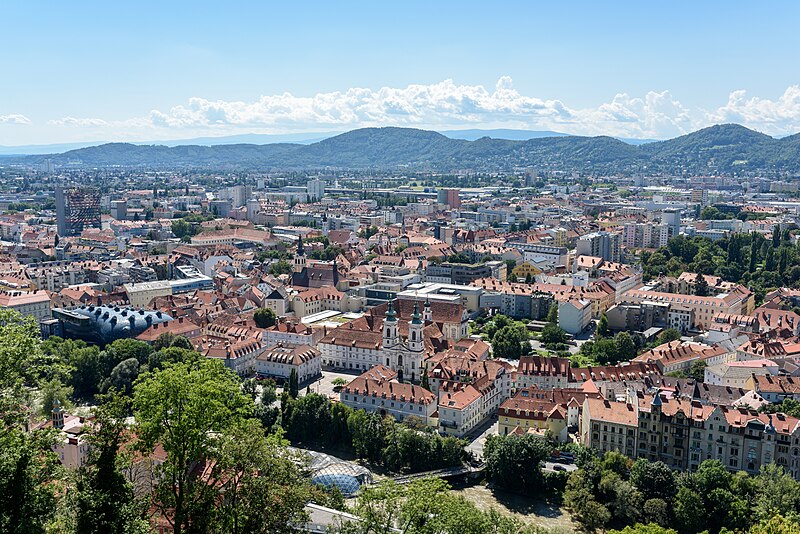
File:Graz_(35932179023).jpg · Wikimedia Commons · See Wikimedia Commons
Graz
Sign in to saveAlso known as Gratz, Grätz, Bayrisch-Grätz, Bairisch-Grätz, Gradec, Graecia, Grez
Graz () is the capital of the Austrian state of Styria and the second-largest city in Austria, after Vienna. On 1 January 2025, Graz had a population of 306,068 (343,461 including secondary residence). In 2023, the population of the Graz functional urban area (FUA) stood at 660,238. Graz is known as a city of higher education, with four colleges and four universities. Combined, the city is home to more than 63,000 students. Its historic centre (Altstadt) is one of the best-preserved city centres in Central Europe.
Graz is Austria's second-largest city and the capital of the state of Styria, with a population of over 306,000 people. It is notable for being a major center of higher education with eight institutions serving more than 63,000 students, and for having one of Central Europe's best-preserved historic city centers.
AI-generated from the Wikipedia summary — may contain errors.
Key facts
- Settlement.name
- Graz
- Settlement.settlement_type
- Statutory city
- Settlement.image_flag
- Flag of Graz.svg
- Settlement.image_shield
- AUT Graz COA.svg
- Settlement.shield_size
- 80x110px
- Settlement.shield_link
- Coat of arms of Styria
- Settlement.image_blank_emblem
- Logo Stadt Wien Graz.webp
- Settlement.blank_emblem_type
- Logo
- Settlement.pushpin_map
- Austria Styria#Austria
- Settlement.pushpin_mapsize
- 280
- Settlement.pushpin_map_caption
- Location within Styria
- Settlement.map_caption
- Location within Statutory city district
- Settlement.subdivision_type
- Country
- Settlement.subdivision_type1
- State
- Settlement.subdivision_type2
- District
- Settlement.subdivision_name2
- Statutory city
- Settlement.parts_style
- para
- Settlement.leader_title
- Mayor
via Wikipedia infobox
Wikidata facts
- Instance of
- district of Austria
- Official name
- Graz
- Country
- Habsburg monarchy
- Located in
- Duchy of Styria
- Population
- 253000
- Area
- 127.57
- Elevation
- 353
- Time zone
- UTC+02:00
- Body of water
- Mur
- Head of government
- Elke Kahr
- Capital of
- Graz-Umgebung District
- Shares border with
- Graz-Umgebung District
- Official website
- www.graz.at
- Image
- 16-07-06-Rathaus Graz Turmblick-RR2 0275.jpg
- Dialing code
- 316
- Licence plate code
- G
Show 15 more facts
- category for honorary citizens of entity
- Category:Honorary citizens of Graz
- category of associated people
- Category:People from Graz
- category for people who died here
- Category:Deaths in Graz
- twinned administrative body
- Lviv
- Commons category
- Graz
- postal code
- 8055
- topic's main category
- Category:Graz
- category for people born here
- Category:Births in Graz
- Commons gallery
- Graz
- native label
- Gratz
- category for people buried here
- Category:Burials in Graz
- member of
- Climate Alliance
- email address
- mailto:[email protected]
- time of earliest written record
- 1128-00-00
- P8168
- Birkenfeld
Sources (12)
via Wikidata · CC0
~38 min read
Encyclopedic overview
29 sectionsContents
- Etymology
- History
- Geography
- Climate
- Neighbouring municipalities
- Districts
- Demographics
- Slovene minority
- Sights
- Historic city centre
- Outside the historic city centre
- Greater Graz area
- Politics
- Culture
- Museums
- Architecture
- Sports
- Styriarte
- Dialect
- Transport
- Health
- International relations
- Twin towns and sister cities
- Notable residents
- Sport
- See also
- References
- Further reading
- External links
Graz () is the capital of the Austrian state of Styria and the second-largest city in Austria, after Vienna. On 1 January 2025, Graz had a population of 306,068 (343,461 including secondary residence). In 2023, the population of the Graz functional urban area (FUA) stood at 660,238. Graz is known as a city of higher education, with four colleges and four universities. Combined, the city is home to more than 63,000 students. Its historic centre (Altstadt) is one of the best-preserved city centres in Central Europe.
The earliest documented mention of Graz dates to the 12th century, when it emerged as a fortified settlement under the rule of the Babenbergs. During the Late Middle Ages, the city developed into an important commercial and administrative center and, from the 14th century onward, served as the residence of the Inner Austrian branch of the Habsburg dynasty. This period was marked by significant cultural and architectural growth, with Renaissance and Baroque buildings shaping the historic city center. Graz also functioned as a strategic military stronghold against the Ottoman Empire, reflected in the fortifications constructed on the Schlossberg. In the 19th and 20th centuries, industrialization and subsequent modernization established Graz as a major urban and educational center, a role it continues to hold in contemporary Austria.
Excerpted from Wikipedia’s “Graz” article, available under the CC BY-SA 4.0 licence.
Gallery (52)
On the map
3 mapped locations
Available in 132 languages
- Español
- Français
- Deutsch
- 中文
- 日本語
- Русский
- Português
- Italiano
- العربية
- Afrikaans
- Albanian
- Albanian
- Amharic
- Aragonese
- Armenian
- Asturian
- azb
- Azerbaijani
Show 113 more
- Bahasa Indonesia
- Balinese
- Bangla
- Bashkir
- Basque
- Bavarian
- be_x_old
- Belarusian
- Bosnian
- Breton
- Bulgarian
- Catalan
- Cebuano
- Chechen
- Chuvash
- Corsican
- Croatian
- Czech
- Danish
- Egyptian Arabic
- eml
- Esperanto
- Estonian
- Faroese
- Finnish
- Friulian
- Galician
- Georgian
- Greek
- Hausa
- Hebrew
- Hungarian
- hyw
- Iban
- Icelandic
- Ido
- Interlingue
- Irish
- Javanese
- kai
- Kannada
- Kashmiri
- Kurdish
- Latin
- Latvian
- Lezghian
- Lithuanian
- lld
- Lombard
- Low German
- Macedonian
- Malay
- Maltese
- Marathi
- Mari
- Mazanderani
- Mingrelian
- Moksha
- Mongolian
- Nederlands
- Northern Frisian
- Northern Sami
- Norwegian
- Norwegian Nynorsk
- Occitan
- Old English
- Ossetic
- Papiamento
- Pashto
- Piedmontese
- Polski
- Quechua
- Romanian
- Sardinian
- Scots
- Scottish Gaelic
- Serbian
- Serbian (Latin)
- Sicilian
- Silesian
- simple
- Sindhi
- Sinhala
- Slovak
- Slovenian
- Svenska
- Swahili
- Tajik
- Talysh
- Tatar
- Tiếng Việt
- Toki Pona
- Türkçe
- Ukrainian
- Upper Sorbian
- Urdu
- Uyghur
- Uzbek
- Venetian
- Veps
- Volapük
- Waray
- Welsh
- West Flemish
- Western Frisian
- Wu Chinese
- Yiddish
- Zeelandic
- zh_min_nan
- zh_yue
- فارسی
- ไทย
- 한국어
via Wikidata sitelinks · CC0